




(-Tate-(Yili-Liu)_011.jpg)
Ana Mendieta, Bird Run 1974, installation view at Tate Modern 2026. Artwork © The Estate of Ana Mendieta Collection, LLC. Licensed by Artist Rights Society (ARS), New York. DACS 2026. Photo © Tate (Yili Liu).
Tate Modern, London
15 July 2026 – 17 January 2027
by ANNA McNAY
What a coup, as Tate’s interim director, Catherine Wood, said in her introduction to the press view, for Tate to be hosting three blockbuster exhibitions by three exceptional female artists alongside one another: Tracey Emin, Frida Kahlo and now Ana Mendieta. Obviously, this has been happening with male artists, without comment, for years, but hopefully the tide is now turning for women, too.
Mendieta (1948-85) was born in Havana, Cuba, and brought up in a Catholic family – to the extent that she could recite all the various ceremonies and play act at being priest in the family chapel. At 12, she and her older sister, Raquelín, were shipped off to the United States as part of Operation Peter Pan, a programme facilitated by the Catholic Diocese of Miami that granted visa waivers to unaccompanied Cuban minors seeking political asylum in the US, as their father was worried for their safety given his support for Fidel Castro. Three weeks after their arrival in Miami, the sisters were placed in a group home in Iowa, until foster care was arranged. Ana then resided in three foster homes and one boarding school until her living situation stabilised. She thus spent her formative years feeling different and very isolated. Five years later, their mother and brother followed and settled nearby. Ana’s father, by this point, had been sentenced to 20 years’ imprisonment.
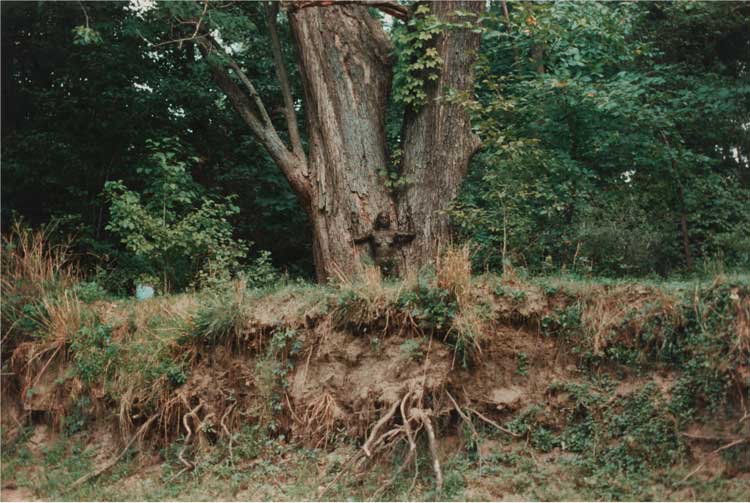
Ana Mendieta, Untitled: Silueta Series,1976 © The Estate of Ana Mendieta Collection, LLC. Licensed by Artist Rights Society (ARS), New York / DACS, 2026 / Courtesy Marian Goodman Gallery and Alison Jacques, London.
It is easy to see where the fodder of good art might come from in Mendieta’s work, with so many potential and impactful themes. What makes this exhibition different and creative in its approach is that it has been organised thematically around space and location, beginning, surprisingly, with the end. That is to say, with her final works, the Rupestrian Sculptures, and her exquisite and minute leaf drawings from Rome (sometimes drawn with just her fingernails!), rather than with the beginning, or, as is sadly all too common, with the end of her life, falling to her death from the 34th-floor window of the Greenwich Village apartment belonging to her husband, fellow artist Carl Andre. This tragic event provoked much controversy for years, with Andre being acquitted of second-degree murder, and, disappointingly, Mendieta is known as much for her death as for her life and work. I therefore find it refreshing that Tate has not so much as alluded to the former, making this solely – and strongly – an exhibition of her art. (Compared to the Kahlo exhibition across the hall, this is certainly worthy of a “Well done”!)
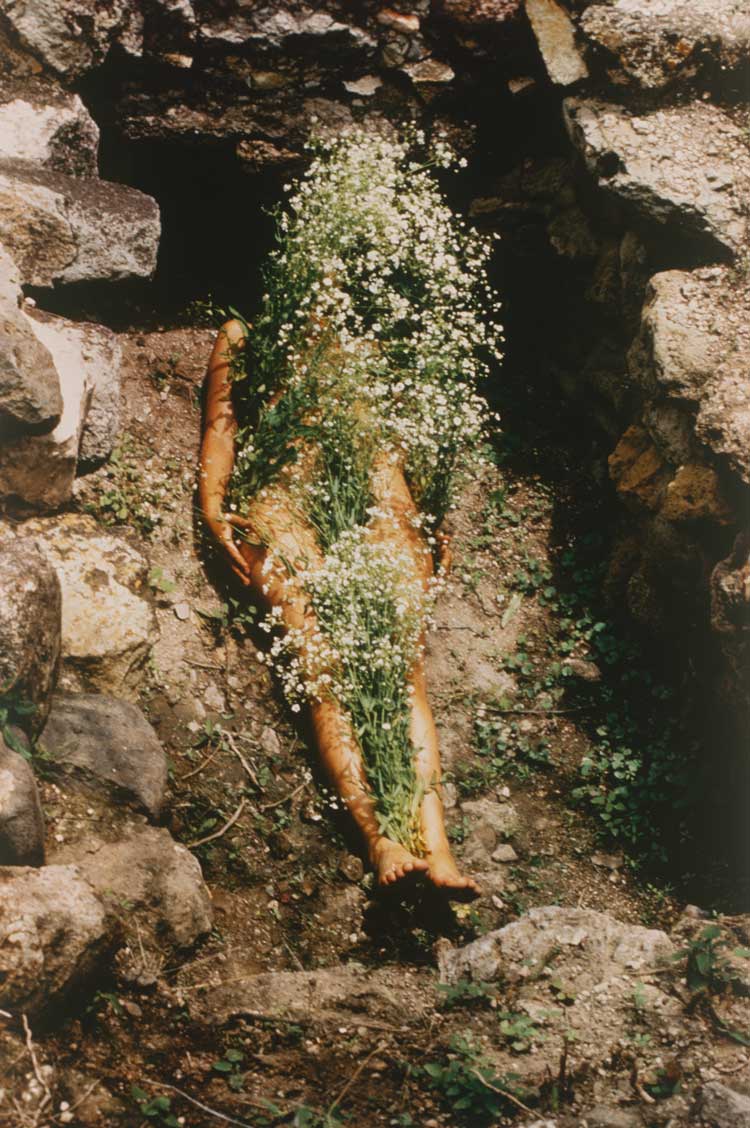
Ana Mendieta, Imágen de Yágul, 1973. © The Estate of Ana Mendieta Collection, LLC. Licensed by Artist Rights Society (ARS), New York / DACS, 2026 / Courtesy Marian Goodman Gallery and Alison Jacques, London
I mentioned the Rupestrian Sculptures. These were, if you like, a branching off from Mendieta’s best-known series, the Siluetas (silhouettes), where she placed her petite five-foot figure in the landscape, removing herself and leaving only a trace. The first Silueta (although technically it isn’t one, as her body is still present in the work) is usually taken to be Imágen de Yágul (1973), made when she travelled to Mexico with her tutor and lover, Hans Breder. Yágul was an archaeological zone, 20 miles outside Oaxaca, and she said in an interview: “I did my first piece in an Aztec tomb that was covered in weeds and grasses – that growth reminded me of time. I bought flowers at the market, lay on the tomb, and was covered with white flowers. The analogy was that I was covered by time and history.” Mendieta denied that the Mexican landscape reminded her of Cuba but said: “I really feel that it’s important in my work that I use dirt and sand because these not only speak about the history of the world or of the earth, but of nature too.”1 She didn’t always use these materials either though, as she progressed to make Siluetas using snow, ice, fire and even gunpowder (all exemplified in the exhibition). “I’m not interested in the formal qualities of my materials but their emotional and sensual ones,” she said.2
One interesting thing I learned was that Mendieta also made works using the shape of her hand, including Rites and Ritual of Initiation (1978), made from burnt grass on paper; Untitled (c1978), made from charred wood; and Untitled (1974) and Untitled: Silueta Series (1977), which are both proto-Silueta pieces dug out of the ground, perhaps also referencing Egyptian hieroglyphs in their simplistic shape. By the time she was making her Rupestrian Sculptures, however, Mendieta was more interested in the Neolithic period. (She had studied the art of primitive and indigenous cultures as part of her fine art degree in Iowa.) They were made during her visits to Cuba from 1980 on and were named after goddesses from the Taíno culture (the original culture of the Caribbean area). “I named them after the goddesses to bring them back into the culture,” cites the wall text. “To reactivate them.” Guacar (1981), for instance, is shaped to directly reference petroglyphs found in caves in the Caribbean, which depict indigenous Taíno mythologies. Guacar is the god of lunar cycles, often evoking menstruation and associated with concepts of the divine feminine.
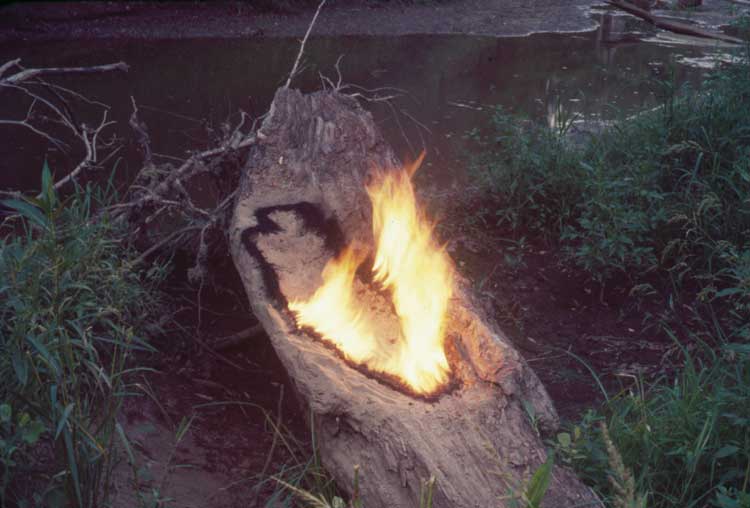
Ana Mendieta, Untitled: Silueta Series, 1977. © The Estate of Ana Mendieta Collection, LLC. Licensed by Artist Rights Society (ARS), New York / DACS, 2026 / Courtesy Marian Goodman Gallery and Alison Jacques, London
The Rupestrian Sculptures are represented in the exhibition by sand sculptures on the ground and some relatively large, black-and-white photographs (she used a medium-format camera called a Mamiya), whereas the Silueta pictures are much smaller but tend to be in colour. Mendieta made her works without an audience, alone, or with Breder to help take photographs and video footage. She said: “In galleries and museums the earth-body sculptures come to the viewers by way of photos, because the work necessarily always stays in situ. Because of this and due to the impermanence of the sculptures, the photographs become a very vital part of my work.”3 The curators of this exhibition were keen to flag that all the works chosen were ones that Mendieta herself had made in or for gallery or museum settings. Seeking to maintain some control over how her non-performative performances were distributed and documented, Mendieta said: “I would shoot a roll of film, right? But I would always choose one. I have them all, but I have always just said: ‘OK, this is the work that I designate as the work.’ In a sense I’m controlling really pretty much what you’re seeing. And I always tried to select the most straightforward view.”4
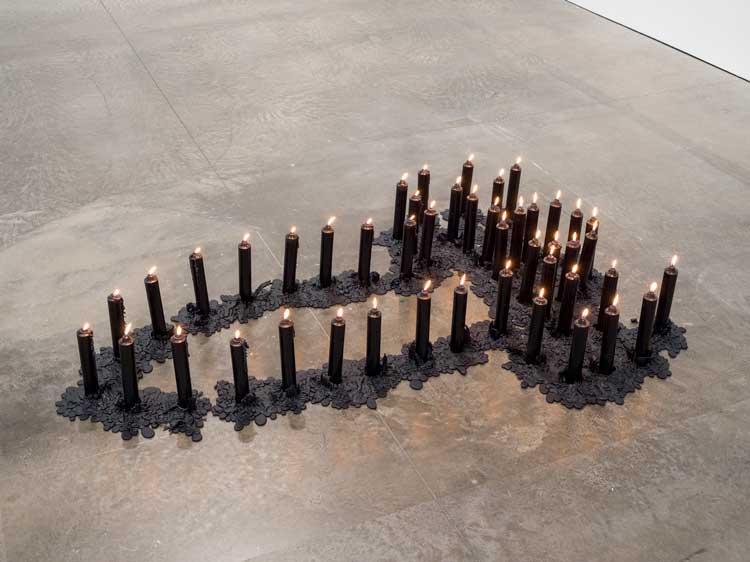
Ana Mendieta, Ñañigo Burial, 1976. © The Estate of Ana Mendieta Collection, LLC. Licensed by Artist Rights Society (ARS), New York / DACS, 2026 / Courtesy Marian Goodman Gallery and Alison Jacques, London. Photo Alex Yudzon.
Despite being raised Catholic, Mendieta became increasingly fascinated with goddess imagery and funerary themes (evidenced especially in the fetish and Ixchel series at Old Man’s Creek, not on show here). She was also interested in Santería, which is a blend of the Yoruba religion of West Africa, Roman Catholicism and Spiritism, and Taíno, as already mentioned. Much of Mendieta’s work is deeply ritualistic, and there is a feeling in the gallery somewhat like in a church. There has been some dispute over how much she was influenced by the Goddess Movement, led by the fellow New York AIR gallery artist Mary Beth Edelson, especially since, from correspondence, Mendieta doesn’t seem to be a fan of her personally, and, in her later works, she did move away from the traditional cactus-armed pose of the goddess, often omitting arms altogether. Specifically, Mendieta said: “It didn’t have any other kind of connotation, but what I found happened was that some critics started writing about my work very specifically, in terms of the Great Goddess, and I didn’t want my work to be looked at in such a very specific kind of way. I want my work to be open because it’s made in that kind of spirit. So, I later on got rid of the arms.”5 Nevertheless, she is never far from the spiritual, also saying: “Through my earth-body sculptures I become one with the earth ... I become an extension of nature and nature becomes an extension of my body. This obsessive act of reasserting my ties with the earth is really the reactivation of primeval beliefs … [in] an omnipresent female force, the after-image of being encompassed within the womb.”6 She also added: “I believe this has been a direct result of my having been torn from my homeland (Cuba) during my adolescence. I am overwhelmed by the feeling of having been cast from the womb (nature). My art is the way I re-establish the bonds that unite me to the universe. It is a return to the maternal source …”7
Certainly, as stated in the exhibition literature, Mendieta had compiled a visual lexicon for building her figures, be they Silueta or Rupestrian Sculptures. This can be seen, too, in her drawings, such as a couple of untitled ones from 1984, one comprised of three simple droplet shapes, the other more a suggestion of a cracked egg; and La Concha de Venus (Amategram) (1982), a drawing on amate paper, a handmade bark paper found primarily in Mexico, comprising a simple spiral with a small kink for the head. These motifs can then be found scaled up on the tree-trunk works she made in Rome, in the last couple of years of her life, where she had an American Academy residency: La Jungla (Totem Grove) (1985) is an unfinished work of hollowed out tree trunks scorched with gunpowder. Another gorgeous wooden trunk piece is Untitled (c1965), which, according to Mendieta’s family, represents a mother and child and was made while the artist was still a teenager.
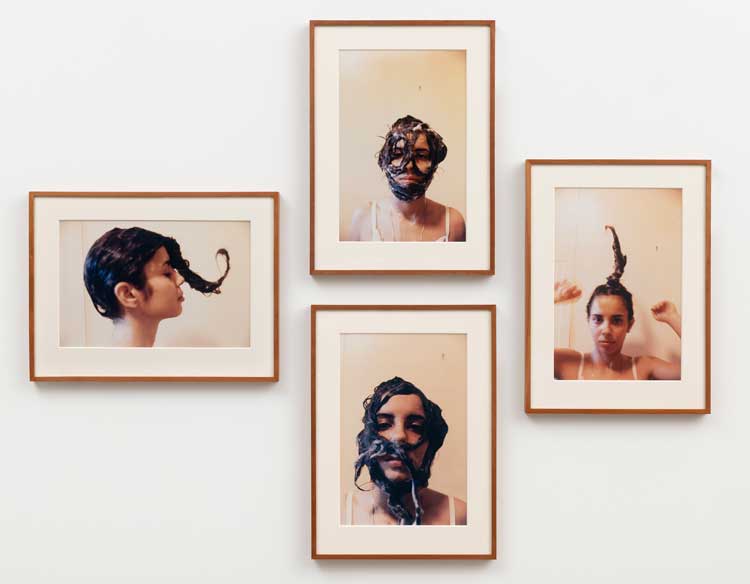
Ana Mendieta, Untitled, 1972. © The Estate of Ana Mendieta Collection, LLC. Licensed by Artist Rights Society (ARS), New York / DACS, 2026 / Courtesy Marian Goodman Gallery and Alison Jacques, London
There are so many other works on display – Tate has managed a truly comprehensive overview of Mendieta’s oeuvre. These include the early painterly Body Tracks (1974), Untitled (Glass on Body Imprints) (1972), Untitled (Facial Hair Transplants) (1972), Blood Writing (1974), and many more. We see Mendieta at work as an elementary schoolteacher, too, asking her pupils to describe the soul, and excitingly also her own early paintings, from before her epiphany in 1972, “when I realised that my paintings were not real enough for what I wanted the image to convey. By real I mean I wanted my images to have power, to be magic.”8 Untitled (Self-Portrait) (c1970), for example, depicts the artist wearing an elaborate headdress and ear adornment particular to pre-Columbian, Aztec art. “[It’s] very similar in some ways to what I’m doing [now] because … They were … icon type things.”9
A pleasant surprise was to learn that Tate owns the largest collection of Mendieta’s films of any museum in the world, and my favourite section of the exhibition focuses on these. It is completely dark, with five hanging screens playing the haunting Grass Breathing (c1974), the lingering Untitled: Silueta Series (1978), the uncanny Sweating Blood (1973), the entrancing Alma, Silueta en Fuego (1975) and the slightly icky Blood + Feathers (1974). As you walk through, it is a completely immersive experience and, for me at least, far more impactful than the photographs.
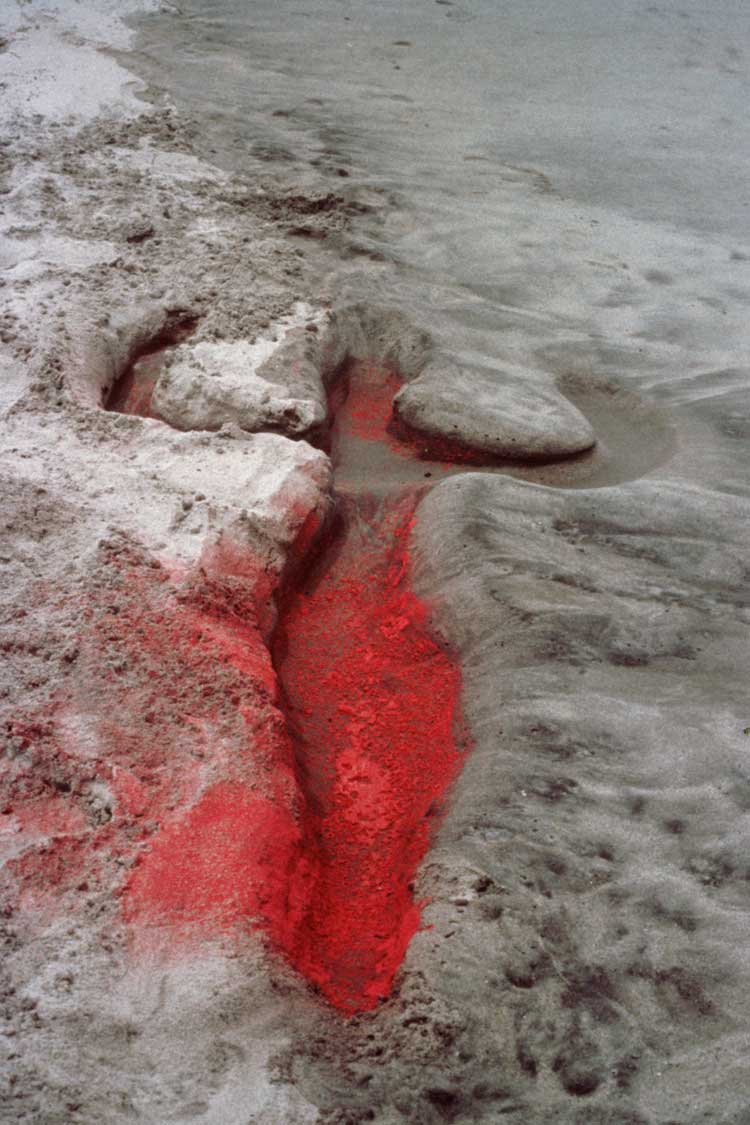
Ana Mendieta, Untitled: Silueta Series, 1976. © The Estate of Ana Mendieta Collection, LLC. Licensed by Artist Rights Society (ARS), New York / DACS, 2026 / Courtesy Marian Goodman Gallery and Alison Jacques, London.
Another powerful exhibit is the recreation of the life-size installation of an indoor forest with a moss Silueta, first created for the State University of New York College Old Westbury (Untitled: Silueta Series, 1978). I only wished we were allowed to walk into it, but sadly it was specifically designed to be looked at from afar, maintaining that distance inherent to so much of Mendieta’s work. Even when she is present, she is absent.
The exhibition closes with a section on the idea of the threshold, and, more specifically, with the quote: “I feel suspended between sky and earth … The obsession in my work – to reaffirm myself in this world.”10 This isn’t the strongest ending, given that it would have been possible, quite literally, to go out with a bang (for example, the film Anima, Silueta de Cohetes (Firework Piece) (1976) with a Silueta made of fireworks, which is being shown just before this final room, and which is set to be recreated outside after an event on 12 September), but, overall, I cannot complain. For me, Mendieta’s notebook pages and tiny drawings were as precious as the film works were absorbing and awesome, and this exhibition comprises such a wide range of her work, and only of her work (cf my grumblings about the Kahlo show), and only of her work, that I can honestly say I came away feeling happy and enriched. While it may be the least shouty and bombastic of the current Tate trilogy, it is every bit as much worth a visit.
References
1. Jean Marter and Ana Mendieta in Conversation, 1 February 1985. In: Ana Mendieta: Traces, exhibition catalogue, Hayward Gallery, 2013, pages 228-231, page 230.
2. Cited in Ana Mendieta, Emotional Artist by Emily LaBarge in The Paris Review, 8 March 2019 .
3. Personal Writings by Ana Mendieta in Ana Mendieta by Gloria Moure (ed.), Ediciones Polígrafa, 1996, pages 167-222, page 186.
4. Op cit, exh cat, 2013, page 231.
5. From a lecture by Ana Mendieta delivered at Alfred State University, New York, September 1981, precised in Ana Mendieta: Traces, exhibition catalogue, Hayward Gallery, 2013, page 208.
6. Cited by Wikipedia, from our America by E Carmen Ramos, Smithsonian American Art Museum, Washington, DC, 2014.
7. Earth and Fire: Mendieta’s Body of Work by John Perreault in Ana Mendieta: A Retrospective by Petra Barreras del Rio and John Perreault (eds), New Museum of Contemporary Art, New York, 1988, page 10.
8. Op cit, LaBarge, 2019.
9. Cited in the exhibition wall text.
10. Cited in the exhibition wall text.
Click on the pictures below to enlarge

Copyright © 1893–2026 Studio International Foundation.
The title Studio International is the property of the Studio International Foundation and, together with the content, are bound by copyright. All rights reserved.
 |
 |
 |
|---|



-300.jpg)


-300.jpg)
 Francesca Woodman: On Being An Angel
 Carl Andre: Sculpture as Place, 1958-2010
 Fondation Beyeler presents Daros Latinamerica Collection
 Ana Mendieta in Rome: interview with Raquel Cecilia
 Chiharu Shiota: Dialogues