
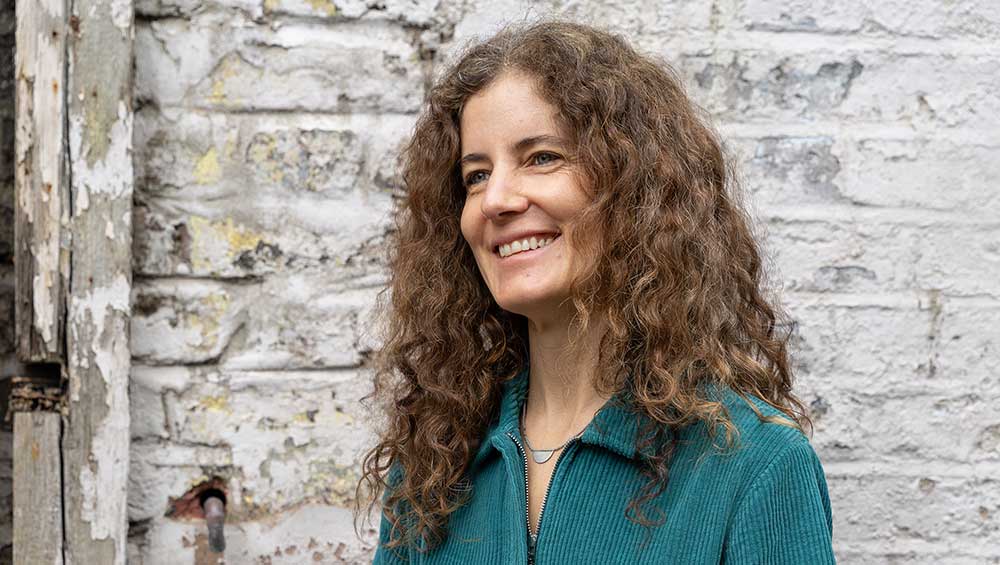
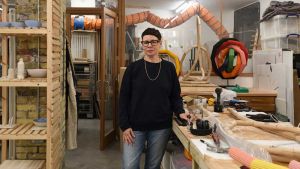
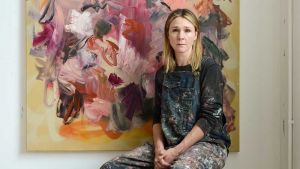
Francisca Aninat at 92 Webster Road. Photo: Sergey Novikov.
by TOM DENMAN
Art is often thought of as bearing the signature of its maker, even when the artist has barely touched the artwork. To view art in this way is an impulse we cannot really shift. Nonetheless, we might still want to question whether such a signature is as individualistic as it is conceived to be. Or whether it is, in fact, much like subjectivity itself, born of a person’s ever-fluctuating relation to the world. No one is an island.
This blurring of the self is felt in the layered, shredded and sutured paintings and collages of the Chilean artist Francisca Aninat. Fundamental to them is the thread, a tactile stand-in for communication, connection and finding one’s way, that evokes exposed nerve endings, a raw encounter between the artwork – and whoever, if anyone, is represented in it – and us. Her work often stems from freewheeling, vulnerable conversations; for the past couple of years, for instance, she has been conducting interviews with patients at Addenbrooke’s hospital in Cambridge. Rather than depict or illustrate these, she allows recurring images and words – in the conversation, then in her mind – to fuel an intuitive search for playful, oblique, open-ended forms that conjure the psychic complexity of living in a relational world.
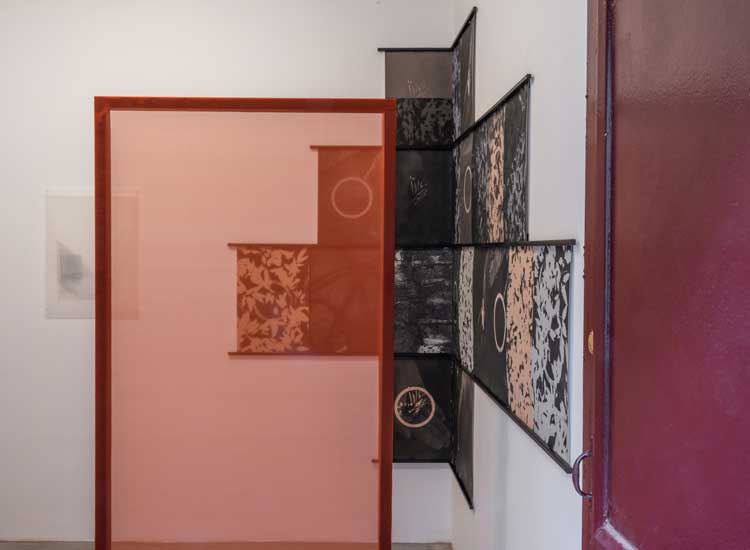
Francisca Aninat: Four Steps and a Looking Glass, installation view, 92 Webster Road, London, 2026. © Francisca Aninat. Photo: Sergey Novikov. Courtesy of 92 Webster Road.
I met Aninat in a cafe near her north London studio to discuss her current exhibition, Four Steps and a Looking Glass, at 92 Webster Road, a single-room gallery in south-east London, run by curator Cecilia Vilela in collaboration with the artist Ron Henocq. This small, trapezoid, windowless box of a space could be the antechamber of another dimension – an appropriate setting for Aninat’s play of asymmetry and surprise. In it, she has installed a large freestanding piece of translucent orange fabric, stretched on a solid frame, that suggests a crossing from one state, realm or subjectivity to another. Another work is a metal ladderlike object, one-sided, its “rungs” warped on a diagonal slant as if to fit the rules of this limbic zone. Spreading from one corner are dusky monochrome photographs, some depicting leaves, others presenting a mysterious hand with matches in its palm. The walls are otherwise scattered with a constellation of curious, delicately charged objects: tiny collages of layered fabric, pins and plaster, a conch-like formation of tea-dyed envelopes, a protrusion of matches bound like a torch.
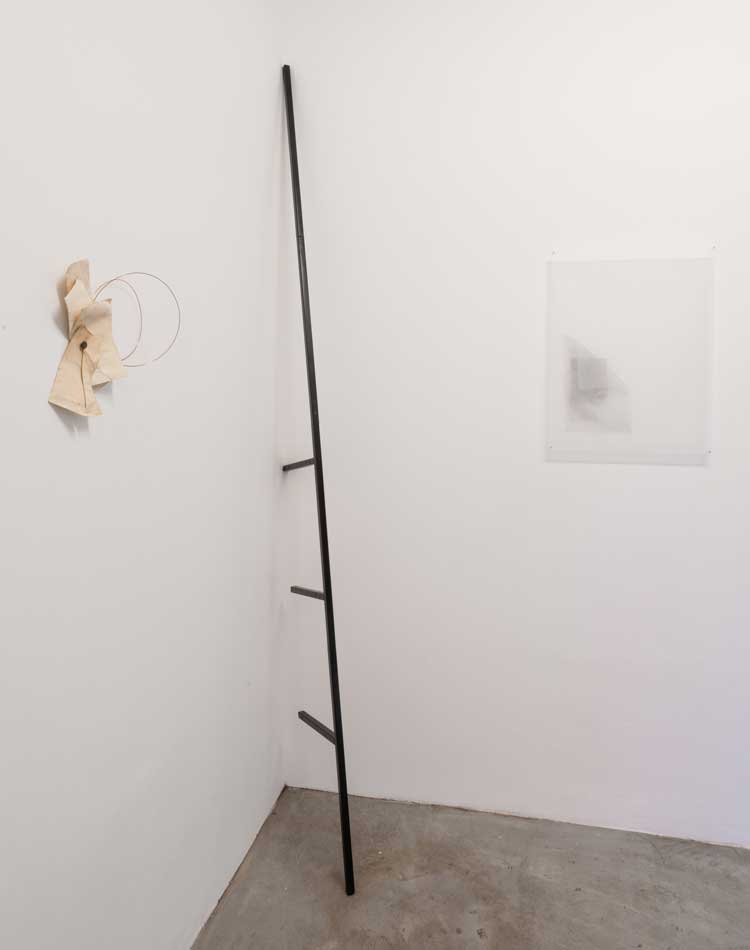
Francisca Aninat: Four Steps and a Looking Glass, installation view, 92 Webster Road, London, 2026. © Francisca Aninat. Photo: Sergey Novikov. Courtesy of 92 Webster Road.
Although overused in descriptions of any art that doesn’t declare a clearcut meaning, here the word poetic is warranted not only because Aninat is an excellent poet in her own right but because, as an artist, she draws inspiration from the Chilean tradition of visual poetry that blossomed in the second half of the 20th century. Her sensitivity to time and rhythm and intelligent juxtapositions endow her work with a spatial and material lyricism, affording us a moment to feel the world without inscribing it with fixed values or meaning. Winding through all of this is the tender threshold of self and other. Aninat and I began our conversation by talking about what it means to listen.
Tom Denman: It seems to me that the crux of your practice is the act of listening – not least when you are interviewing hospital patients. What does listening mean to you?
Francisca Aninat: Well, I think about this a lot. The way I see it, there are different ways of listening, all to do with hearing another person. But it is about so much more than sound or the sense of hearing in the physical or sonic sense. Silence often plays a vital role. In my work, I look for ways of listening nonverbally. I try to create a space where this type of empathic connection can occur, like when I asked the people in the waiting rooms of the San Juan de Dios hospital in Santiago to make things out of thread. Here, the listening was in the collective participation, the vulnerability of their “voices” in the fragility of what they were making and the way they were all making these things together. At Addenbrooke’s, I asked oncology patients if they could draw a map of their journey there. I hoped this might give them a chance to reorient themselves in a tactile way.
For the patients in Chile, the thread was the most important thing. It was a way of writing mentally, often enigmatically, in repetitive gestures. It was about getting involved with something as they waited, not just passively waiting there. Listening meant giving space to someone to be who they are. When we have voice is when we are listened to, and that voice can take many forms, and it doesn’t have to be verbal or declaratory.
In a more recent project in Cambridge, I met a man who had amnesia. I took a wooden board and pieces of fired clay and string, and while he spoke – and with the amnesia patients the conversation was completely unplanned – I used the thread to connect the various components of what he said, and so the thread became the listening. Another woman in the same hospital quite simply gestured at the blue curtain round her bed. There was something in that moment. I cannot put my finger on it.
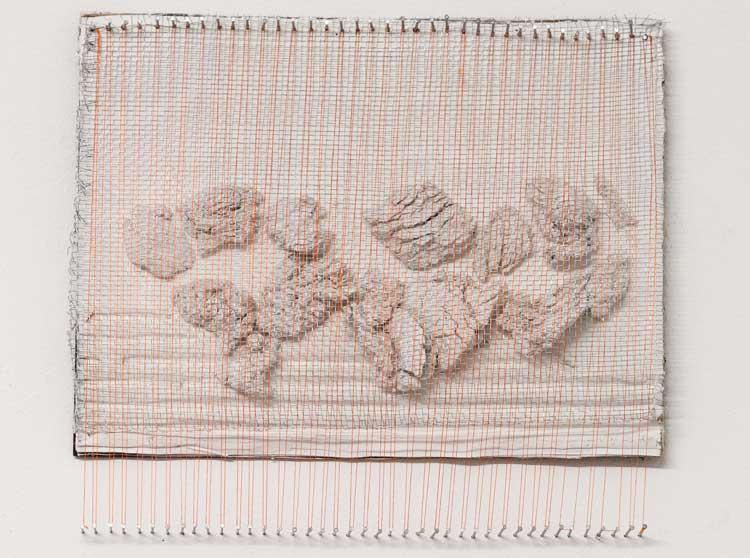
Francisca Aninat: Four Steps and a Looking Glass (detail), installation view, 92 Webster Road, London, 2026. © Francisca Aninat. Photo: Sergey Novikov. Courtesy of 92 Webster Road.
TD: Do you have a plan as to how your conversations will evolve into a physical artwork?
FA: When I talk to someone, it is a very vulnerable process because I don’t have a predefined idea of what I want. I try to establish some loose coordinates within which we can talk and that’s it. This way of not knowing exactly what the result will be, or even what I am looking for, gives the conversation a sense of mystery that I love. I like to leave things as open as possible and this mystery to follow through to the artwork, with the viewer being a sort of listener. Which means being open to uncertainty, to the unknown. I think this is crucial to my conversations, even if we feel we are heading somewhere. I don’t disregard clear and explanatory artworks, but I feel more of an affinity with ambiguity – which is the ambiguity of relating. There’s ethical responsibility in maintaining it, too.
TD: This mystery is often manifest in your use of layers and stitches, as well as assemblage and found poetry, in your collages.
FA: Yes, I am drawn to accumulation and repetition, a constant redrafting that becomes part of the artwork you see. It goes back to not knowing what the result will be, not planning. When I want to retry something, I leave the previous attempt partly visible. I want to keep the vulnerability you don’t see in a perfect product. Also, ever since I began making art, I have always enjoyed the slowing down of time, feeling it with my fingers – hence the importance of thread. The large installation I presented in my degree show [Exterior/Interior Field, 2007; The Roberts Institute of Art, London] consisted of multiple layers. It was a massive work filling much of the room, and it took a long time to make and to install. And at my current show at 92 Webster Road, I have photographs of matches in a hand, and then there are burnt matches in the wall sculpture. I like the dichotomy of before and after. And then, of course, burnt matches aren’t the sort of thing you keep, let alone display. In them is this sense of time passing.
Stitching became central to my practice early on, when I was still at college. I was drawn to stitching when I began tearing up my paintings and resewing them. I loved the notion of the stitch, the very fabric of a painting, as being about communication. This led to my collaborations with others, in a way. The found objects and words are again about connecting to the world beyond myself. I’m also much inspired by the Chilean tradition of visual poetry, especially Juan Luis Martínez’s La Nueva Novella from 1977, in which he juxtaposes images of, say, Rimbaud with a mathematical formula. And then, on another page, he’ll have some photographs of walking legs next to text commenting on writing and reading – naturally the mind links the two, legs and words. This endless associative play, it’s like magic.
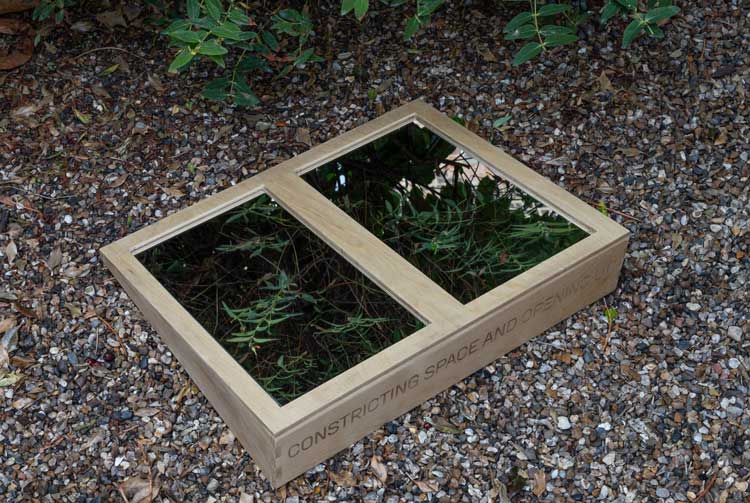
Francisca Aninat: Four Steps and a Looking Glass, installation view (garden), 92 Webster Road, London, 2026. © Francisca Aninat. Photo: Sergey Novikov. Courtesy of 92 Webster Road.
TD: It’s funny you mention Martínez. There’s a line in that book, in English, which reads: “Throught the Looking Glass, and What the Poet Found There”, the typo in keeping with Martínez’s playfulness (the word combining “thought” and “through”, a sort of thinking threshold, perhaps …). The words “Looking Glass” are in the title of your show, which – á la Lewis Carroll – also seems to point to an alternate dimension.
FA: I didn’t have Martínez in mind when I came up with the title, but I love his use of relational forms and the mirror is one of them. Mirrors are also like portals. I have a small mirror in the gallery’s garden, on the ground at an angle, facing the sky. I had the idea for this sculpture when I saw a piece of furniture fly-tipped on the pavement in London. I thought the work would make a nice outdoor counterpoint to the installation inside – as if it were taking you there. I am excited by a sense of trespass, which again is crucial to how we relate to one another. And so the Martínez thing is a funny coincidence!
TD: Over the past couple of years, you have ventured into photography. Could you talk a little about what brought you to the medium?
FA: Well, it’s like a direct extension of what I have always done. Many of my photographs I print on copper plate, and the ones at 92 Webster Road are gum prints. This is a 19th-century method with multiple layers. I always prime the paper with a wash-like mixture of pigment and gum Arabic. The overall feel of the works, once they are developed, is very rough and quite painterly. In all my photographic work – which I often include in my stitched-together collages, too – there’s still a strong sense of layering and touch.
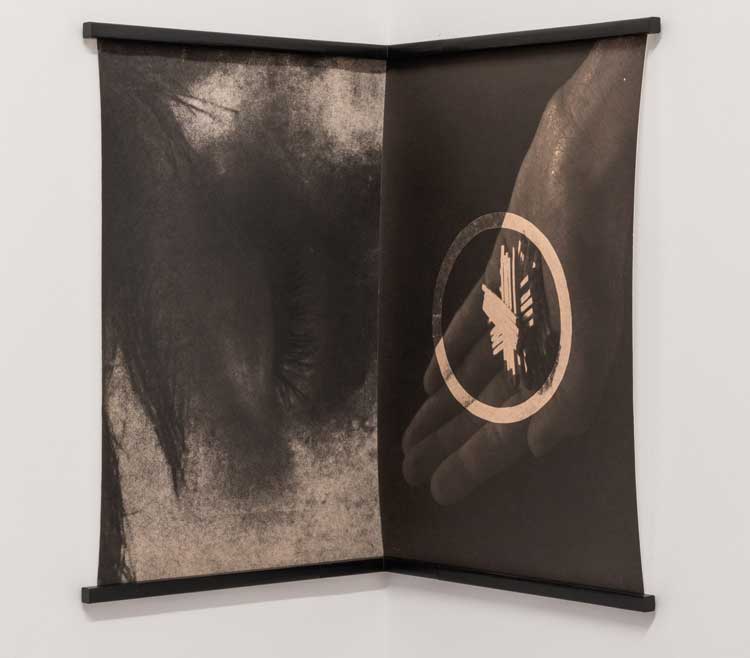
Francisca Aninat: Four Steps and a Looking Glass (detail), installation view, 92 Webster Road, London, 2026. © Francisca Aninat. Photo: Sergey Novikov. Courtesy of 92 Webster Road.
TD: In the way your show at 92 Webster Road is installed, there is a curious sense of something being said, almost a narrative, born out of a relationality of forms.
FA: It all started with these two phrases I noted down at Addenbrooke’s. A woman in one of the waiting rooms was telling me about a recurring dream of being locked in a house and walking from room to room. She said it was like a labyrinth. She talked about mirrors, about turning, this constant need to turn around and around. And I kept revisiting this story in my mind. And when I had the chance to show my work in this room with no windows, with no obvious relation to the rest of the house, the story came back to me. But still, I don’t base my work on the story. What matters is the memory of it, how someone else’s experience stays with you and becomes a part of you. I became interested in the idea of being trapped within oneself, which is also the struggle of relating.
The photographs have these circles in the middle – I think of them almost as camera lenses, or the impulse to make sense of something in the memory, or some fragments we’re trying to recollect. I like to think of them as our goal-oriented and linear – as opposed to lateral – attention. Such attention can be so arbitrary. What’s in the circles is no more in focus than what lies outside them. I also like the warmth in the orange fabric I use in some of the works – it’s like when something lights up the mind, an epiphany maybe.
TD: You have made work responding to the bouts of insomnia you have experienced after transcribing your interviews with hospital patients. I cannot help but be intrigued by this. How does sleeplessness work its way into your art?
FA: Well, the thing is, I am not trained in art therapy. I have stayed away from it because I want to maintain an intuitive approach based on what I know as an artist. Most of the safeguarding is provided by the hospital and so I am free to do this. But this also means I lack the tools to offload what I have taken on. But insomnia doesn’t have to be a negative space, I have come to realise. It is discomfiting, sure, but my experience of it really drove home for me the importance of listening in artmaking.
For my show at the Heong Gallery in Cambridge last year [a dual exhibition with Alexandre da Cunha], I made some photographic collages called Night Visions/Light Shadows. They were made up of images of shadows projected into my flat from the garden at night, with poetic fragments from my conversations in the hospital printed directly on to the surface. When I was unable to sleep, the patients’ voices would manifest visually in the branches I saw on the walls. It’s incredible how the depth of human relations can be found abstracted in the world around us. I’ve also made something else I haven’t shown yet, an “archive” of boxes containing found objects and poetry, sculptures, paintings and photographs, all tiny and fragmented, that carry the strangeness of insomnia.
I want to give space to a listened-to voice in material form. It could be a piece of rough paper with a delicate one laid over it. A fragile thread going through the box. A mirror. I want that voice to fill the space without being explained or explanatory.
TD: Have you noticed any effects of your work, or the processes that go into it, on the people you work with?
FA: It’s subtle, not always easy to pick up on, maybe because the work itself is hard to detach from the process – but, yes. In Santiago, the waiting times in public hospitals are really long. Even still, sometimes a patient would come out of the doctor’s office and say they wanted to stay and complete their piece. And, of course, there was the memorable art opening for patients and staff at San Juan, when they looked at and handled these books I made based on our conversations. And in the UK, well, it has been more of a feeling. I’m thinking of the patients with amnesia. Something happens. Through the process, the patient becomes alert to their sensorial space, and they remember something, a fragment. The energy really shifts, something mystical starts to happen. Words can’t do it justice, but you feel it: in the blue, in the curtain, in the draft through the door opening and closing, in the whirring of machines.
TD: Listening to you now, it occurs to me that your work is less a poetic relaying of a conversation or interaction than something that is poetic from the start. You are neither clarifying nor mystifying anything because you are staying with the mystery of the initial encounter. How would you describe the relationship between the hospital and your studio?
FA: At Addenbrooke’s, I became particularly interested in the patients with recurring treatments, which meant they had to come and go. I decided I would work with the oncology ward, where some patients had been going for years. I always had a health worker with me, and we asked patients in advance if they would be willing to have an interview with me. And I would sit beside them and work with them on the making of a memory map. And they would recall things about their journeys there: the sky, the leaves, the colour of the morning, the weight of the doors. And when I transcribed the interviews, I was amazed by this vivid sensorial recollection.
Even though the work at 92 Webster Road is farther removed from the hospital than the work I showed in the Heong or Addenbrooke’s (where I also had an exhibition), I like to explore free association without overthinking, and so one project will still seep into the next. This is why I am drawn to collage. Some of the photographs were taken in the garden of the gallery itself. The hospital garden was important for the wellbeing of patients, and so there’s a link of sorts. Again, it’s that passing between the outside to the inside. But none of this is entirely explicit or planned.
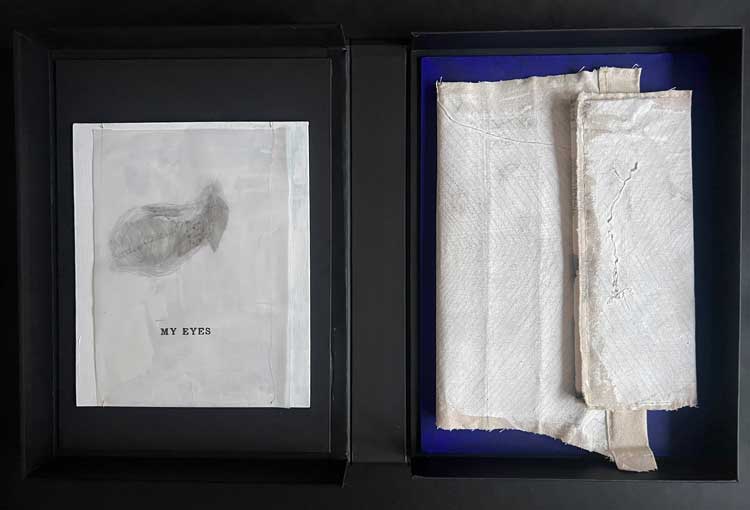
Francisca Aninat, My eyes, 2026. Botanical Books. Courtesy of the artist.
TD: You are often drawn to the artist book in your work. Recently, for instance, you made two books inspired by orally transferred botanical knowledge in Chile. My Eyes and My Skin (both 2026) consist of layered medical gauze with stitched patterns and poetic phrases.
FA: I find books fascinating as an art form. The way you can’t see the whole picture in one go. You have to build it up in your mind as you go along, and then there’s the tactile element I love. You don’t normally get to touch artworks, but books really need to be handled – even if you normally can’t when they’re displayed in a gallery or museum. The emphasis on touch, which is very important to me in all my work, even if imagined, is about breaking restrictions.
The books you refer to were commissioned for a small exhibition curated by the art historian Valentina Gajardo at Cambridge University to accompany a symposium around histories of ecological knowledge in Latin America. Deciding to look outside traditional academic botany, I interviewed people living in the Choapa Valley in northern Chile. I asked them about two plants in particular. One was called matico, which I chose because of its healing properties. You can use it on bad cuts to aid cicatrisation. I loved the idea of a plant that is so vital to healing our membrane to the world. And then I was also interested in ruda, which people put at the entrance to their homes. The saying goes that when someone with bad energy comes to your home, the plant will self-combust.
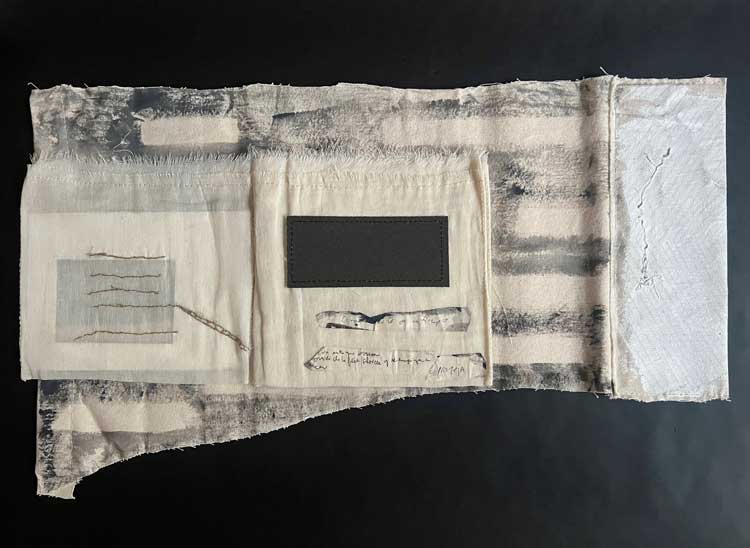
Francisca Aninat, My eyes, 2026. Botanical Books. Courtesy of the artist.
TD: Like the matches on the wall at 92 Webster Road!
FA: Maybe, I was working on the show and the books in tandem, although I can’t say that link was intentional.
TD: I’m reminded of your work in the hospitals, in a way. Not only are the books based on interviews, but they engage with heterodox means of apprehending the world.
FA: Both plants are about how we relate to the world, each in their own way. One is more about the body, the other more about the spaces our bodies occupy. One more physical, the other more about invisible resonances. I tried to capture these two dynamics, the tangible and the strange, and how they might overlap. It felt right to offset the academic discourse of the symposium with the mystery of this oral knowledge that people still use – and, as always, to respect this mystery.
• Francisca Aninat: Four Steps and a Looking Glass is at 92 Webster Road, London, until 11 October.
Click on the pictures below to enlarge

Copyright © 1893–2026 Studio International Foundation.
The title Studio International is the property of the Studio International Foundation and, together with the content, are bound by copyright. All rights reserved.
 |
 |
 |
|---|
-300.jpg)