




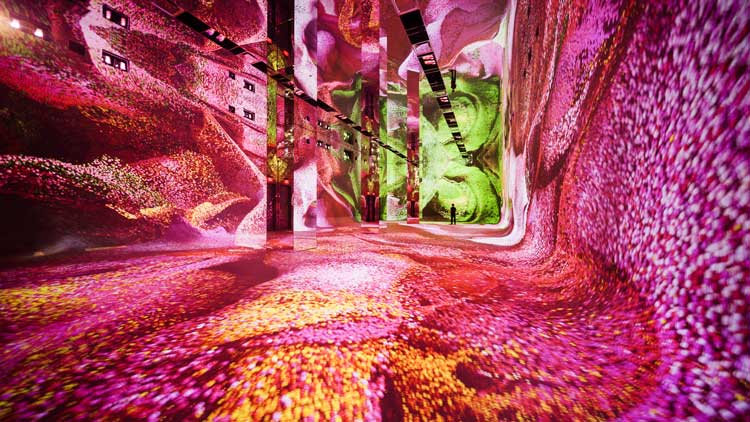
Installation view of Machine Dreams: Rainforest, Dataland, Los Angeles, June 20, 2026 – January 31, 2027. © 2026 Refik Anadol Studio on behalf of Dataland. Photo: Refik Anadol Studio.
Dataland, Los Angeles
20 June 2026 – 31 January 2027
by JILL SPALDING
On 20 June, to much press and fanfare, the artist Refik Anadol, together with his wife, the painter Efsun Erkılıç, launched Dataland, their ultimate exercise in redefining an art museum as a visceral, alternative world designed to engage, mystify, astonish and, above all, delight. Inaugurated with Machine Dreams: Rainforest, its five successive galleries, programmed on human biometrics and artificial intelligence, translate ever-evolving data into a “living” experience of our biodiverse ecosystem.
Predictably, reception has been mixed. Anchoring the Grand LA in a Frank Gehry-designed building, Dataland’s trailblazing showcase has been igniting the buzz and controversy that has dogged Anadol since MoMA premiered his swirling Unsupervised 2022-23, modelled on MoMA’s entire collection to digitally reinterpret the museum's history in real time. The elitist pushback (you call those flashed AI streaks and daubs painting?) may prove the last finger in the dyke of traditional art.
Anadol, the Turkish-American media artist who has come to world attention since 2021 for monumental, data-driven installations at Casa Batlló in Barcelona, the Serpentine Galleries in London, and the World Economic Forum in Davos, holds Dataland his masterwork. There is no denying its groundbreaking achievement – a world-first omni-sensory, immersive museum programmed on biometrics and AI.
For the inaugural exhibition, Anadol partnered with universities and museums to train his pioneering generative-AI Large Nature Model (LNM) on their billion-plus records of the Earth’s flora, fauna and fungi that he then programmed to produce a machine-generated hallucination. As you move through the galleries, the smartwatch and collar issued to you on arrival activate the data powering this tech-driven ecosystem to deliver a vivid, “living dreamscape” of light, smell, taste and sound.
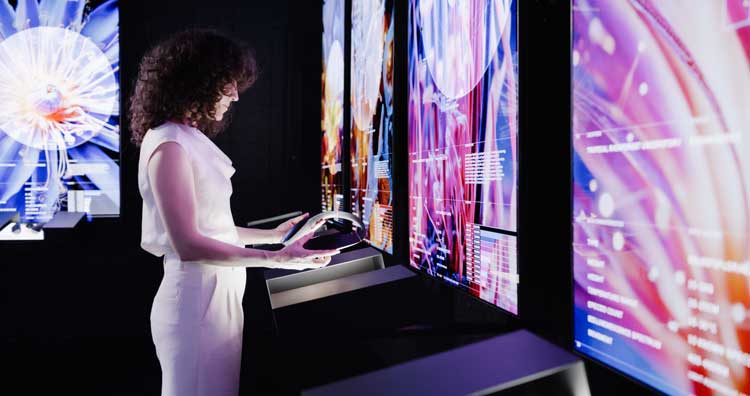
Discovery Portal: Installation view of Machine Dreams: Rainforest, Dataland, Los Angeles, June 20, 2026 – January 31, 2027. © 2026 Refik Anadol Studio on behalf of Dataland. Photo: Refik Anadol Studio.
The first gallery, the Discovery Portal – no technical skill required – introduces the LNM and shows how the watch unlocks the QR code that programmes your real-time body reactivity to directly interact with the images evolving in subsequent rooms. Navigating the gallery is effortless but unsettling. You move freely through it while it registers and responds to your presence, but you’ll need to stand still as the room’s floor-to-ceiling mirrored walls, roiling with data become pigment, immerse you in trippy, ceaselessly pulsing, strongly scented and coloured abstractions of Earth's ecosystems.
Closer to art, the Data Pavilion, the museum's second and largest gallery, is a wraparound treescape built of humid turf, storm activity, birdsong and every past and present visitor’s biometrics. Animated by 84 synchronised projectors and a 250-channel sound system, tumbling data from 16 real-world rainforests immerse you in the dense foliage, tangled lianas, high canopies and turbulent weather of untrammelled nature. Data-dense but compelling, it’s a captivating intermezzo. Even luddites will find poetry in the varying patterns of rainfall and the pigmented abstractions wafting around them.
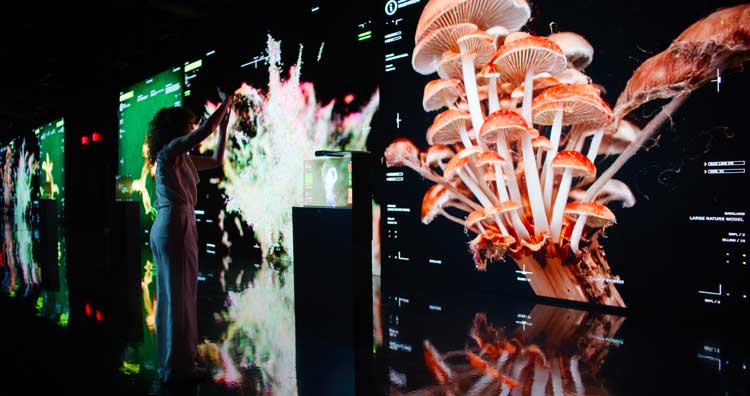
Latent Gallery: Installation view of Machine Dreams: Rainforest, Dataland, Los Angeles, June 20, 2026 – January 31, 2027. © 2026 Refik Anadol Studio on behalf of Dataland. Photo: Refik Anadol Studio.
The third, Latent Gallery, is where the data get tricky. Every visitor’s movements and identifiers drive how the LNM projections of ocean, flora and landscape propagate, flow and evolve across the gallery walls. Your devices enable you to engage with them on touchscreens to convert your scribbles into real-time digital drawings.
If, though, like me, you find unintuitive the “thinking” paintbrush programmed to shift the colour and composition of the images projected on the walls, or have difficulty scrolling to options such as "Diffuse Control” and "Living Patterns”, you may not be able to generate what you envision. Also frustrating, as experienced by the totally clued-in youngster next to me, the timed flow through the galleries doesn’t let you fully interact before the touchscreen shuts down.
Happily, the Infinity Room delivers its promise, folding you into a journey through a magical land, created, it would seem, to convey Anadol’s personal dreamscape – a welcoming paradise programmed with data from Hawaii’s lush interiors and his life-changing sojourn in the Amazon with the Indigenous Yawanawá people. Follow the glass hummingbird past waterways and through foliage lavished with flora to be pulled through its eye as through a cosmic black hole and into a new universe as tenuous as it is gorgeous.
The Sanctuary Room, the last gallery, is intended to still your emotions and quiet the mind – a catharsis of sorts meant to consolidate all you have experienced and induce a profound meditation. Instead, it delivers a pounding, swirling, exhilarating grand finale. Aggregated from the real-time and continually recorded biosensor-fed measurements of everyone previously and now in the gallery – heart rate, skin temperature and skin (goosebumps!) conductivity – the visuals manifest as an engulfing floral and sea-floor abstraction, timed rousingly to music collated from 50m birdsongs and the Los Angeles Philharmonic.
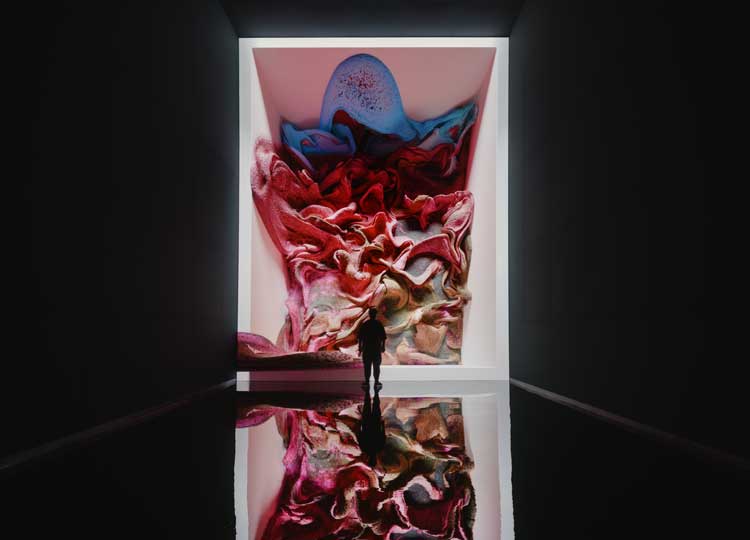
The Sanctuary: Installation view of Machine Dreams: Rainforest, Dataland, Los Angeles, June 20, 2026 – January 31, 2027. © 2026 Refik Anadol Studio on behalf of Dataland. Photo: Refik Anadol Studio.
Trip out or come down to earth with your small personal data token, a "unique computational memory” of your biometric footprint to take home or delete, that struck those exiting with me as either a “cute gimmick” or a “Trojan horse”.
For those more interested in what constitutes art – aesthetic/emotive/human-made? – what to make of an AI-generated “machine dream”? The orthodox view is that code can originate images but only as remixed from existing ones or as derived from pixels rather than thought and conscious intent. Whereas gen Z, at home in gaming’s fast-paced, colour-drenched graphics, doesn’t differentiate, their elders, strangers to immersion in virtual worlds, may find their volume and pace overwhelming, and tune out.
So personally experienced, so specific to each viewer’s encounter with what presents – like the monolith at the start of Stanley Kubrick’s 200l: A Space Odyssey – as a meta-narrative opening us to an evolved consciousness that the only way to impart its impact and import is subjectively. As a child I’d say “cool”; as a student, “crazy”; as a spectator, “dazzling”.
Greatest the challenge if you’ve come for the art. To see as such Anadol’s immersive virtual environments and his deepening command of them, it helps to know the evolution and art history of generative AI.
By the 1960s, artists were already using computers and algorithms to create generative art. In 1968, the British-born painter Harold Cohen programmed robotic arms to deliver autonomously generating paintings; and, in 1986, Stanford’s Tamiko Thiel, based her studies of the human brain and on Richard Feynman’s 12-dimensional hypercube, introduced the modern generative era to the CM-1, the first commercial AI supercomputer.
Creative coding dates back to the 2000s, when artists began engineering their own complex, mathematical systems. In 2018, Mario Klingemann’s Memories of Passersby 1, a groundbreaking installation streaming human portraits in real time positioned the algorithm itself as an artwork by relinquishing part of the artistic process to neural, machine learning models known as generative adversarial networks (GANs). Three years later, Casey Reas created software structures for the Whitney Museum of Art – a series of Sol-Lewitt inspired machine-readable code that spawned elaborate, endlessly evolving, autonomous visual systems.
Anadol came to the fore in 2018 with WDCH Dreams, which projected AI-driven generative "memories" of the LA Philharmonic’s digital archives directly on to the swooping facade of the Frank Gehry-designed Walt Disney Concert Hall in Los Angeles. He then began mining millions of publicly available images of cities and nature to train AI models on a collective global memory. In 2020, he partnered with Google to enable a quantum transformation of data into multidimensional, endlessly generating “sculptures”. A year later he was rendering archival data into living installations with models like the one used for Unsupervised that were trained to react in real time to the lighting, acoustics and atmosphere of a specific environment.
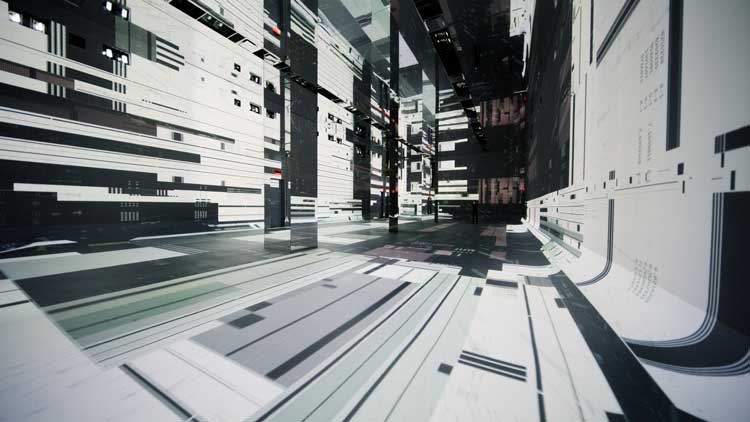
Data Pavilion: Installation view of Machine Dreams: Rainforest, Dataland, Los Angeles, June 20, 2026 – January 31, 2027. © 2026 Refik Anadol Studio on behalf of Dataland. Photo: Refik Anadol Studio.
Which brings us full circle to Dataland, its achievement, its impact and its relation to art. Those raised with fast-pulsing visuals will think it mind-bending, while those vulnerable to motion sickness, loud sound and the overpowering aroma derived from half a million scent molecules, will feel otherwise. There are glitches to be worked out. Some of the watches didn’t work, earning a free second visit, some of the gallery walls shake and the soundscape can be deafening. But there’s no denying Dataland’s achievement and, if drawn into Anadol’s dream, you will look differently on exiting at all that surrounds you. Still haunting me after a sparrow flew past, the Infinity Room’s lingering song of Hawaii’s now extinct Kauaʻi ʻōʻō bird. And I am still sporting the AI-personalised T-shirt purchased with my data token.
But is Dataland an artwork? And if so, should the artworld not rethink the meaning of art?
Even traditionalists differ on how to define it. Christo and Jeanne-Claude’s 1985 The Pont Neuf Wrapped – surely art: JR’s immersive 2026 La Caverne du Pont Neuf, perhaps not. The binary model, though, is a challenge. Does art wrought by a system – virtual, digital, generative, cognitive, responsive, computational, algorithmic – cross a red line?
Whatever your take on Dataland, you would be hard-pressed to question its achievement – vast datasets of the natural world synthesised into visuals that respond to your body's biometrics and emotions to create an immersive, living experience in real time and beyond.
I would argue that whether you think a virtual assemblage art depends on your response to it. Anadol is an artist. He coined the terms “AI data painting” and “AI data sculpture” to describe the LNM’s millions of fluid, digital, planet-derived visual data points, designed the Discovery Portal to evoke California’s Light and Space Movement, and transformed the museum’s looming wall screens with digital pigment into abstract paintings. And, yes, Dataland’s limitless, evolving, remembering, interactive and experiential “living system” is visually wondrous.
Yet the finished work remains a system. Even those thinking the modern distinction between art and entertainment is newly relevant question whether, given that Dataland’s tools were data sets and machine-learning algorithms, and that Anadol insists “the system is the art”, he manifests here more as a superb AI creator and technologist. The pressing question for our time is can art be born of artificial intelligence? Or must it be fashioned of physical images, materials, movements, sounds, or words, rendering Dataland’s ultimate achievement sublime entertainment? Marcel Duchamp and Andy Warhol might have said, if it’s in a museum, it is art – but in the end, or no-end, it is up to you.
Turning to other noted AI art essays, although Anadol’s elaborate system is widely thought the most advanced, the binary universe teems with creators. Determining who has pushed AI’s boundaries farthest depends on whether you value Anadol’s sensory, multimodal environments over sociopolitical critique or – as we covered in a past review – the field of computational autonomy epitomised by Botto, the AI “artist” that creates and auctions such as NFT art without direct human control over the ultimate output.
Those like myself who hold art a medium that – small or immense, simple or elaborate, wispy or substantial – moves heart over mind, will respond to the virtual worlds created by the Irish conceptual computer artist John Gerrard.
Recently, Gerrard gathered a small group of fans to view two of the better known digital works on his laptop. The most elaborate, Spirits, a 2025 public art commission for the Los Angeles County Museum of Art that is still unfolding on the museum’s website, transforms 96 meticulously photographed discarded plastic sandals retrieved from global beaches into an interactive, 3D meditation on labour, migration and humanity’s catastrophic support of the oil industry.
Built of digitally glossed, cloud-like points of light with the advanced AI technique called gaussian splatting whose powerful 3D engines render every frame live, Spirits inhabits actual sites, evolves in real time, ties in to astronomical events and generates an evolving audio score that you can engage with on your phone. Drag your finger across a sandal and unfold glistening oceanic heat maps, iridescent waves of washed-up plastic, and shiny dead birds – testimony to the oil industry's devastating impact on our fragile environment.
-2023.jpg "John Gerrard, STANDARD (formerly Surrender (Flag) 2023). Formed from plumes of water vapour evaporating in a desert landscape. Presented in high resolution on a large outdoor LED screen, Surrender (Flag) 2023, is a continuous simulation made using real-time computer graphics software.")
John Gerrard, STANDARD (formerly Surrender (Flag) 2023). Formed from plumes of water vapour evaporating in a desert landscape. Presented in high resolution on a large outdoor LED screen, Surrender (Flag) 2023, is a continuous simulation made using real-time computer graphics software.
Still closer to art are Gerrard’s foundational flags, in that they shift the focus from AI to the image it empowers. Placed in 3D simulations of actual sites built from thousands of drone images, they reflect more viscerally and lastingly on our degrading ecosystem. Gerrard shared two with us: Western Flag (Spindletop, Texas), 2017 (edition of four, one of which joined the collection of the Museo Nacional Thyssen-Bornemisza), waves virtual plumes of dirty oil in such as Spindletop (site of the Lucas Gusher); and Surrender (Flag), 2023, commissioned by Bono – a perpetually evaporating white water-vapour cloud of peace virtually planted in the Mojave Desert. Attesting to its impact, the video premiering it the same year at Sphere in Las Vegas showed the audience applauding its beauty, then cheering its fleeting promise – then sobbing.
On to the mighty Endeavour. Given that, built to sustain life, it pushed the boundaries of science, while Dataland, built to simulate life, pushes the boundaries of art, had they not premiered the same week, I might not have connected these two engines of frontier exploration. Yet so visually marking are Endeavour’s structural majesty and Anadol’s dreamscape, and so dependent are they both on physics and programming, as to blur the line that divides them.
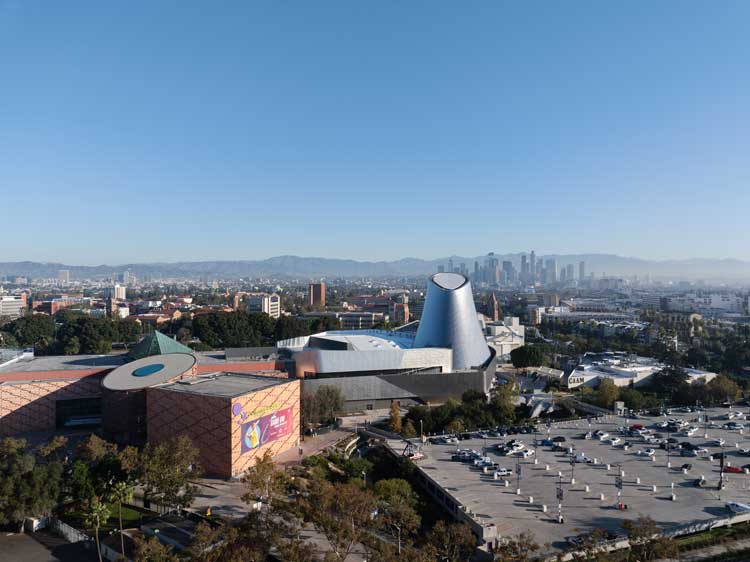
Samuel Oschin Air and Space Center, Los Angeles. Photo © Mike Kelley
Like Anadol’s groundbreaking generative reality, the great spaceship, now erect on its launchpad, was powered by a matrix of wires and AI technology. While Dataland uses complex AI code to immerse humans in a “living” simulation of our world, Endeavour called on complex AI support systems to propel humans into the universe. Both systems build self-contained worlds that isolate inner perception from outer reality and utilise control panels, screens and sensory feedback to move humans through an otherwise inaccessible environment. Both are entirely reliant on cutting-edge computation and data networks to function and would collapse if their primary power or core operational systems failed. Both illustrate how humanity engages science to dream. And for both, beauty factors in – incidentally, with the svelte, science-led, aerodynamic design of the spacecraft; intentionally, with Dataland’s vivid tapestries of light, sound and scent produced by Anadol’s data-trained neural networks.
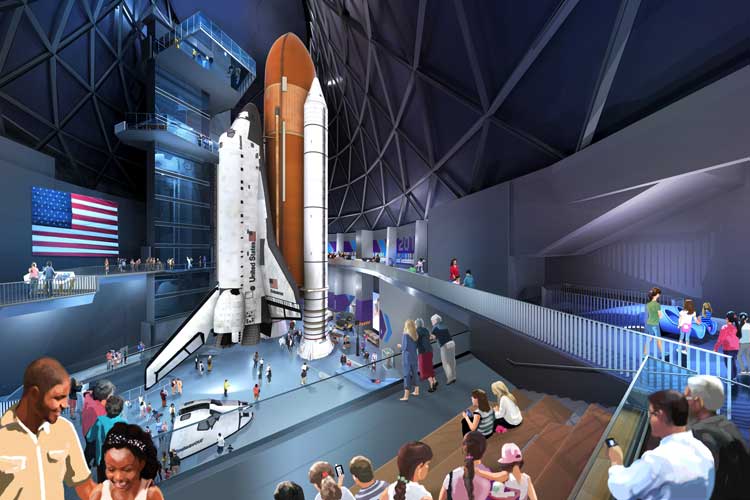
Space Shuttle Gallery., Samuel Oschin Air and Space Center, Los Angeles. Photo © California Science Center.
The parallels end there. While Anadol’s virtual worlds are ingenious, Endeavour’s achievement, timed to celebrate the birthdate of national aspiration, is gobsmackingly awesome. Mind-boggling, its arrival at Los Angeles international airport atop Nasa’s 747 shuttle carrier aircraft; the myriad permits and tree-removals enabling its two-day journey to Exposition Park, and the prodigious overhaul of the museum tailored to house it. Wondrous, too, the sky-high crane hoisting upright on to the ready-to-launch rocket boosters and ET-94 external fuel tank, with the care of a fragile Fabergé Egg – the weight of a Tar Pit dinosaur.
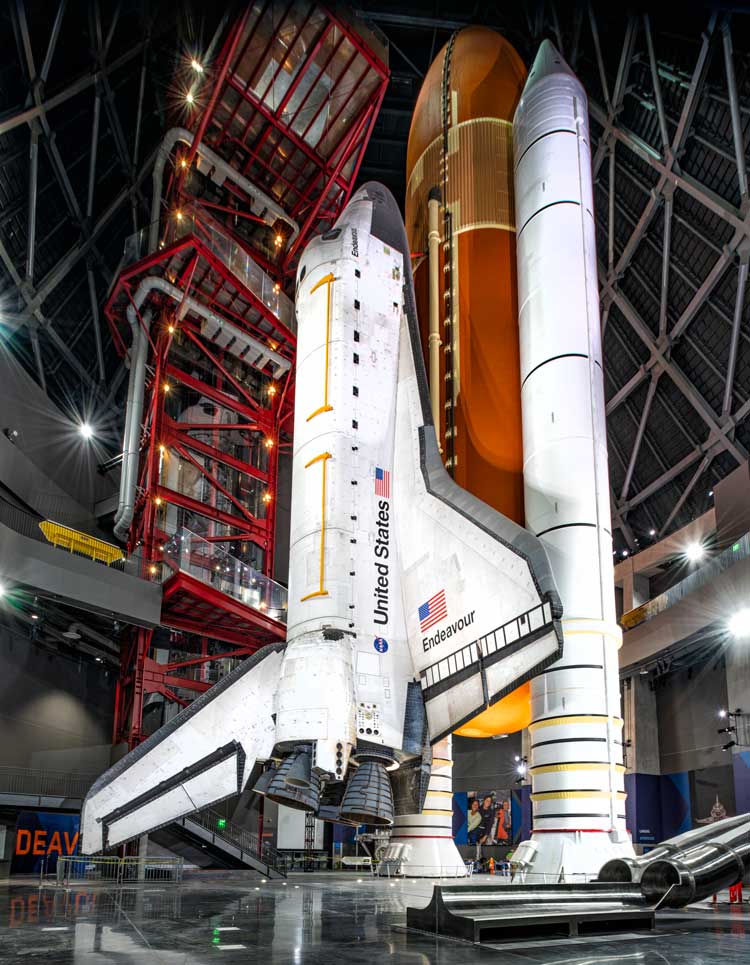
Space Shuttle Endeavour in launch position in the Samuel Oshin Shuttle Gallery, Los Angeles. Photo © California Science Center.
Pounding applause greeted the unveiling of this scientific milestone of wires, computer technology, reaching once again for the moon in its vast custom-built steel shell, followed by tears as the Endeavour’s deep symbolism sunk in, on this 250th birthday of a nation dedicated to all humanity’s right to aspire, that science can lead humanity to new worlds, and that technology and human imagination are inseparable.
The entire exhibit will be open for viewing on 13 November in the just-completed 200,000 sq ft addition to the Samuel Oschin Air and Space Center located in Exposition Park, a five-minute walk from the soon-to-open Lucas Museum of Narrative Art and – bonus! – the adjacent metro station features glimpses of the park fashioned by LA artist Robbert Flick as if seen from a moving vehicle.
Click on the pictures below to enlarge

Copyright © 1893–2026 Studio International Foundation.
The title Studio International is the property of the Studio International Foundation and, together with the content, are bound by copyright. All rights reserved.

 |
 |
 |
|---|
-300.jpg)

-300.jpg)


 Alexandra Daisy Ginsberg – interview: ‘We need to radically rethink our behaviours, globally’
 AI: More than Human
 Casey Reas – interview: ‘There is an increased understanding that software is central to our lives’
 Lawrence Lek – interview: ‘AI could become the ultimate content creation mechanism. It could also signal the death of the author’
 Nye Thompson – interview: ‘The bots are actually the primary audience for the show’