




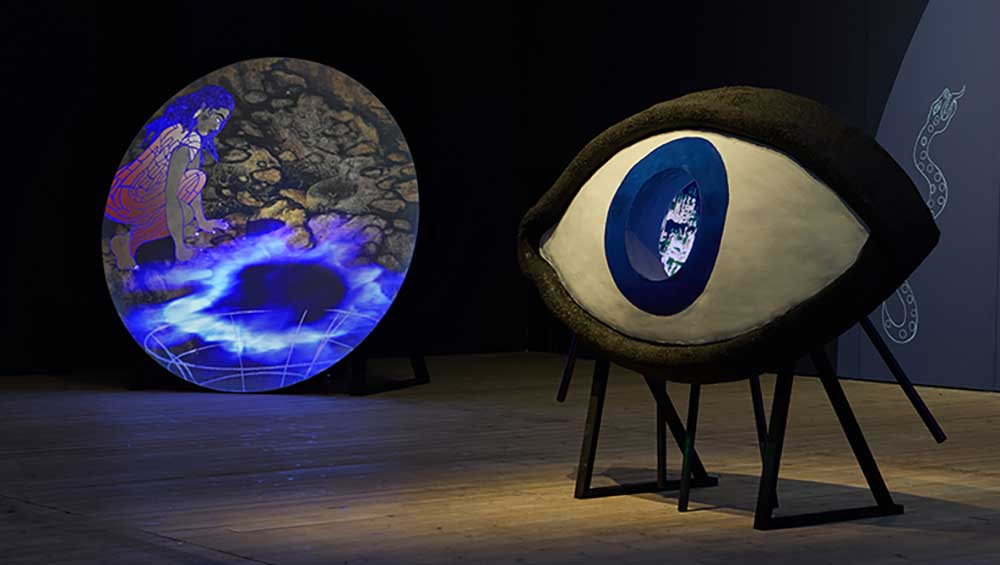
Chitra Ganesh: Journey to the Great Below, installation view, Baltic Centre for Contemporary Art, Gateshead, 2026. Photo: Tom Carter © 2026 Tom Carter & Baltic Centre for Contemporary Art.
Baltic Centre for Contemporary Art, Gateshead
4 July 2026 – 17 January 2027
by VERONICA SIMPSON
Baltic really knows how to go all out for an immersive experience when the artist is willing. In a spectacular set that felt like a lost necropolis, Ali Cherri’s 2025 show How I Am Monument asked important questions about the value of art. Now the Brooklyn-based artist Chitra Ganesh draws us into her world view with Journey to the Great Below. Inspired by what is considered to be the world’s oldest recorded myth, The Descent of Inanna into the Underworld, written in Mesopotamia in BC1900-1600, it follows Inanna, Queen of Heaven (said to be the goddess of love, fertility and war) as she descends to face her sister Ereshkigal, the “queen of the underworld”, and wrest back her powers and – seemingly – her life.
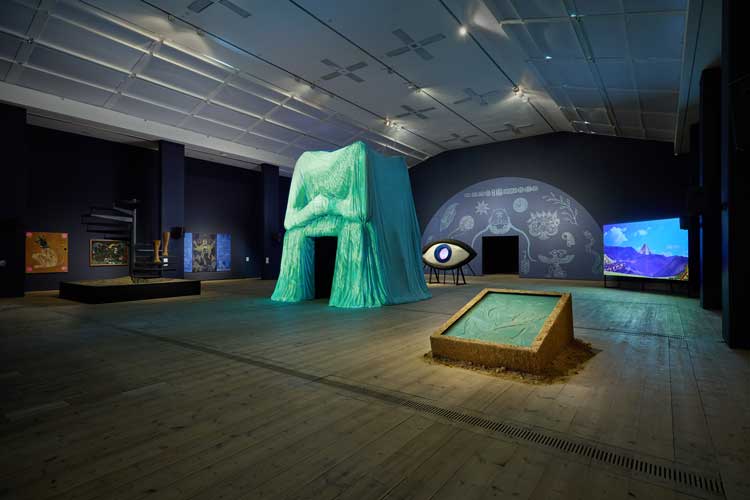
Chitra Ganesh: Journey to the Great Below, installation view, Baltic Centre for Contemporary Art, Gateshead, 2026. Photo: Tom Carter © 2026 Tom Carter & Baltic Centre for Contemporary Art.
Ganesh and the team have gone full-on theatrical with the scenography: we enter a darkened space and are drawn immediately towards and through an animated blue gateway with projections of owls, goddesses and constellations playing across its facade. We proceed towards a headless votive figure – illuminated in eerie green – with a doorway at its centre, beyond which we encounter a sculpture in the shape of a large, glowing eye. Its “pupil” plays fiery swirls of cosmological, meteorological or botanical phenomena. For someone who has rarely played video games, it feels very much like entering one in the physical realm, an impression enhanced by the soundscape of thuds and crunches, harp-like twirls, and more otherworldly generic AV soundtrack noises. Either side of the eye is a screen, one oblong, one circular, which play the same, central animation Ganesh has made to tell the story of Inanna, albeit with slightly different timings.
At the end of the gallery there is a separate room where a large model of a hand – apparently Ganesh’s own, magnified X12 – has been conjured via an aluminium frame robed in raw silk, the silk said to emulate the “texture and tone of brown skin”. It was inspired by monumental statues encountered in the Ajanta and Ellora caves in India. The silk proves a wonderfully absorbent material for the sumptuous tones Ganesh projects: shifting shades of deep indigo, violet, orange and red. Patterns of eyes, roses, droplets form, vanish and reform, along with portals and cyborg heads. The intention is to conjure ideas of invention, travel and transformation, but it is all too pleasurable to allow the lava-lamp style shifting interplay of colour and pattern seduce the gaze, while droplets pulse and play up and across the fingers, or eyes blink.
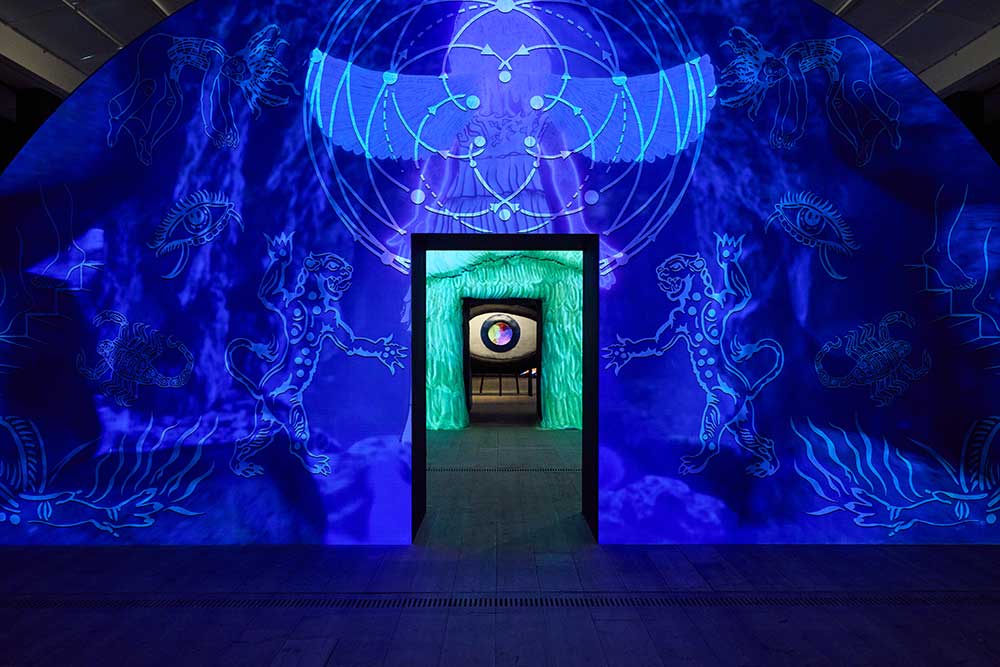
Chitra Ganesh: Journey to the Great Below, installation view, Baltic Centre for Contemporary Art, Gateshead, 2026. Photo: Tom Carter © 2026 Tom Carter & Baltic Centre for Contemporary Art.
These films and the large sculptural elements have been commissioned for this show. It is like wandering into a fantasy land, a cave or temple dedicated to assorted exotic, female deities. But while the imagery is compelling and the experience enjoyable, I find any underpinning narrative elusive.
I know from the wall text that the key story is Inanna’s descent into the underworld. I watch for a few minutes in fascination as the events on the two screens unfold in each time I pass them, enjoying the rich colourings and the playful collaging of styles from anime to ancient manuscript imagery, but it is easy to drift off and explore the other tempting twinkling, pulsating elements. I don’t feel any the wiser about the motives or emotions driving Inanna’s narrative, so I return to watch the full six minutes to try to pick up the story more clearly.
It is easy enough to identify the start of the film: the Queen of Heaven heads down to the underworld, processing through many gates and portals ranging from caves to tunnels to classically pillared ruins. Finally, she encounters her sister, the queen of the underworld, who appears to destroy her. After this, everything is confusing or ambiguous. While Innana’s body lies broken in the underworld, her spirit (presumably) rises up above the Earth and flies around petitioning help from three different men – kings, princes or gods? (we know they are powerful men because each is sitting on top of a vaguely pyramid-shaped fortress). Only the third responds positively. He does so – seemingly – by shaving off his fingernails (I must have got this wrong, but that’s what it looks like). These glowing nail clippings then transform into cute, anime style dragonflies/fairies who take small glass beakers of some special liquid down to the underworld, which they use to revive the broken/dead version of Inanna. Then, with various vaporisings and transformations of creatures along the way, Inanna ascends to Heaven again, throws some bloke off her throne, and rules supreme.
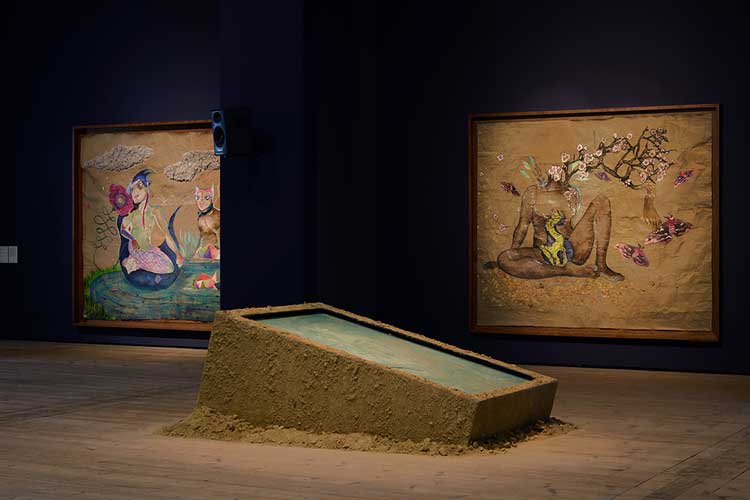
Chitra Ganesh: Journey to the Great Below, installation view, Baltic Centre for Contemporary Art, Gateshead, 2026. Photo: Tom Carter © 2026 Tom Carter & Baltic Centre for Contemporary Art.
The aesthetics are compelling, absorbing: hand-drawn figures, lush landscapes and flamboyant palaces merge with hard-edged video-game animations. Characters slip, slide and levitate. For me, these fables are unfamiliar, so it is all too easy to stay in a state of surface appreciation, semi-mesmerised. If you know these stories, and the iconography is more familiar, it is probably more thrilling to see these rendered as contemporary art. The rest of us are given the who, the what, the when (roughly) but not the why of this story. Why does Innana head down to the underworld? Why does her sister kill her? These are crucial elements of the story, surely. There are a few cartoon-style illustrations just inside the entrance wall that give us more detail, but when the attractions of the glowing, pulsating screens, statutes and portals are so much greater, who will take the time to study them and unpick the confusing elements of the action?
Do we need to know all these details to appreciate the narrative of a brown female goddess conquering death and an evil sister? Possibly not. The mythologies Ganesh wants to foreground – as an antidote to the prevailing patriarchal white male as hero mythologies we have absorbed over the last 2,000 years – are well represented, both in the animations and in compelling beautifully collaged goddess portraits on paper all around the walls.
What does the show communicate to the uninitiated? The power of transformation? That there is more to this universe than meets the eye? That there are multiple goddesses from whose inspirations we can draw heart and strength? The ancient civilisations were evidently richly peopled with powerful women. But I think we need to get to know them a little better before we can translate their stories in any meaningful way.
Click on the pictures below to enlarge

Copyright © 1893–2026 Studio International Foundation.
The title Studio International is the property of the Studio International Foundation and, together with the content, are bound by copyright. All rights reserved.

 |
 |
 |
|---|



-1000-300.jpg)


 Enchanted Alchemies: Magic, Mysticism, and the Occult in Art