



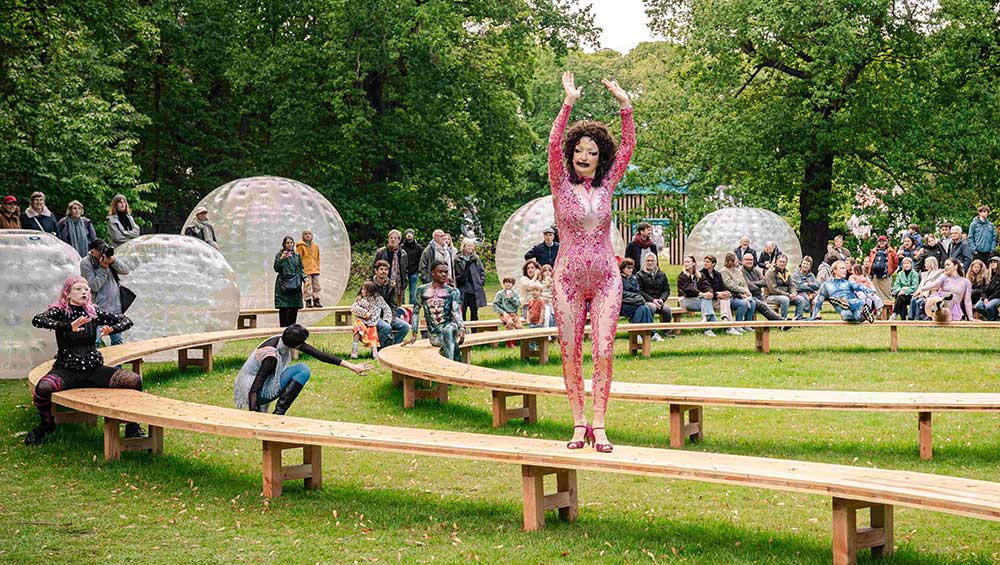
Monster Chetwynd, A Friends Making Machine, exhibition view, 2026. Courtesy the artist and Middelheim Museum, Antwerp. Photo: Tom Cornille.
Middelheim Museum, Antwerp
16 May – 11 October 2026
by VERONICA SIMPSON
Monster Chetwynd is a tonic. In person, she exudes a fizzy vitality and approachability; open, engaging and quick to laugh. On a tour of her new outdoor exhibition at Middelheim Museum, an elegant sculpture park in Antwerp – founded in 1950, it is one of the oldest sculpture parks in Europe – she shares her inspirations. In a seemingly effortless stream of consciousness, she enthuses about how the work sits in the place and the skills and support of the people who have worked on the show with her, and anticipates the reactions of those who come to the park to experience it. Her glee is infectious.
Though she was nominated for the Turner Prize in 2012, when she was known as Spartacus Chetwynd, it has taken me a while to warm to her work. I admit to a bias against performance art and art that looks like set design. Both these fields are embedded in her practice, and I have only recently come to appreciate the skill with which her imaginative creations manifest a mischievous, disruptive, provocative spirit. They act as triggers for the energies and imaginations of those who encounter them, which is why she is consistently invited to contribute her antic charms (in the Shakespearean sense) to major institutional spaces.
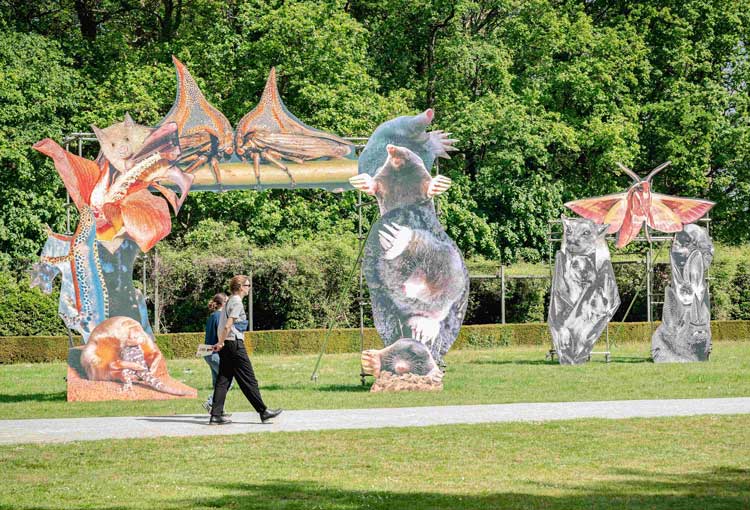
Proscenium Arches, exhibition view, Monster Chetwynd, A Friends Making Machine, 2026. Courtesy the artist and Middelheim Museum, Antwerp. Photo: Tom Cornille.
Past highlights include two huge slug sculptures, emanating blue iridescence and trails of LED slime across the facade of Tate Britain, for the winter of 2018-19 and three fantastical, fairytale theatrical play sets, filled with costumes and hand-crafted props inside Tate Modern from May 2024 to May 2026. From April 2025 to this February, Chetwynd’s immersive Monster universe at Copenhagen Contemporary invited children to create and enact their own performances (A Feather in Your Hat!). Also in 2025, her Dictionary of Dreams was a standout at Beyond Surrealism at Boijmans van Beuningen Museum Depot in Rotterdam. There is darkness in the work, but it is the kind we recognise from our worst fears or our craziest dreams, or the disturbing, under-the-skin creepiness of old school “fairy” stories.
Two years ago, Chetwynd was selected to design a new, permanent gateway into the Middelheim park that would provide direct access to visitors, staff and patients of the large healthcare and further education complex on its fringes. Within that complex is a general and a children’s hospital as well as a centre for child and adolescent psychiatry. Middelheim felt the park and the art within it could play a significant part in the healing and recovery of the youngsters, as well as other patients and their families, and wanted an artist who would engage thoughtfully with these communities.
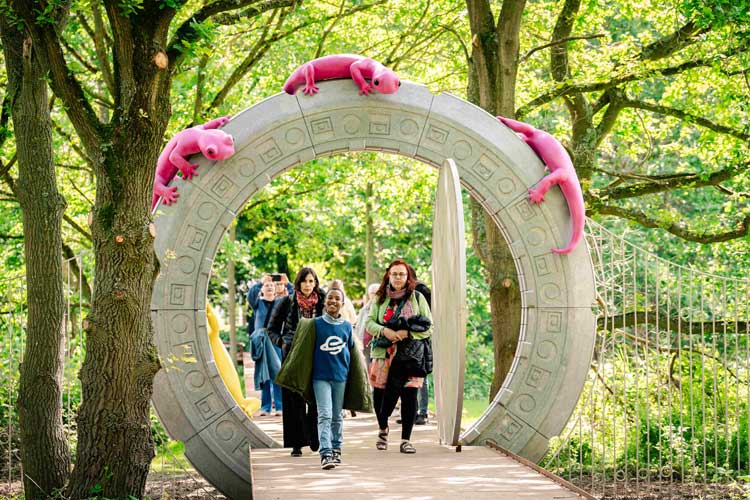
Salamander Portal, exhibition view, Monster Chetwynd, A Friends Making Machine, 2026. Courtesy the artist and Middelheim Museum, Antwerp. Photo: Tom Cornille.
Chetwynd’s response is a “Salamander Portal”. A fairy ring made from a distinctive blue local stone, imprinted with mysterious symbols from science fiction and paganism, with a circular gate that allows visitors in and out during daylight hours. The metal gate includes delightful “bubbles” of stained glass across its vertical bars. The stone ring is occupied by four perching salamanders (a signature Chetwynd species), three pink and one yellow. The craftsmanship of the pale, metal gate is impeccable. Chetwynd says it was created, along with the Corten-steel pathways that pass through it and fork beyond it towards the hospital campus, by a family firm of father and son.
Chetwynd has an impressive track record of working with and for children since she created a permanent indoor play space in Barking, east London, in 2015; there is delightful footage online of her galloping around classrooms with the kids, in workshops, effortlessly accessing her own inner child, as well as being interrogated by the class. She followed that with an outdoor playground (also inspired by salamanders), still awaiting construction in Folkestone, as part of her 2025 Triennial commission. Here, in Antwerp, she did not meet the children from the psychiatric unit – their mental health is too fragile for workshops – but she did meet many of the staff who look after them, and she worked alongside local groups.
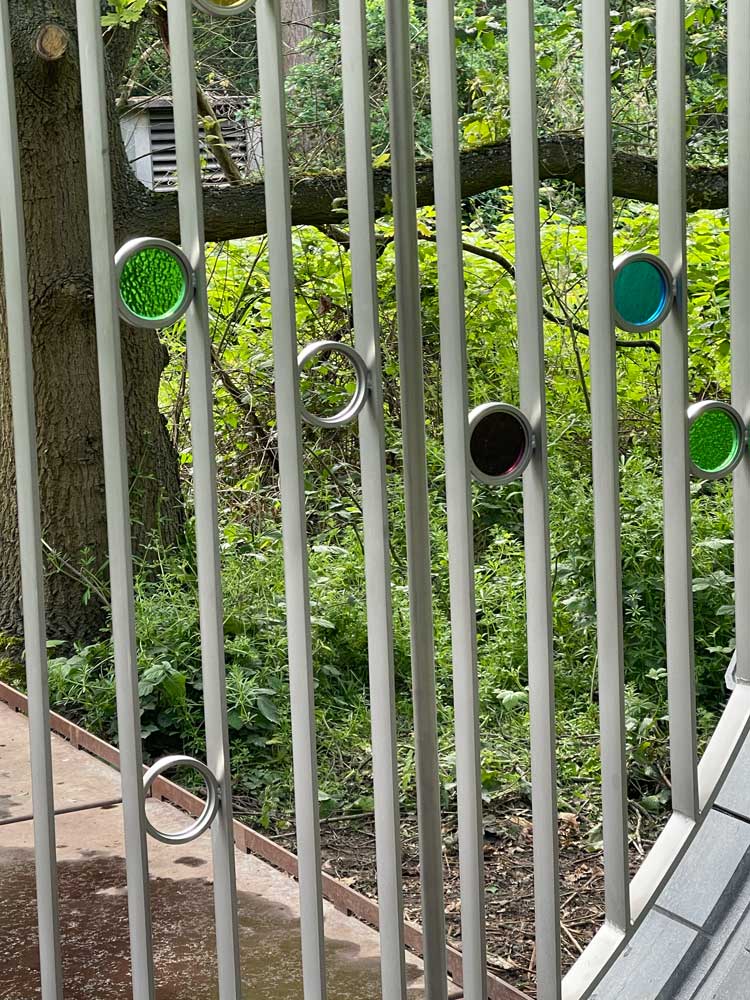
Salamander Portal (detail), exhibition view, Monster Chetwynd, A Friends Making Machine, Middelheim Museum, Antwerp, 2026. Photo: Veronica Simpson.
“The children asked us to make it ‘fairy not scary’,” she says. “How do you make something conceptually light as well as seeming substantial? These light colours and symbols are trying to meet that brief. The thing I find so exciting is the combination of metal and stone. The metal is sandblasted, so it’s soft and beautifully silvery and it goes so well with the stone.” Pieter Boons, who co-curated the show with Sara Weyns, Middelheim’s director, tells us that the choice of blue stone was symbolically appropriate – it’s a material often used in Antwerp for thresholds. Chetwynd is delighted with how her Salamander Portal sits in the landscape. “The fear for me was that it would be hidden. But it pulls you here, and through to the garden … The whole point is to be uplifting.” She was also pleased to get approval for the intense, bubble-gum pink of her salamanders. Chetwynd doesn’t play by mainstream rules of taste or etiquette. Her work has long been filled with a punk, DIY spirit, in its execution and the presence of creatures that many people find repulsive – bats, moths and, of course, salamanders. She has said: “Going for something ugly to undercut the saccharine is a good artistic formula.”
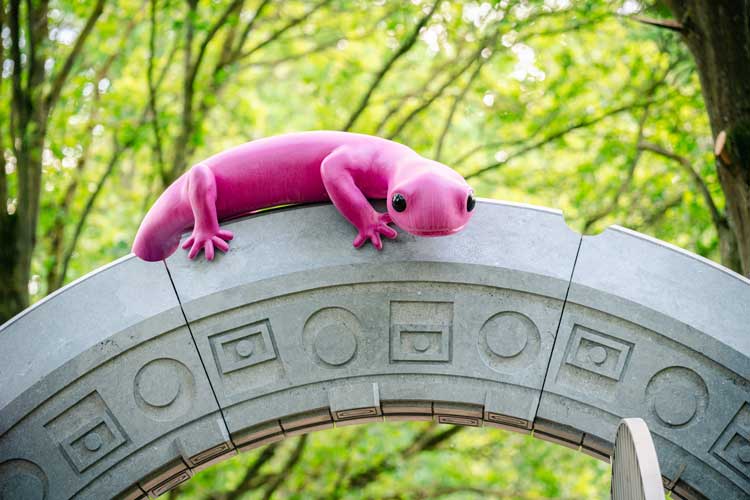
Salamander Portal (detail), exhibition view, Monster Chetwynd, A Friends Making Machine, 2026. Courtesy the artist and Middelheim Museum, Antwerp. Photo: Tom Cornille.
Salamanders, she says, are near miraculous creatures: “The salamander can regrow limbs, even organs, and there’s one that can regrow its brain. The skin of the salamander is toxic so if a predator eats it, it will be vomited up, and it can live up to half an hour inside the animal.” Referring to the salamander-inspired performances at the official opening, she says: “We tell facts and have fun and there’s a band playing a salamander song.”
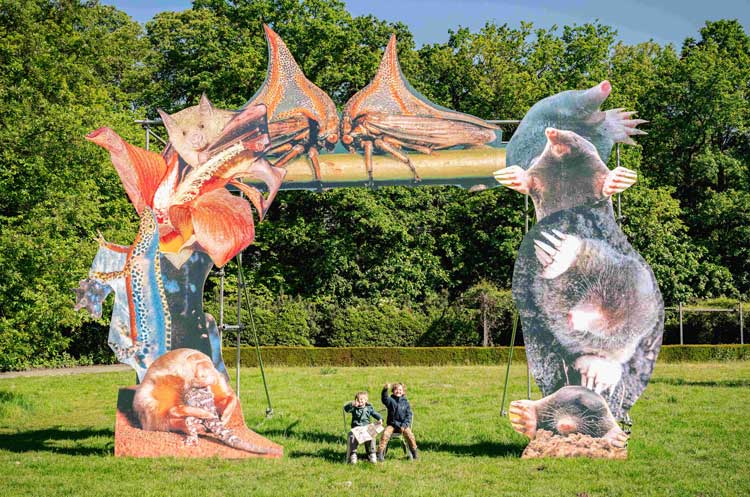
The opening of this new permanent commission for the park has been timed to coincide with an outdoor exhibition of Chetwynd’s sculptures on some of the adjacent lawns, including four full-sized theatrical Proscenium Arches (2026), one of which straddles the main path – acting as a gateway to this show. The others line up across the grass. Their surfaces include the classic Chetwynd collage of fascinating creatures verging on the grotesque. One in black and white features a cast of statues and gargoyles. The rest are peppered with massively magnified images of moles, moths, bats and salamanders. These arches will be used in the opening and closing performances, though during the summer months, visitors can move around them as they like. They are secured with very visible scaffolding. She wants to “break the fourth wall”, she says, celebrating their artifice, letting people make up their own choreography around them. She says: “I find the scale amazing and … the energy that’s still in them.” She is thrilled that, even at 10ft (3 metres) tall, what started out as “a collage that’s small and on my desk and has me with scissors just chopping away” still has vitality and a “lightness”.
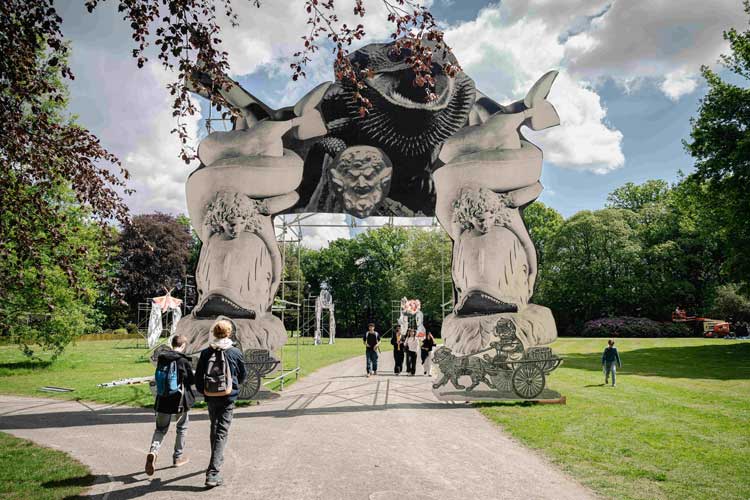
Proscenium Arches, exhibition view, Monster Chetwynd, A Friends Making Machine, 2026. Courtesy the artist and Middelheim Museum, Antwerp. Photo: Tom Cornille.
There are some unusually appealing bat portraits across the arches. “I came across bats when I did social anthropology [at University College London] before I studied art. I found a book in the Folklore Society Library there and, amazingly, the photographer had made little portraits of the bats against this very bright blue that reminded me of The Ambassadors by Hans Holbein, which is at the National Gallery. The portraits made me think they are a worthy subject. And because I was looking at them so closely, because I was painting them, I came to appreciate that they are incredibly sophisticated animals. There are 1,400 species; they’re the only mammal that flies, they only have a few offspring. They are the opposite of mice. Mice have 300 offspring, and only live three years; bats can live up to 30 years.”
She admits to an enduring fascination with “lovable monsters”, saying: “I’m completely drawn to the underdog.” Her more recent interest in moths was sparked during the summer of 2023, when she was artist in residence at Mount Stuart, a stately home in Bute, Scotland. “In the grounds was a small sign saying local people were counting and recording the local indigenous moths. I had no idea: there’s 700 species. More than butterflies. I saw photos of them, so stunning. And they are around in the daytime. I find them exotic and beautiful.”
Three of these creatures resonate particularly with the Middelheim setting, being very much present in the landscape: salamanders (there are newts in the ponds), moths and moles. The gardeners do regular battle with moles, and there a couple of fresh mole hills by the arches as if to reinforce this point. The show’s title, A Friends Making Machine, relates not only to the hospital community they hope will become regular visitors and the performers Chetwynd calls on to deliver her live repertoire (who are now all hugely bonded, she says, by their performing experiences), but also the role the local flora and fauna play in support of the park’s ecology. Boons says: “The Friends Making Machine is a care system. It’s a social system of people around you that hold you. And we found there’s a funny overlap with other care systems that are present right now. The moles, the bats, the salamanders – there are so many invisible care systems here. That’s why this exhibition feels right in the Middelheim Museum. It references the place or the context where it is located, it plays with it.”
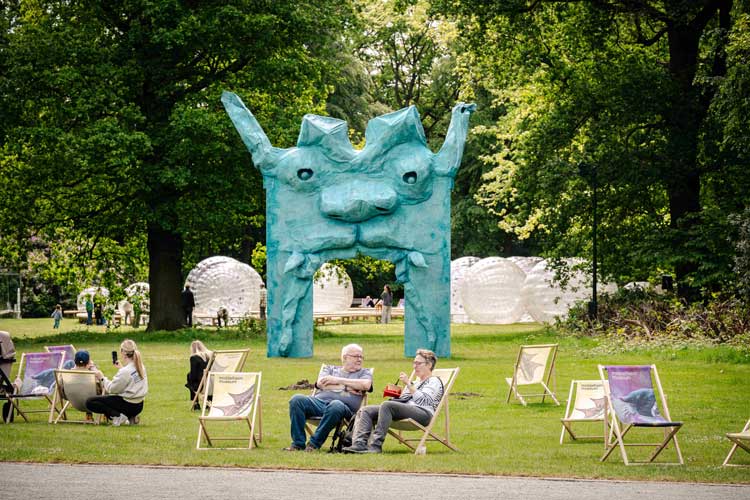
Hellmouth 5, 2025, exhibition view, Monster Chetwynd, A Friends Making Machine, 2026. Courtesy the artist and Middelheim Museum, Antwerp. Photo: Tom Cornille.
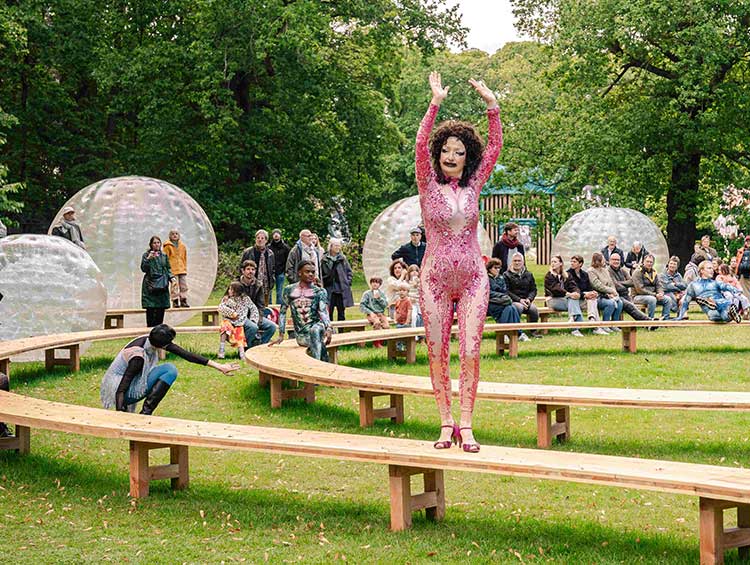
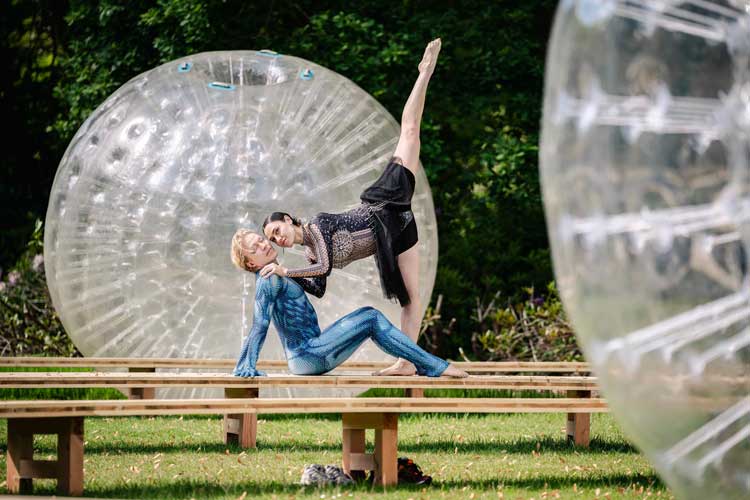
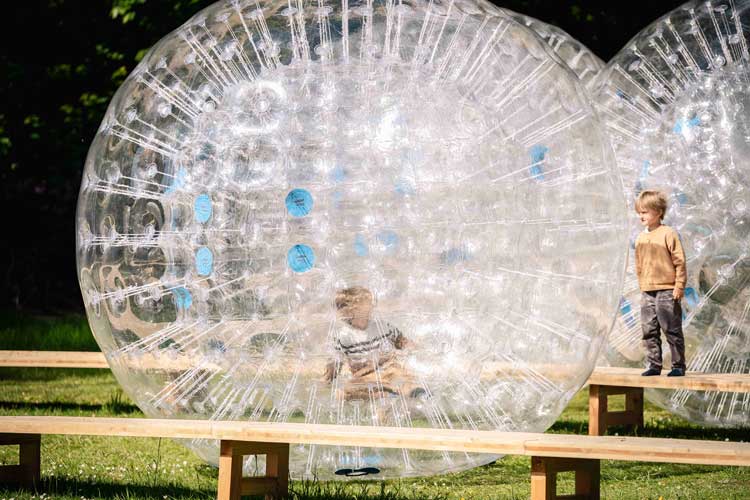
Across the lawn is the gaping mouth of a blue Hellmouth 5 (2025) from last year’s installation at Tate Modern’s Turbine Hall. The fantastical scenery she devised for that was, in part, inspired by Ingmar Bergman’s 1975 film The Magic Flute. Beyond that, are giant, glowing inflatable spheres, like Zorbs, which visitors can climb into. Part of the installation Tears (2021), the spheres are funnelled along a sculptural pathway of wooden benches/walkways. The form is inspired by a priceless watch designed by Salvador Dali: the benches take the shape of an eye, featuring diamond tears – the spheres – which move slowly between the benches. For the opening performance, says Chetwynd: “We choreograph a ballet in the middle and there are people doing constructivist movements outside. It’s on the edge of cheesy. It’s very bravely taking on grief. It was commissioned during Covid. But in a bizarre, totally contradictory way, I was making an elegant, exuberant celebration … It’s a bizarre tangle of subject matter. The glittery costumes are exaggerating the flex of light in the orbs.” The featured ballet is by choreographer Roland Petit and his wife, Renée Zizi Jeanmaire, which Chetwynd describes as a “1950s sexy French ballet”. As for her role: “I’m embarrassing myself singing a song walking along the platform.”
Boons says: “The theme of mental health is coming more to the fore in the programme of the museum. Tears play an important role when talking about feeling good or regulating emotion. They refer to joy as well as grief.”
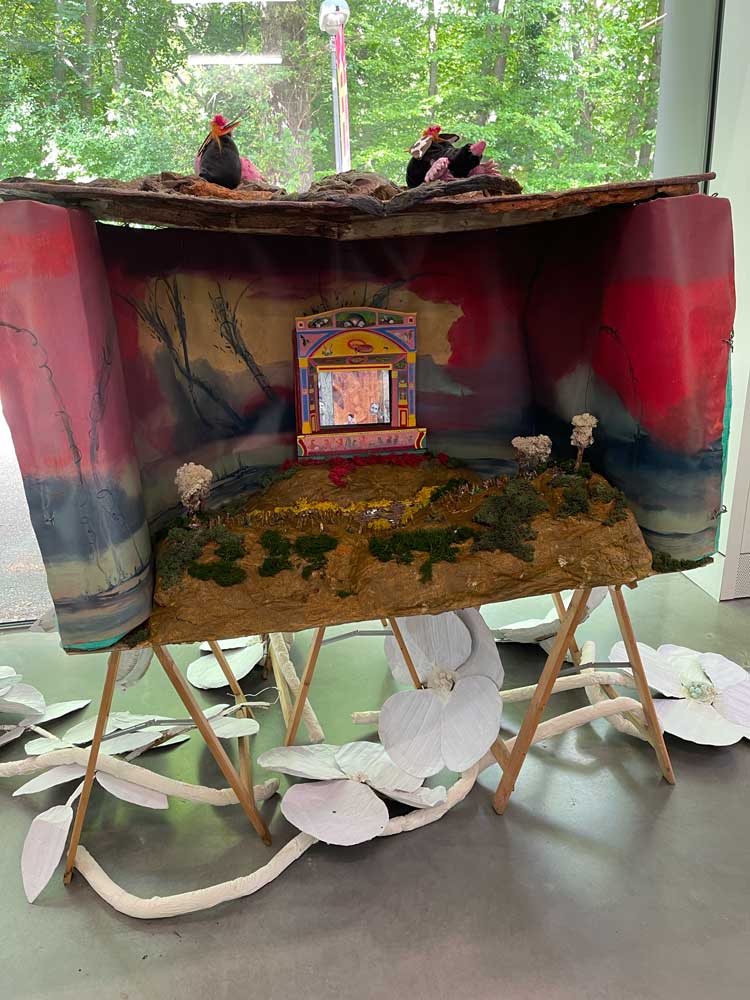
Monster Chetwynd, the Movie Palace Diorama in the libarary, Middelheim Museum, Antwerp, 2026. Photo: Veronica Simpson.
One final element made by Chetwynd remains: in the calm of the library building on the edge of the park, she has created a theatrical setting with a small TV screen at its centre – the Movie Palace. Here, films of the opening performances will be relayed to those who have been unable to see them. She says that, when she learned that many of the youngsters would not be able to cope with being at the performances: “I thought, that feels a bit wrong. We’re spending all this money for them. The Movie Palace Diorama was the answer.” Here, they can watch the performances and vicariously live the excitement of the opening weekend in the peace of this library.
Speaking to Chetwynd, many fascinating threads emerge about her life and how it informs her practice, including that her father was in the SAS,and that she turned down the chance to be at a Venice Biennale and also declines lucrative invitations if her instinct tells her the experience will not be rewarding. She likens that instinct to: “When you’re watching a nature programme and there’s a rabbit and a fox and the fox has some ability to know … like in an Arctic situation, that the body gain of eating it would be less than the energy loss of hunting it.”
I pick out that choice morsel – turning down the Venice Biennale – to highlight the fact that her work is not about the value of the thing (most of what she makes is highly perishable), it’s in the experience. She has no desire to collude with commodification of the art. “I’m not interested. I don’t have the logic of it.”
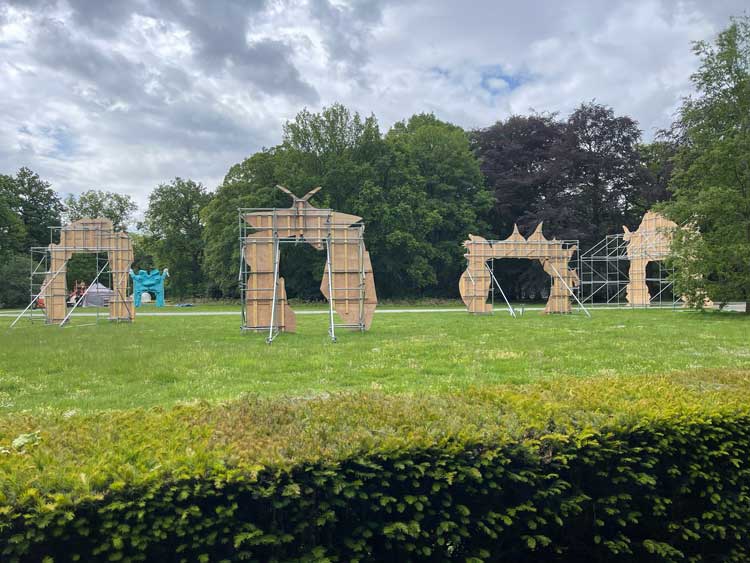
Exhibition view, Monster Chetwynd, A Friends Making Machine, Middelheim Museum, Antwerp, 2026. Photo: Veronica Simpson.
She puts this down to being “a natural risk-taker”. Her father’s work for the SAS clearly flags that up as a family trait. “He was going to Afghanistan and all sorts of places, and my brother and I were not with my mum – they were together, but she was also working. We were left with ‘safe families’, for example, with a Zoroastrian family in Karachi. It was amazing. When I told a Scottish friend of my ridiculously unconventional and unstable – but happy – childhood, they said my self-reliance is through the roof, and it has been, from when I was tiny. It does explain an awful lot … I don’t know how to put it, about my having a free attitude.”
Given this peripatetic upbringing, it figures that her imagination would become a place of refuge. But her family time was also rich and stimulating. “I am pretty sure we were cultural experiments,” she says. “My parents were absolutely determined that we would not be conservative, that we would be imaginative. We were obviously not nurtured very much, but when we did have contact, they would read to us incredible books. My mother read Orlando to us when we were tiny. They were never talking down to us. They read us Noël Coward. They were very ambitious with us … the sky’s the limit. Incredibly far-reaching. We did also live in a caravan (once). It was not economically … materialistic. But to be honest I’m very respectful and happy now.”
Chetwynd’s mother was often away on location. “She’s a set designer, a production designer. She’s been very successful – Oscar winning, Bafta winning, very cool, with 54 films to her name. She only retired two years ago.” To me, this makes perfect sense in the way Chetwynd builds worlds with her art – from settings to costumes to performances.
She is wary of the way she has suddenly found herself being labelled as an artist for children. “With the Tate Play and Copenhagen shows, for the first time in my life I was pushed into being seen as an artist for children. I love Edward Lear [but] I read that he ended up being marginalised by Victorian society as someone who makes drawings for children. There is a certain freedom within that, which I recognise. If I’m with children, I’m allowed to be myself. But I found within the last year, because I’m successful in this way, I’m a little bit pushed only to be a children’s artist. And that is uncomfortable. I want to do everything.”
She feels there is a different appreciation for set design in Europe in a way that is absent in Britain, recognising it as a serious art. “In Europe, people have a really different relationship with set design. It’s like a whole career, a whole other job.” Having relocated from Glasgow, where she lived for seven years, she is now based in Switzerland, where she teaches. This gives her the stability to pick projects according to her instincts rather than playing by the usual art world rules. “I know that I play the art world like a game. I love playing the game. And I don’t think of it as serious.
“I have friends who get totally caught up and so stressed and everything. And I’m having a lot of fun playing a game. And I’ve loved it right from the beginning, when I recognised it and thought I want to play this game.”
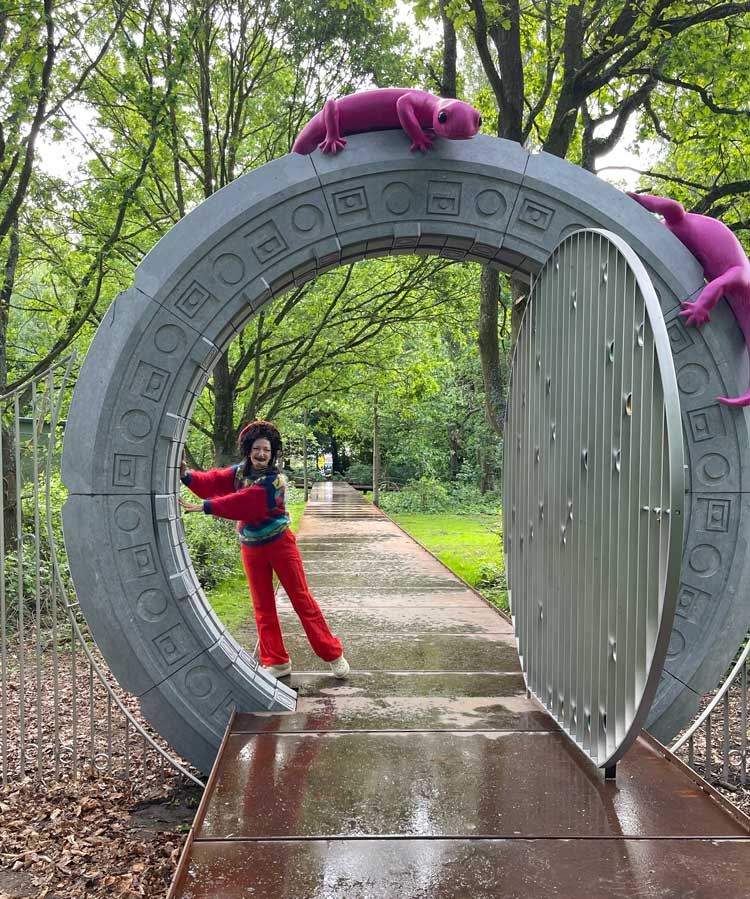
Monster Chetwynd posing with the Salamander Gate prior to the exhibition opening. Photo: Veronica Simpson.
Click on the pictures below to enlarge

Copyright © 1893–2026 Studio International Foundation.
The title Studio International is the property of the Studio International Foundation and, together with the content, are bound by copyright. All rights reserved.
 |
 |
 |
|---|

-18-300.jpg)
-300.jpg)
-Tate-(Larina-Fernandes)-(12-1000)-300.jpg)
 Jonathan Baldock – interview: ‘Weird is a word that’s often used to describe me. I like the use of that word, I’m reclaiming it and giving it power’
 Assemble + Schools of Tomorrow: The Place We Imagine
 Testament
 Marvin Gaye Chetwynd: 'But is it art? I don’t even care'
 Bloomberg New Contemporaries 2014