
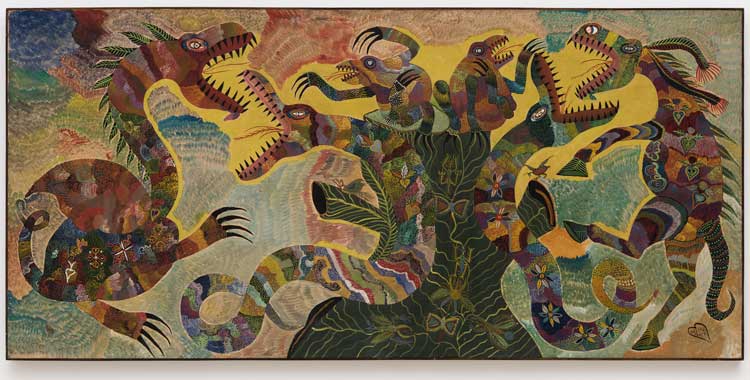
Chico da Silva (Francisco Domingos da Silva), Animais Fantásticos, 1973. Photo: Ding Musa, Courtesy Galatea.
Nottingham Contemporary
6 June – 6 September
by JOE LLOYD
The paintings of Chico da Silva – the first Indigenous Brazilian artist to garner international acclaim – offer a headlong rush into a fantastical Amazonian bestiary. Fauna and flora are rendered in intricate patterns and flamboyant colours, evoking a rainforest that seems located somewhere between reality and mythology, waking and dream. It is a world full of violence. Chico, as he is known, often shows unequal encounters between creatures, where one seems likely to snaffle down the other without mercy. A fearsome lizard extends its jaw to clamp down on a luminescent fish, while an aquatic bird with a writhing tentacle-like tail is about to crush the head of an insect. Animais Fantásticos (1973), the only named work in the exhibition, shows six apocalyptic beasts roar, hiss and croak at each other, on the edge of some cataclysmic battle.
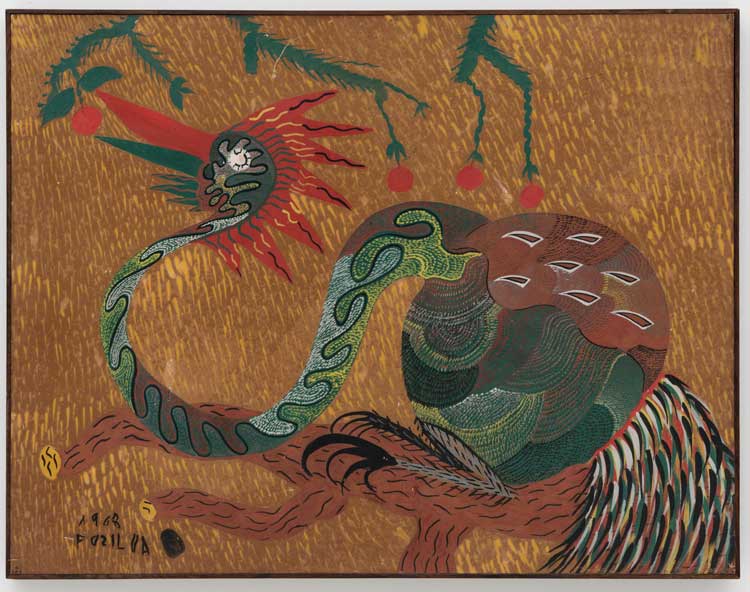
Chico da Silva (Francisco Domingos da Silva), Untitled, 1968. Photo: Ding Musa, Courtesy Galatea.
Chico’s story is equal parts astonishing and upsetting. Originally thought to have been born in 1910 but now believed be more than a decade younger, he grew up Francisco Domingos da Silva in Alto Tejo, deep in the rainforest. His father was an indigenous Peruvian, while his mother had moved inland to join the rubber extraction boom: a movement that led to horrendous crimes against native Amazonians. After his boatman father succumbed to a rattlesnake bite, Chico and his mother moved across the country to Fortaleza. Here, in the waterside favela Praia Formosa, he began drawing murals of birds on the walls of fishermen’s houses, using chalk, black charcoal and found objects such as bricks and leaves.
This might have remained his lot but for the arrival in 1943 of the Swiss painter and critic Jean-Pierre Chabloz. Chabloz bought Chico paint and canvases, introduced him to the local art scene and urged him to exhibit. Soon Chico became a feature of local group shows. Chabloz turned into his publicist, promoting Chico in Brazil and Switzerland. He also came to profit from it. Was Chabloz an enabler, an exploiter or both? According to an article published by the Independent Art Fair, Chabloz described Chico as “gloriously primitive, divinely illiterate and, above all, a wonderful artist”, tempering praise for Chico’s art with a stereotyped depiction of a noble savage, an atavistic remnant of a premodern world.
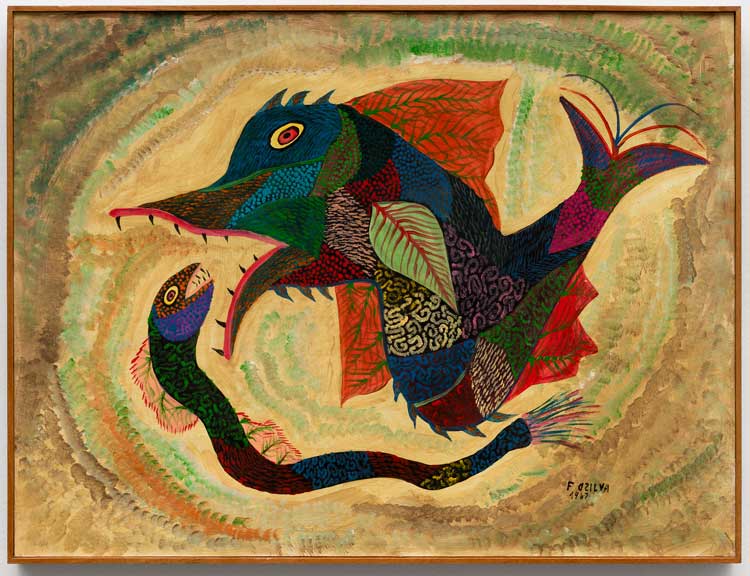
Chico da Silva (Francisco Domingos da Silva), Untitled, 1967. Photo: Ding Musa, Courtesy Galatea.
When the Swiss artist left Brazil in 1948, Chico lost access to materials and his practice slowed significantly. Chabloz returned in 1960 and soon found Chico a job painting murals at the art museum of the Federal University of Ceará. Things quickly picked up. In 1961, Chico had his first solo exhibition, in Rio de Janeiro. His work began to sell widely. In 1966, four of his works were included in the Brazilian exhibition at the 33rd Venice Biennale. He received an honourable mention; pavilion curator Clarival do Prado Valladares claimed that the judging panel might have given Brazil the Golden Lion if there had been more Chico works on show. The next year, Chico appeared in the São Paulo Biennial. About half the works in Nottingham Contemporary come from this heyday.
The art world giveth and the art world taketh away. Chico took on apprentices at his backyard workshop, which became known as the Pirambu School. Works by these followers came to circulate under his name. Chico’s reputation as a one-off faux-naif genius began to crumble. While New York cooed over Warhol’s adoption of mass production at the Factory, the idea of an indigenous Brazilian artist working with assistants threatened its “authenticity”. Work in the style of Chico began proliferating across the region. At one point it was reported that hundreds of people were producing and selling their own “Chicos”. In 1969, Chabloz publicly broke with him in a newspaper article presumptuously titled “The Rise and Fall of Chico da Silva”, in which he accused Chico of devaluing his own work, creatively and financially.
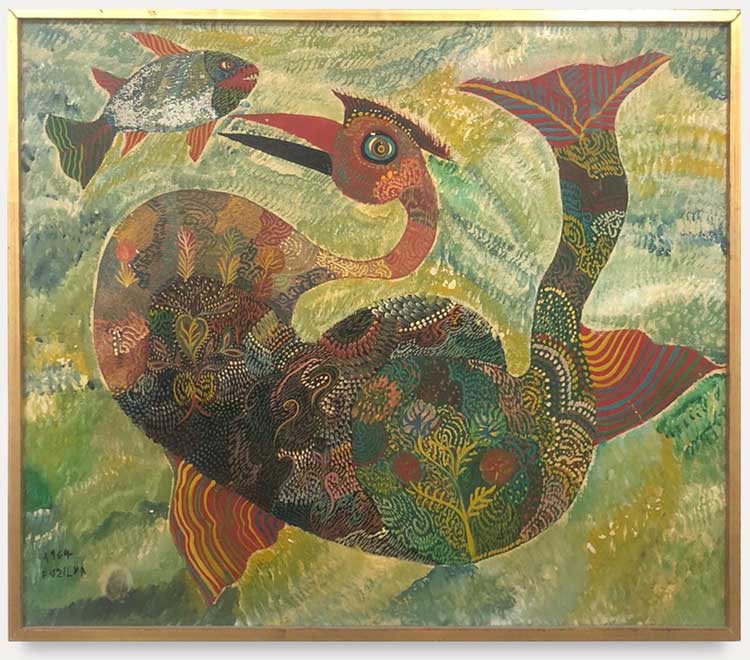
Chico da Silva (Francisco Domingos da Silva), Untitled, 1964. Photo: Ding Musa, Courtesy Galatea.
Chico continued to exhibit in Brazil, but his moment had passed. After a thrombosis in 1983, he died two years later, a destitute alcoholic. He was swiftly forgotten. The upswing has come only very recently, as part of a larger interest in Indigenous art. The Tate bought one of his paintings in 2022, while the Pinacoteca de São Paulo’s 2023 exhibition Chico da Silva and the Pirambu Studio was the most significant showcase in decades. And the soul is for the birds at Nottingham Contemporary is first solo exhibition of his work in a European institution.
Chico’s work demonstrates a Brazilian art far removed from the modernist experiments of his tropicalismo contemporaries. But it is not entirely without parallels to modern western painting. His dabs of paint bear similarity to the pointillism of Jean Metzinger (though not the more delicate patter of Seurat), but this application of paint serves a decorative, expressive purpose, rather than an exploration of light. The bright hues of his work call to mind fauvism and German expression, although similarly these strong colours appear inherent to the fantastical subject matter themselves rather than an emotional experience of reality. Chico works in the realms of metaphor and myth. Perhaps he is a spiritual cousin of the late-19th-century symbolists. A 1978 work sees a naked mermaid squat on a river shore – perhaps Iara, the pink-skinned siren of Brazilian mythology, known to ensnare men with her sweet voice. She is joined by a sharp-toothed monster fish, harpy-like chimeras and a small fleet of sailboats. The landscape seems to morph and stretch around her, underscoring that we are somewhere beyond conventional geographies.
This piece aside, there is a formula to many of the works represented here. Two or more creatures rendered in a patchwork of coruscating colours and elaborate patterns face off, above a background that may be a landscape or an abstract realm. Within this template there is a lot of variance. A 1967 depiction of a fish and a snake has a soft, watercolour-like background that resembles scales. Some of the patterns on the fish resemble leaves and branches, suggesting a correspondence between plant and animal life. Some of the monsters, such as a 1976 snail, have human-like eyes, compounding this interconnectivity. A 1968 piece sees a man appear to converse with a bizarre beetle/tortoise hybrid supported by delicate pink human feet: was this creature once a man? Whatever meanings lurk beneath, Chico’s appeal today largely rests with his distinctive approach to colour and texture – as well as what his story reveals about art world hypocrisies over Indigenous artists.
Click on the pictures below to enlarge

Copyright © 1893–2026 Studio International Foundation.
The title Studio International is the property of the Studio International Foundation and, together with the content, are bound by copyright. All rights reserved.
 |
 |
 |
|---|

-300.jpg)
-300.jpg)