




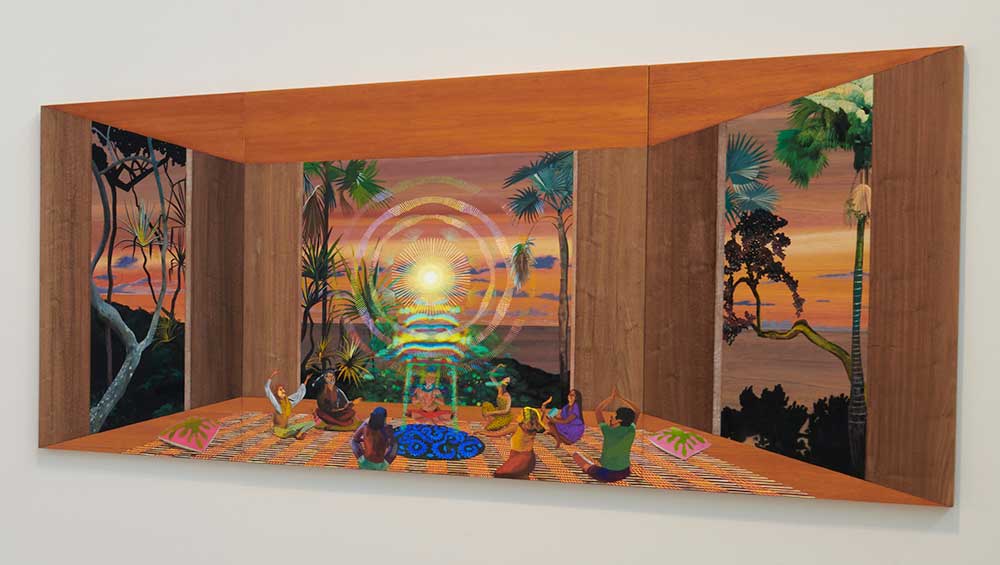
Hulda Guzmán: Please awake – asked Nature kindly, 2026. Installation view. Courtesy Turner Contemporary. Photo: Jo Underhill © Turner Contemporary.
Turner Contemporary, Margate
23 May – 13 September 2026
by DAVID TRIGG
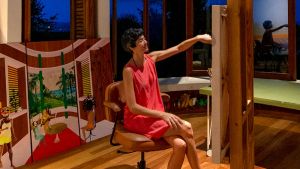
In Hulda Guzmán’s painting In the Studio (2022), a phantasmagorical cloud of blue paint erupts above the artist’s head, arcing towards a large canvas lying on the floor. Something magical, even supernatural, is occurring here, just as it seems to be in many of the Dominican painter’s vibrant works at Turner Contemporary, in her first European institutional solo exhibition. From mysterious interiors to majestic tropical landscapes, each piece draws us into a realm where the boundaries between inside and outside, and between the material and ethereal, become strangely porous. Drawing attention to what Guzmán describes as “dimensions of existence that remain unperceived”, her works are permeated by a sense of the fantastical yet are rooted in the lush topography of the Dominican Republic’s north-east coast.
Born and raised in the Dominican capital of Santo Domingo, Guzmán is now based on the Samaná Peninsula, where she works from a remote oval-shaped studio designed by her father, an architect, and surrounded by tropical forest. The studio’s large ceiling-height windows frame the surrounding landscape, bringing the outside into the modernist structure. This architecture has undoubtedly informed the many ambiguities between interior and exterior space found in the exhibition’s first room, where it is not always clear whether Guzmán’s hallucinatory landscapes are appearing through the windows of architectural settings or are painted on to their walls. Take Holy Visit (2021), in which two figures in a large, wood-panelled room seem to be worshipping another, unearthly figure, floating in a spectral landscape that fills an entire wall: is this a dream, a mystical encounter or are they admiring a giant mural?
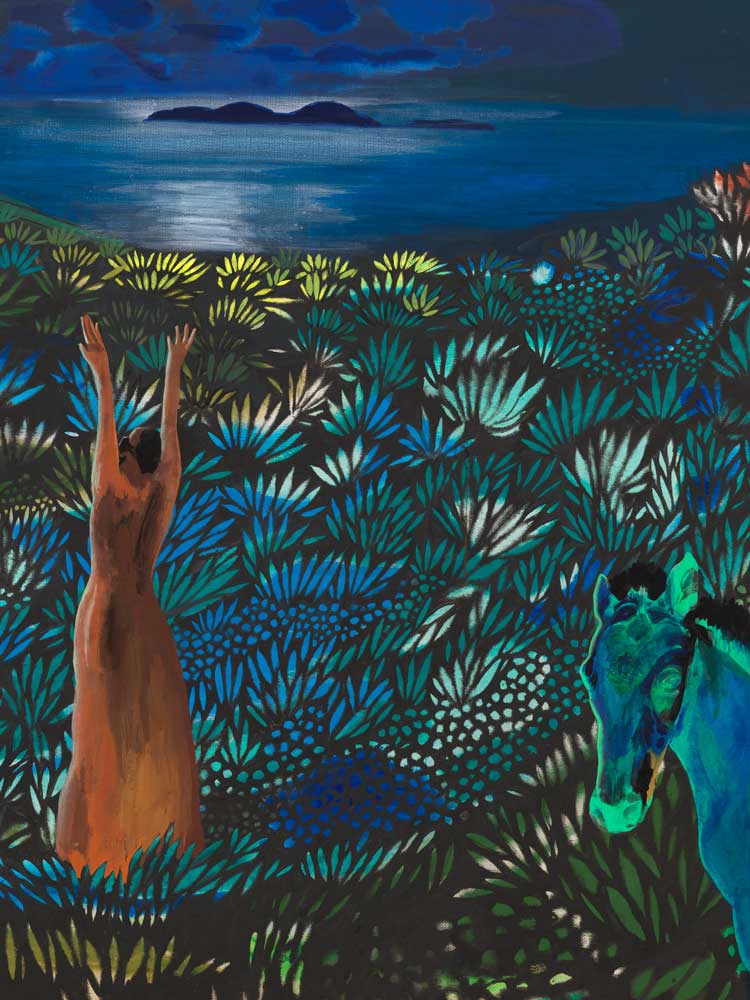
Hulda Guzmán, Avatara, 2023. Acrylic gouache on linen, 101.6 x 101.6 cm. © Hulda Guzmán. Courtesy of the artist and Alexander Berggruen, NY. Photo: Dario Lasagni.
The desire to live harmoniously and connect with nature is expressed throughout the show. In Core (2016), an ancient tree grows through a modernist building, intersecting hard-edged geometries with its gnarled trunk that stretches through an aperture in the roof. Elsewhere, figures engage directly with the landscape, swimming in lakes, climbing trees and gardening. In Lunar Gardening (2026), Guzmán races through the jungle on a motorcycle, carrying a palm tree to be planted by moonlight, while in The Veil is Thinning (2026), revellers dance amid palm trees beneath an otherworldly cloud. Elsewhere, in Avatara (2023), a figure loses herself in a moonlit coastal landscape. Again, there is the suggestion of a supernatural presence in the form of a glowing, amorphous vapour, rising from a verdant field like a will-o’-the-wisp.
,-2018.jpg "Hulda Guzmán, Be kind to your demons (Until next time), 2018. Acrylic gouache and acrylic ink on wood veneer on cedar plywood, 53.5 x 33 cm. © Hulda Guzmán. Courtesy of the artist and Alexander Berggruen, NY.")
Hulda Guzmán, Be kind to your demons (Until next time), 2018. Acrylic gouache and acrylic ink on wood veneer on cedar plywood, 53.5 x 33 cm. © Hulda Guzmán. Courtesy of the artist and Alexander Berggruen, NY.
In Guzmán’s pictures, the artist, her friends and family members frequently mingle with animals and chimerical creatures. The latter of these she calls “Demons”. In some works, they appear as benign entities, helping with gardening tasks, while elsewhere they are more threatening, invading the artist’s bedroom. Are these grotesque characters derived from Caribbean folk tales? Or are they ancient nature spirits? Perhaps they represent Jungian aspects of Guzmán’s psyche? Regardless, their presence points to an unseen world beyond materialistic rationalism, recalling the work of Hieronymus Bosch, as well as non-western traditions such as Mexican votive paintings and Persian and Indian miniatures.
Rarely are any of these figures main characters, however, for they are typically overshadowed by nature. Indeed, the natural world is never simply an exotic backdrop to the artist’s obscure narratives as it might be in the work of Henri Rousseau, whom Guzmán cites as an influence. Rather, it is an active, even sentient force. Throughout the exhibition, the tropical rainforest with its dramatic vistas and rich biodiversity is revealed as the true protagonist of these works.This is reflected by the exhibition’s title, taken from Guzmán’s 2019 painting “Please Awake” – Asked Nature Kindly. In this triptych, the artist reclines with her cat, her naked body bathed in a golden orange light as she gazes at a hazy night sky filled with two bright stars and a shooting comet. Adding to the scene’s surreality is a large luminous plant, a curious mushroom with a staring eye, and a strange, sausage-shaped cloud suggestive of a portal to another dimension.
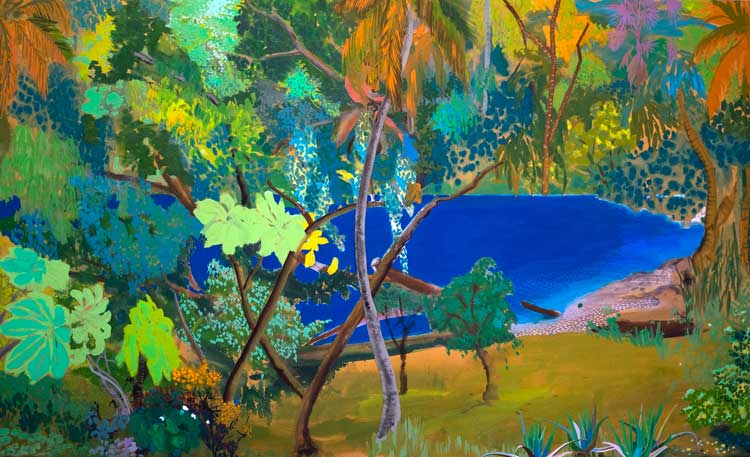
Hulda Guzmán, Fresa salvaje, 2021. Acrylic gouache on canvas, 75.2 x 122 cm. © Hulda Guzmán. Courtesy of the artist and Alexander Berggruen, NY.
Enamoured with the colours, shapes and textures encountered all around her, Guzmán sketches and paints vegetation from direct observation. It is therefore surprising to learn that her compositions are mapped out digitally with Photoshop before being committed to canvas. This collage-like approach, where imagery of nature is combined with personal and found photographs results in compositions characterised by shifting scales and perspectives, not to mention a range of expressive painterly styles and techniques. It is this mix of observation and imagination, along with their vibrant arrangements of colour and form, that give Guzmán’s paintings their uncanny allure.
Furthermore, her cut and paste sensibility alludes to the human tendency for managing and cultivating nature – an impulse that can lead to a harmonious, symbiotic existence with the environment or, conversely, exploitation and damage. At a time when the artist’s home country and its Caribbean neighbours are increasingly vulnerable to the ecological challenges of rising sea levels, deforestation and loss of biodiversity, her enigmatically joyous works simultaneously revel in the beauty of the natural world while revealing its vulnerability. They are a call for us to “awake” and attend to nature afresh.
Click on the pictures below to enlarge

Copyright © 1893–2026 Studio International Foundation.
The title Studio International is the property of the Studio International Foundation and, together with the content, are bound by copyright. All rights reserved.
 |
 |
 |
|---|
-300.jpg)
-300.jpg)

 Hulda Guzmán – interview: ‘I feel a little bad for the rest of the natural world, that it can't laugh’