




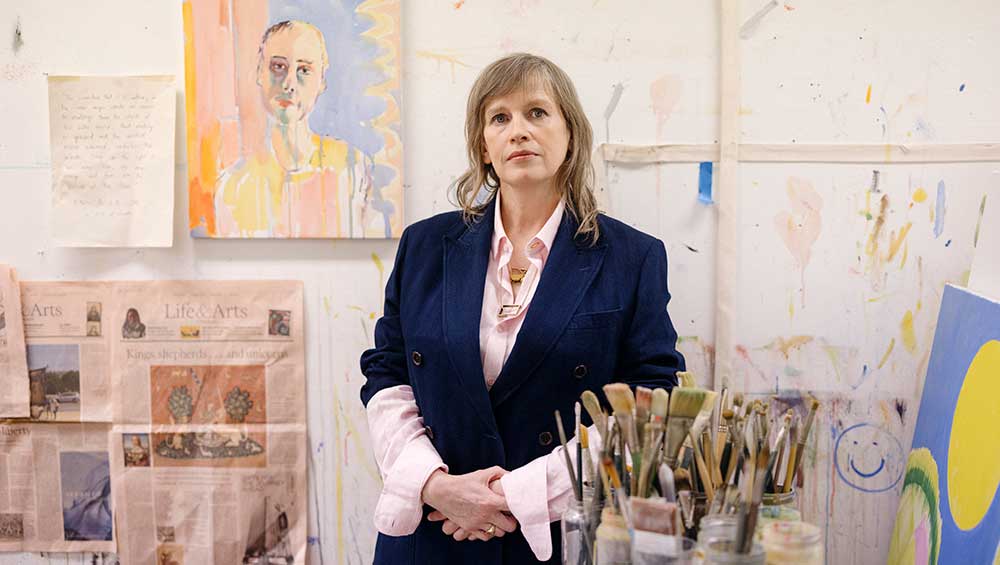
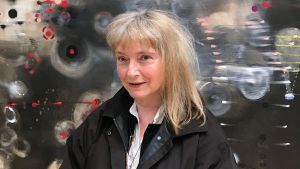
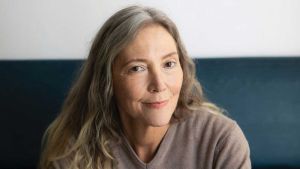
Isabel Nolan. Photo: Rich Gilligan.
by VERONICA SIMPSON
Spending an hour in the company of the Irish artist Isabel Nolan (b1974, Dublin) is like a deep dive in time, illuminated with visits from some of the key figures, events and forces – natural, scientific, religious - that have shaped our planet and our culture. She is fascinated by the imagery that has been used to educate/manipulate us over the centuries and seeks to “instrumentalise” it to conjure her own fables and mythologies, exploring who we are and how we got here, across photography, drawing, painting, tapestry, textiles, text and sculpture. The longer you spend in her company, the closer you get to the perspective she shares here, where “the real world becomes quite magical-looking and miraculous events become really kind of ordinary”.
My first encounter with Nolan’s work was the tapestry Deep Time Day, commissioned for the Irish Museum of Modern Art’s group show Take A Breath (2024), a rigorous exploration of the politics and poetics of the air we breathe. It was inspired by the “time before oxygen”, as she said at a talk for the show. “Around 2.4 to 2.1 billion years ago, the Earth was certainly toxic to the life forms that thrive on it now, humans included. Suddenly, oxygen became the dominant gas in the air.” The resulting arched tapestry is filled with movement: a whirling vortex of gases, in doomy tones of midnight blue, forest green and black, circle around a pulsating red and orange sun, while the oceans seethe below it. A major chemical event is clearly building here, though a positive (for us humans) outcome is perhaps hinted at by the yellow stars sparkling along the upper-left perimeter and the glowing, sunrise tones emerging across the landscape.
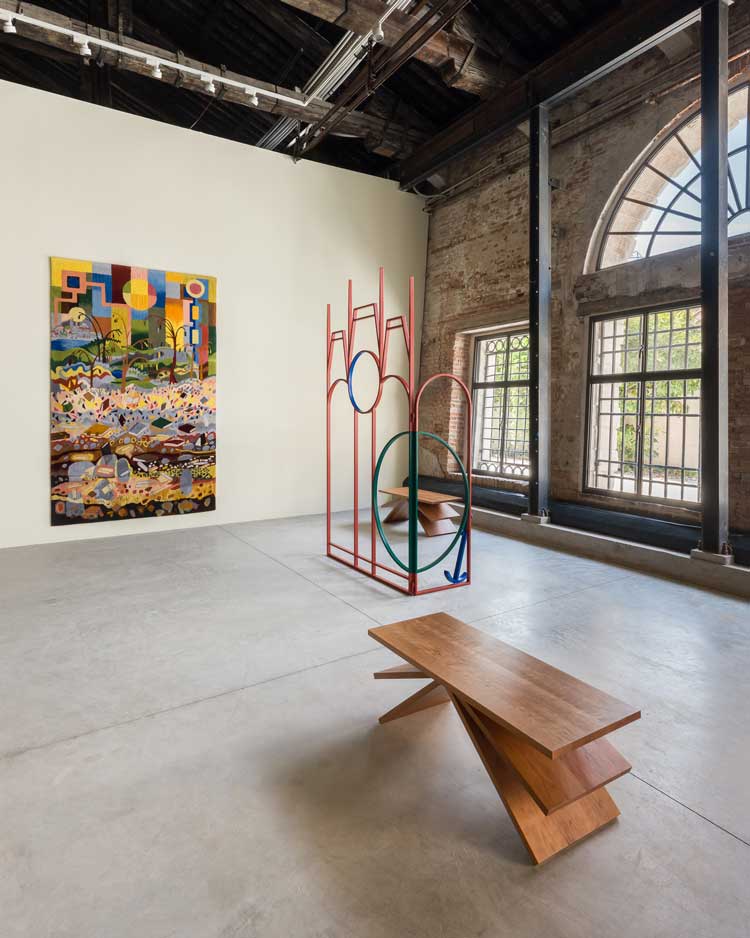
Isabel Nolan, Dreamshook, 2026. Installation view, Pavilion of Ireland, 61st International Art Exhibition, La Biennale di Venezia, 2026. Photo: Mark Blower. Courtesy of the artist and Kerlin Gallery, Dublin.
For Nolan’s Venice commission she delves into the history of the 15th-century Italian scholar Aldus Manutius (AKA Aldo Manuzio). Inspired by his classical studies in Rome, he set up the Aldine Press in Venice to share the ideas of leading, pre-Christian thinkers in their original Greek and in Latin translation; in this way, he was a key figure in the spread of humanist philosophy as a counterpoint to the prevailing Christian hegemony. His small books, enchiridia, are considered the precursors of the modern paperback. Nolan’s resulting installation, Dreamshook, features two richly coloured, finely wrought tapestries, plus sculptures and drawings.
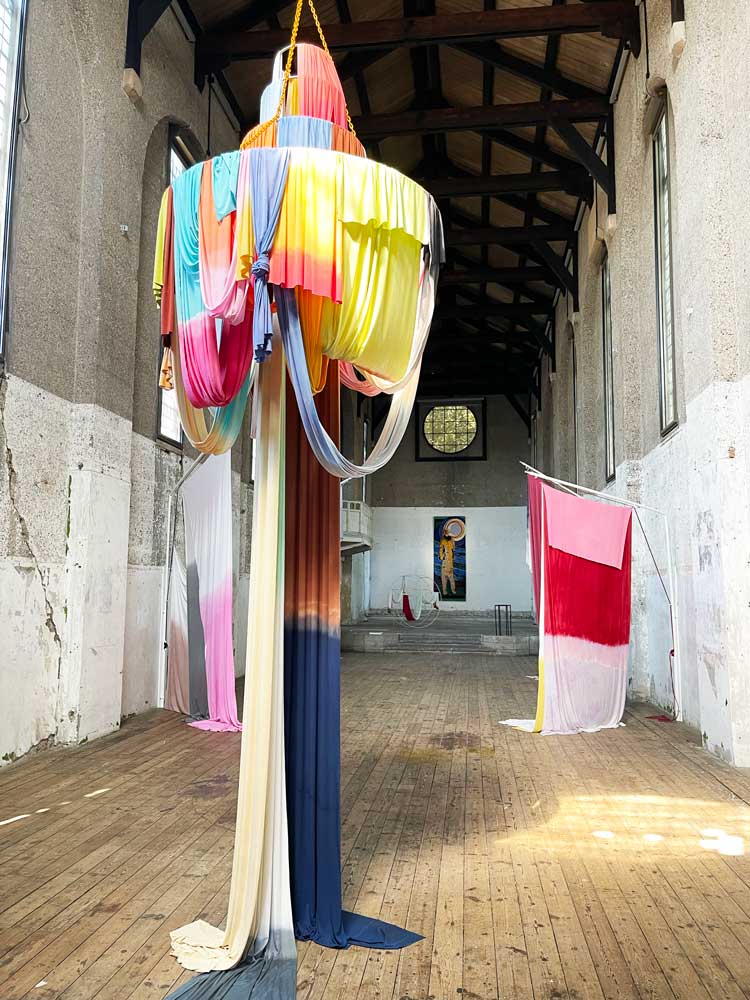
Isabel Nolan, The Light Poured Out of You, 2016. Mild steel, paint, dye, fabric, dye, 300 x 134 x 134 cm, installation view, Southwark Park Galleries. Photo: Veronica Simpson.
Closer to home, Some Fundamental Forces is a travelling show co-commissioned by Liverpool’s Bluecoat gallery and Southwark Park Galleries in London, which reveals traces of Nolan’s thinking and making over more than 20 years. In the London venue, the show is spread across the contemporary Lake Gallery and the Dilston Gallery, the latter housed in a restored church built originally in 1911 as a mission church “to improve the souls of Bermondsey”. Colourful and eccentric flags draped along the nave on bent flagpoles are from Nolan’s 2015 show at the Kerlin Gallery, Dublin. Called Bent Knees Are a Give, it was inspired by the bony, bent knees of the marble statue of the poet and cleric John Donne, in St Paul’s Cathedral, London. Nolan’s photograph of the statue is included here as a poster, with an essay on the reverse that is well worth reading – she can extrapolate a lot from the angle and pose of a knee.
-(Self-portrait)-Pic-V-Simpson.jpg "Isabel Nolan, Mirror, 2005. Coloured pencil on paper, 29.5 x 41.5 cm, installation view, Southwark Park Galleries. Photo: Veronica Simpson.")
Isabel Nolan, Mirror, 2005. Coloured pencil on paper, 29.5 x 41.5 cm, installation view, Southwark Park Galleries. Photo: Veronica Simpson.
The oldest work is a drawn self-portrait (Mirror, 2005). It sits in a corner of the lakeside site, side-eyed by Nolan’s portrait of Tony Soprano, the fictional mafia boss from the hit HBO series. At the preview, Nolan admits to having had a crush on this hugely problematic man: “He’s a gang boss, a psychopath. And he really hates art and yet I really fancied him. So, I punished him by placing him in the Kunsthistorisches Museum in Vienna – an incredible place, full of suffering, full of incredible work by incredible craftspeople, many of whom are not even credited.” His satanic allure is expressed in his unhealthy, ruddy cheeks, the way his black suit bleeds off the page; his furtive, sideways gaze, which determinedly avoids the golden light of the domed window above his head.
There is a Tony Soprano sketch also in the Dilston chapel. And Nolan’s preoccupation with feet is visible in both spaces – photographs of pedestrian feet on pavements, of supine marble statues of kings and bishops placed feet forward, the paws and hooves of animals. And we see another enduring figure: the Löwenmensch (lion man), the earliest known figurative sculpture (carved from a mammoth tusk 40,000 years ago, it is part of the British Museum collection). Part animal, part human, it appears here in a featherlight drawing in the Lake Gallery, and as a richly coloured tufted rug, rendered larger than life and placed in the chapel where once a crucifix no doubt stood.
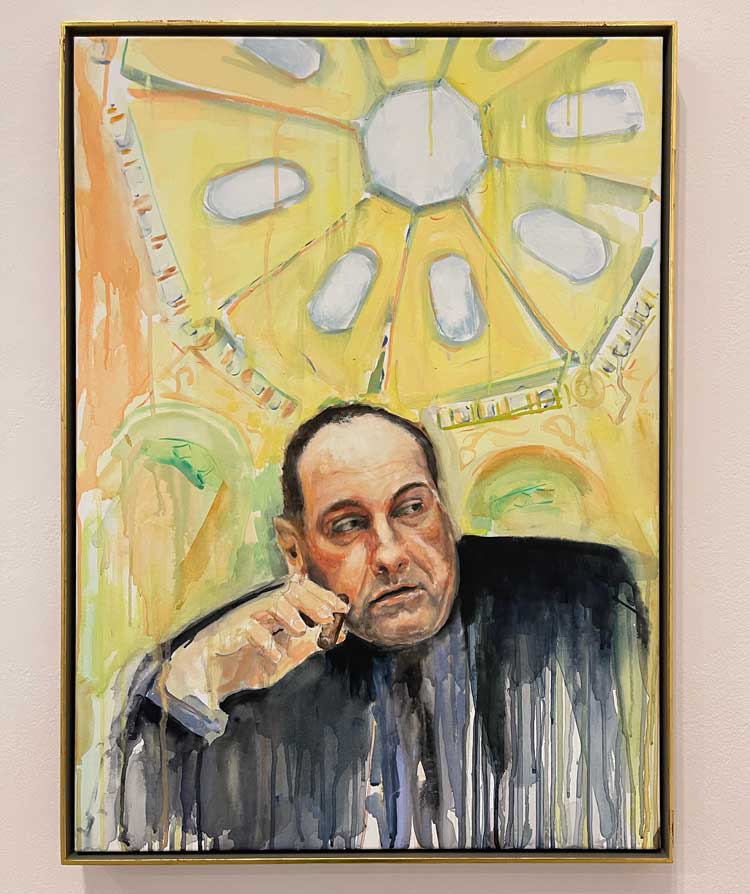
Tony Soprano at the Kunsthistorisches Museum, 2017. Water-based oil paint on canvas, installation view, Southwark Park Galleries. Photo: Veronica Simpson.
In reference to pulling together all these pieces for the show, Nolan said at the preview: “Sometimes you can think you are just making the same work over and over again, and returning to the same tropes. And it’s been so gratifying over the last two weeks to realise that there are some through lines.” Those through lines she summarises as: “a preoccupation with European culture. Objects that I have loved. Things that have been made from Greek civilisation and before, through to the Renaissance. I fell in love with these things and then realised that they have all been made by dead white patriarchs who wouldn’t piss on me if I was on fire – being a woman and a peasant from Ireland, to boot.”
She concluded: “I am the algorithm that brings all these works together. Between love and hate, high and low culture, the death of the sun. It’s a tiny microcosm of being in the world.”
Nolan studied at the National College of Art and Design in Dublin and the Dún Laoghaire Institute of Art, Design and Technology. She featured recently in the 13th Liverpool Biennial (2025). She has had many solo shows, including at: Kunst-Station Sakt Peter Köln, Cologne, Germany (2025); Chateau La Coste, France (2023); Void Gallery, Derry, Northern Ireland (2022); Solstice Arts Centre, Navan, Ireland (2021); Kunstverein Langenhagen, Germany (2018); London Mithraeum Bloomberg Space, London (2017); and the Douglas Hyde Gallery, Dublin (2017). She is represented by Kerlin gallery in Dublin.
Studio International interviewed the artist in person at the opening of her London show.
Veronica Simpson: The Venice presentation sounds fascinating. What was it like landing that commission, representing your country on this global stage?
Isabel Nolan: I think that’s such an abstract idea. It sounds very concrete, but there isn’t a lot to get hold of in the sense of what does it mean to represent your country. It’s an opportunity to make a substantial exhibition. You get funding and support for a project that will have a huge international audience. That’s the primary capacity that it offers.
The idea of Venice as this trophy, this reward, this mirage of art world success is not something that it’s wise to take on, in terms of my own mental health.
I was as focused as I could be on the exhibition. I worked with brilliant people who facilitated it all. What is lovely is that you have this huge community of interest behind you. And people are really invested. They want it to be good. And other people wanted the gig and you got it. So, you really should do a good job.
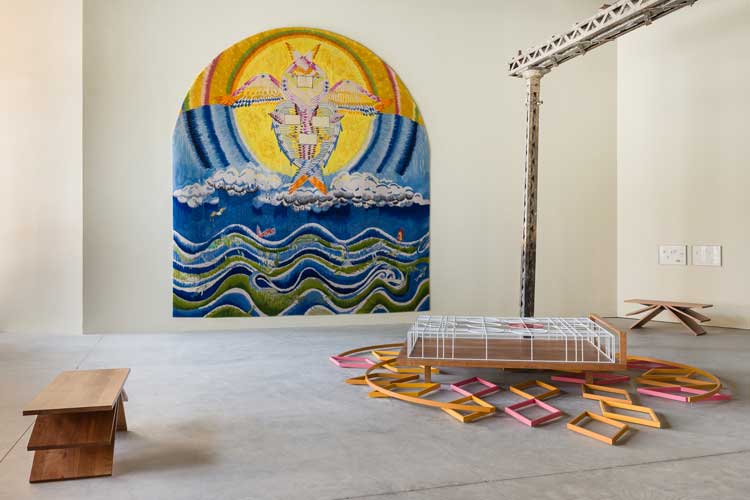
Isabel Nolan, Dreamshook, 2026. Installation view, Pavilion of Ireland, 61st International Art Exhibition, La Biennale di Venezia, 2026. Photo: Mark Blower. Courtesy of the artist and Kerlin Gallery, Dublin.
VS: Until I read about your installation, I had never heard of the printer who inspired the Venice work, Aldus Manutius?
IN: He’s super-famous in book history world. I had read something about him in the London Review of Books and realised he worked in Venice so that was kind of perfect. I became completely preoccupied with him and what he was doing against the backdrop of the times. It feels as if there is a real resonance with that late middle ages moment, with transformative technologies, a lot of turbulence in world politics. [The late middle ages were characterised by protracted wars, the Great Famine, the Black Death and the western schism in the Catholic church].
It really feels, with AI and large language models emerging, that our understanding of ourselves as a species is undergoing a change. And it’s strange and alarming – and maybe exciting for some people – to witness it. But, initially, I thought his was a beautiful story: he wanted to share the great works of Greek literature and philosophy and he believed that this would make the world a better place. It was that moment of humanism emerging in a time when there was a crisis of authority.
Manutius wanted to find a way to reclaim all of that lost teaching and learning and practical philosophy that is dedicated to the idea of humans having the capacity to better themselves and to live in a moral way for reasons that are not to do with either abiding by Christian convention, or – a huge preoccupation for people then – getting into heaven. It changes the nature of how we understand ourselves as humans if we think that we have a kind of agency, that whether we go to heaven or not is irrelevant. That we should aim to be smart, kind, informed, decent, moral people, because that’s a valuable thing to be in and of itself. This is the role someone like Aldus would have played for being responsible for the spread of the humanities in Europe.
.-Dilston-chapel-Pic-V-Simpson.jpg "Isabel Nolan, Soft thinking in tall places, 2015, installation view, Southwark Park Galleries. Photo: Veronica Simpson.")
Isabel Nolan, Soft thinking in tall places, 2015, installation view, Southwark Park Galleries. Photo: Veronica Simpson.
VS: How does one go about representing such complexity in a tapestry?
IN: Of course, I can’t take all that on. I’m not interested in representing research. It’s always a question of what’s the beautiful story here. And what I found to be the beautiful story is quite a dry story, about a man in his 40s deciding to set up a print shop in Venice. He has this vision of being a publisher and having an ideology and making the books available to as many people as possible by making the books small.
I was also thinking of the art in that period, which is similarly going through a transformation, leaving the gothic and the abstract and symbolism and becoming something that has much more humanity in it, and much more feeling.
I was so charmed, in a really deep way, by the art of that period. When I see these narratives of the lives of the saints, they are brought to life in a way that borders on being slightly cartoon like, but it’s also slightly magical. It’s represented in this everyday way: simple stories, often whole stories told across one picture plane, set within these absolutely jewel-like cities or beautiful, strange landscapes. I find it a paradox where the real world becomes quite magical-looking and miraculous events become kind of ordinary. I wanted to make a version of that for Manutius. To combine this idea, to represent his probably slow and thoughtful decision-making as a dream narrative (in the tapestry titled Make Haste Slowly, 2026). There’s this moment, annunciation style, where a muse is visiting him in a dream and bringing him all these scrolls and classical texts, and proposing that he release them into the world, and this is where they become these small, winged books, flying out of Aldus’s hands and into the world.
The other tapestry is slightly a follow-on, thinking about that relationship between humanism and Christianity. That beautiful moment of humanism takes us on to the enlightenment, the scientific method. And as I said earlier, it’s still a world dominated by white, male, wealthy patriarchs. This is why I decided to use the image of a seraphim – which you find in all these cathedrals. Here, it’s like a monstrous image of Christianity, glorifying certain books and holding them up in front of the sun. And beneath them, in the waves, there are all these other books that are drowning. I was thinking of Goya’s etching, The Sleep of Reason Produces Monsters, so I called it The Dreams of Reason Produce Monsters (the Seraphim of the Canon). As much as there’s a beauty in that moment there are all these consequences – such as the creation of the canon, which is very hierarchical, very exclusionary.
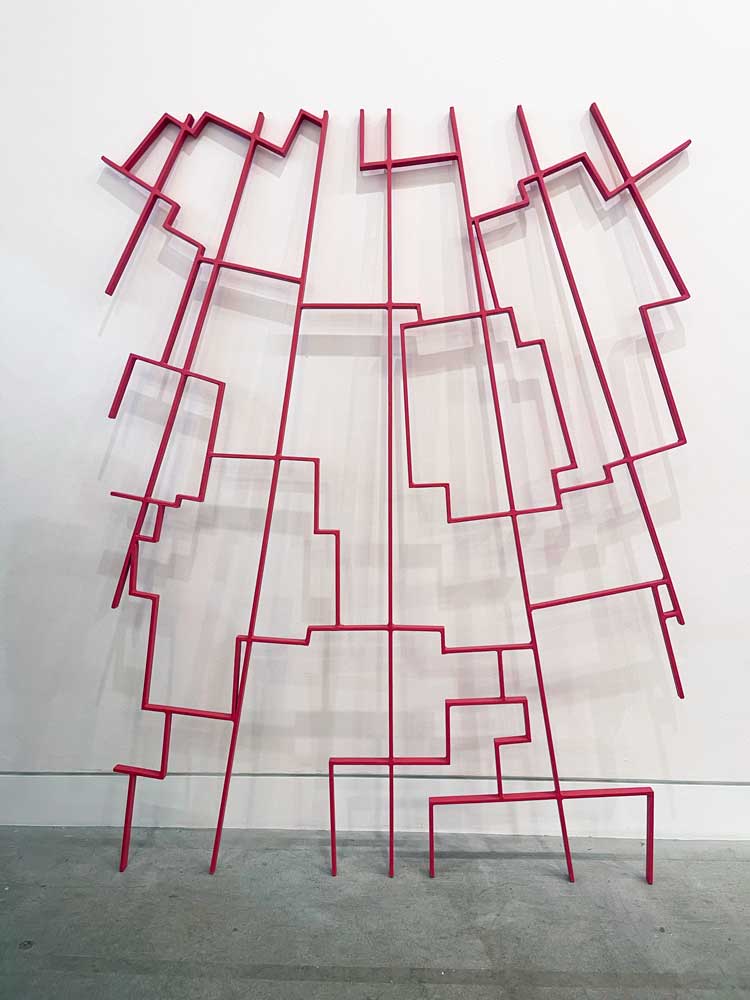
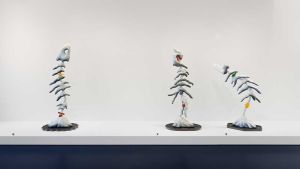
Isabel Nolan, Somewhere between Andromeda and Vulpecula. Sky Atlas, 2014, installation view, Southwark Park Galleries. Photo: Veronica Simpson.
VS: What role do the sculptures play in that Venice installation?
IN: I had been thinking about using the architecture of theatre, as a space that has an on-stage and an off-stage and an audience. It slowly transformed into wanting the space to feel a little continuous with the city. We made lots of models in the studio, and ended up with a rectangular platform that could look like a bed, but it’s a bed you can’t sleep in. And there’s a mattress-like steel form and a very regular symmetrical steel, open-form box that was taken from a page from The Book of Kells. I like weaving these motifs in in a different way. It has this floor that’s fragmenting and falling apart around it. That’s the piece that’s titled Dreamshook. I’m not sure whether it’s Manutius being shaken by this beautiful dream I’ve envisaged on his behalf or whether it’s me waking up in a panic because the world is on fire.
Also, we wanted to have this flowing curtain form, this dramatic gesture to the space, like a gust of wind. Is it coming from the arrival of the muse in the dream, or is it from the shaking of the current world? I’m just interested in using sculpture to interrupt space in a playful way and activate it. There’s a small selection of drawings. You have the grandeur of the tapestries and then these more intimate small drawing moments where you’re enclosed by the different sculptures, and then this taller work, like a screen you might find in a domestic space, which is based on a frame you might find in a Renaissance painting. But it’s quietly triumphal, holding its ground within the space and echoing the architecture you might find in Venice – though it probably nods to the architecture I’d seen in Italian paintings more than the architecture you see in the city.
-pic-V-Simpson.jpg "Isabel Nolan, Hungry & Thirsty. Sorry and Angry. A flag for John Donne, 2015, installation view, Southwark Park Galleries. Photo: Veronica Simpson.")
Isabel Nolan, Hungry & Thirsty. Sorry and Angry. A flag for John Donne, 2015, installation view, Southwark Park Galleries. Photo: Veronica Simpson.
VS: In London you have two very, different contrasting spaces here. I loved your use of the bent flags along the nave of the Dilston Gallery, and the colours you have used in them. I am really intrigued by your use of colour. There is that first “chandelier” work with glorious, stained-glass tones, tumbling from the heavens, and then the bent flags, which are more muted: greys and lilacs and pinks, with occasional splashes of blue and red.
IN: With the flags, they’re such straightforward symbols of some kind of religious order or military organisation or country. What they do is supposed to be very straightforward. They communicate an identity and a spirit and they claim ground. I wanted to make flags that were just wrong in every way I could think of. We introduced these dramatic bends, and in the world of vexillology, a flag should never touch the ground, they should never be knotted. I thought they should be as gaudy and layered and as unreproducible as possible. I have a real penchant for things that are of the world but also fail to inhabit the world in ways in which we expect them to or want them to. The colour in terms of decision-making is often very intuitive. The John Donne flag (Hungry & Thirsty, Sorry and Angry, A flag for John Donne, 2015) is a little more austere. Some are more ridiculous. One, Fresh Disorder Diminishing Energy (2015), I think of as the tequila sunrise, with a melting yellow blobby circle on it, on this awful tie-dyed background.
I used a slightly heavier fabric where I wanted to have a plaiting or unveiling of these splits coming together. I get an idea in my head, but then the process of making it is very intuitive, and I absolutely trust that, and give in to it. Colour is the thing I find hard to talk about, it is very intuitive. It is to do with the energy of things, making things pop.
VS: There is a vocabulary of colour you are drawing on, however. When I think of the Deep Time Day work at the Irish Museum of Modern Art, there’s a stained-glass intensity to the colours and geometries of that piece. And a medieval manuscript quality to the textile works in Venice.
IN: I look at medieval manuscripts a lot. The very first tapestry I made, I was thinking of The Book of Kells and about stained glass. I also think it is to do with abstracting them from the everyday world, and making them look like art. I’m saying: this is not a real flag, this is not a real bed, this is not the real world. Even the paintings, they’re not real people. Maybe it acts as an amplifier of the fictionality and the instability of these things.
VS: After the intensity of completing the Venice commission, you said it has been gratifying to take a step back and look at these threads running through your work over time.
IN: Yeah, it’s been a good year (laughs). Both moments have made me nervous, which I think is good. And I can have all the confidence in the world, but I’m happy to have a crisis every now and again. But I am proud – if that’s not weird to say – of the consistency within the work, the qualities that matter to me. They talk to each other. It’s like bringing together a big pile of friends and they all get on in ways that, before the event, you’re not quite sure will make sense.
There are moments of tenderness with moments that are tougher, moments that are funny with faux and failed grandeur, which I really got to lean into with the Dilston space.
VS: In the chapel, there are some great interactions between the recurring circles – the suns – in your work and the circular windows and skylights in the building.
IN: Yes, it’s a very longstanding preoccupation with the sun. I don’t have affection for the sun. I am mostly made angry by the sun. A bit obsessed with it. A kind of hostility. I am becoming a bit more reconciled to it as I age. It’s hegemonic.
•Isabel Nolan: Some Fundamental Forces is at Southwark Park Galleries, London, until 1 November. A co-commission with Bluecoat, Liverpool, it will open in Liverpool in 2027. Dreamshook is in the Irish Pavilion, at the 61st Venice Biennale, which runs until 22 November.
-Dilston-chapel-Pic-V-Simpson.jpg "Isabel Nolan, The Light Poured Out Of You, 2016 (detail), installation view, Southwark Park Galleries. Photo: Veronica Simpson.")
Isabel Nolan, The Light Poured Out Of You, 2016 (detail), installation view, Southwark Park Galleries. Photo: Veronica Simpson.
Click on the pictures below to enlarge

Copyright © 1893–2026 Studio International Foundation.
The title Studio International is the property of the Studio International Foundation and, together with the content, are bound by copyright. All rights reserved.
 |
 |
 |
|---|
-300.jpg)
-300.jpg)