




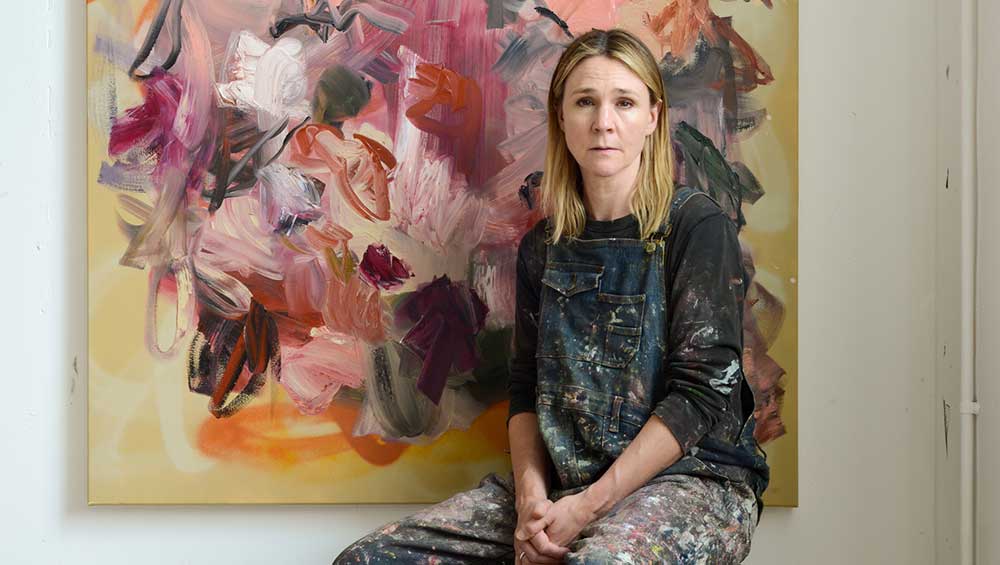
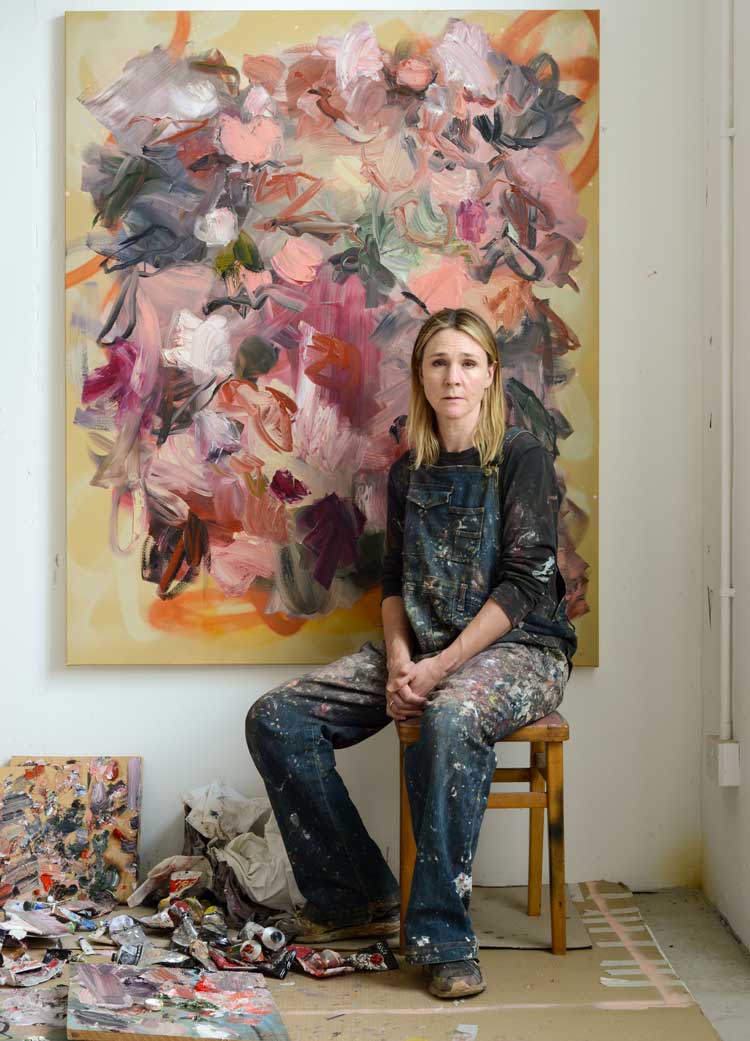
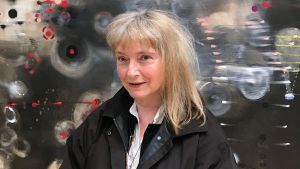
Miranda Boulton. Photo: Dan Boulton.
by ANNA McNAY
At its simplest, Miranda Boulton (b1973, Cambridge) paints flowers; in a little more depth, her abstracted paintings deal with questions of memory and time. Using the process of slow-looking, she spends hours with other artists’ floral still-lifes, absorbing them and committing them to memory. Then she settles down to paint, allowing memories of the work(s) she studied to intermingle with things that happened that morning and thoughts running through her mind. The output is series after series of vibrant works, some where the subject matter is more apparent than others. The works on paper are freer and more experimental, heavy under the weight of so much paint. The canvases seem tighter, more considered, but riotous nevertheless.
For her first institutional exhibition, Boulton studied the works of Eloise Harriet Stannard and Emily Stannard, two 19th-century painters and prominent members of the Norwich Society of Artists. Discovering their shared inspirations, Boulton followed in Emily’s footsteps with a trip to Amsterdam, where she studied the works of Jan van Huysum in the Rijksmuseum. Although not shown together with Boulton’s, the Stannards’ pictures have been brought out of storage and are on display in another gallery at Norwich Castle, creating, as Boulton puts it – and has titled her show – a Chain of Flowers.
Anna McNay: Tell me about Emily and Eloise Stannard. Who were they, and why are they of interest to you?
Miranda Boulton: About five years ago, I was researching floral still-life painting, and I was looking at Germaine Greer’s book The Obstacle Race. She has a chapter on floral still-lifes and feminism, and she mentions the Stannards. Emily is the aunt, and Eloise Harriet is her niece. I started to research them, and I discovered the Norwich Society of Artists, and found out what a prolific school it was in the 19th century. I learned that there were paintings here in the collection [at Norwich Castle], so I came and met with the curator, Georgia Bottinelli, who showed me the paintings, which were in the stores at the time. Two have since been restored, and they have been brought out to coincide with my exhibition. It’s been lovely to work with the collection and shine a light on this very specific subject within the works.
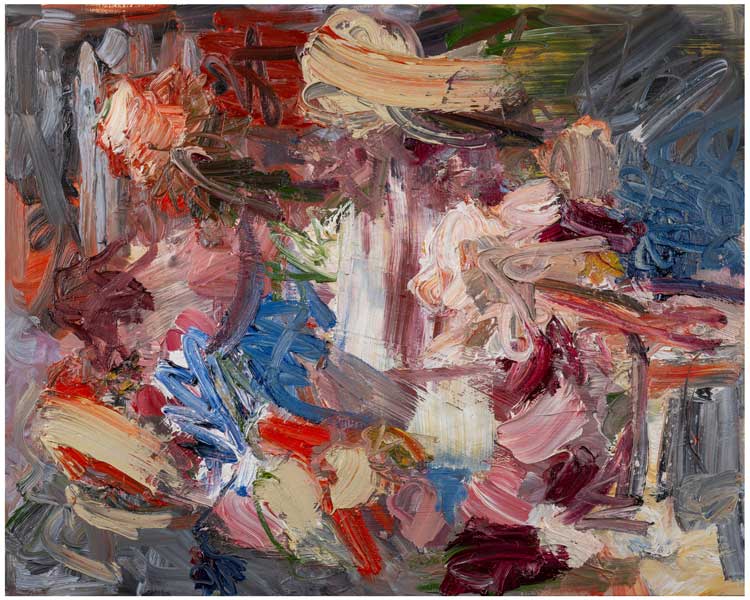
Miranda Boulton, Time & Tide, 2025. Oil and acrylic spray paint on canvas, 76 x 61cm. Image courtesy of the artist and Patricia Fleming Gallery. Photo: David Kirkham.
I have a process I have developed over the years when I spend time with paintings slow looking. I try to do it in real life as much as possible, but, with these works, because they were in the stores, I spent a little bit of time there, took photos, and then spent more time really absorbing the images online. Then I paint from memories of the works. We had a big discussion before the exhibition was put together about whether to put the Stannards’ paintings within the exhibition itself, but, because my work is about layers of memory and as much about forgetting as remembering, we ultimately decided to leave them apart, but we put up wall texts so that people realised the link – the chain of flowers.
It’s interesting for me as I was born in Cambridge, grew up in Ipswich and came to Norwich quite often as a girl. Norfolk, Suffolk, you know, it’s this localised history. I think the older you get, the more you look back at your childhood and your locality, and it makes more sense. It feels like there’s a beautiful synergy to this project.
AMc: Emily went on a trip to Amsterdam, and I believe you have retraced her steps.
MB: Yes, something else interesting that I found we have in common, when I was researching Emily, was that we have the shared influence of the Dutch still-life painters. I found out that she went over to the Netherlands in 1820. She went to the Prince William V in The Hague, and then on to the Rijksmuseum, which was in the historic Trippenhuis at the time, before it moved to its current location, but it still had an amazing collection. She got permission to make copies of Jan van Huysum’s paintings in the Rijksmuseum, and the director at the time praised her work. I was amazed because I knew Van Huysum’s work. It was more Rachel Ruysch that I had worked from, but I’m very aware of Van Huysum. The title of my exhibition, Chain of Flowers, references these influences that flow through the generations.
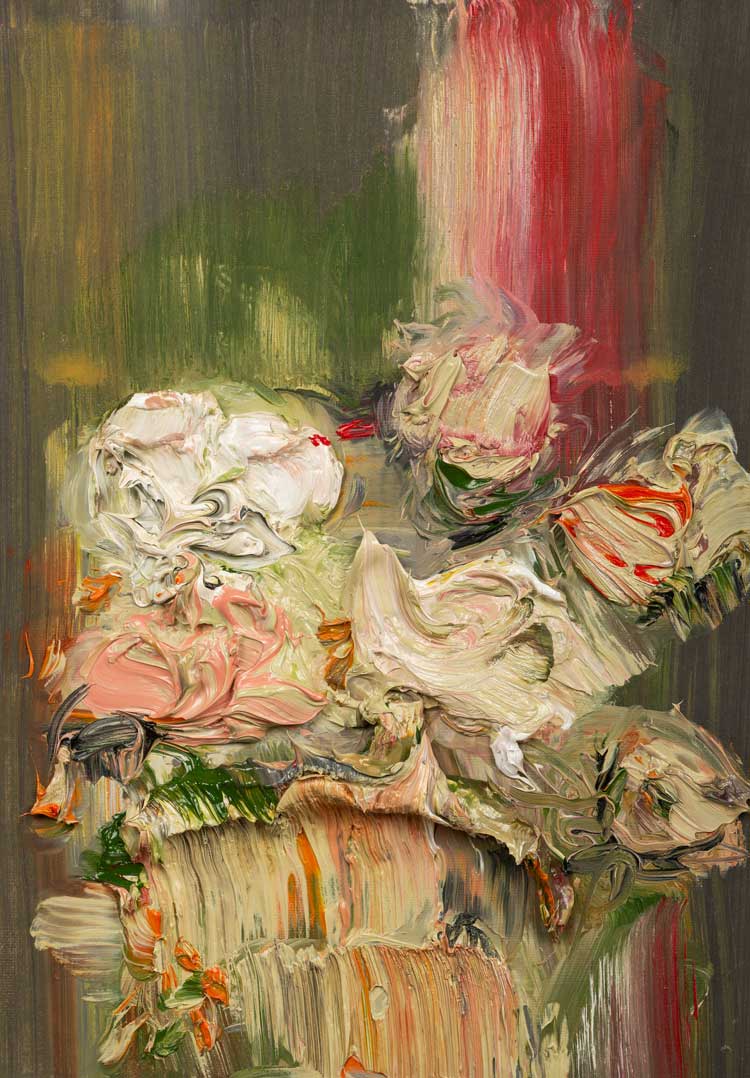
Miranda Boulton, Rebel Flowers 2, 2025. Oil on paper, 25 x 18.5cm. Image courtesy of the artist and Patricia Fleming Gallery. Photo: David Kirkham.
Before I started this body of work, I went to Amsterdam and spent a lot of time slow looking in the Rijksmuseum. I was there for a week and spent about two or three hours staring at different paintings, and it felt amazing. It’s quite a meditative experience, and I think it has really affected how I paint as well. The memories are both very clear and very hazy, and that’s kind of the point. It’s about trying to express how memory works, and how we remember things, and how what you have been doing the morning before a painting session can affect it as much as the memory you’re trying to pull up. It’s the fluidity, the messiness, that I’m really trying to pull out within the mark-making.
AMc: Broad brush, your work deals with ideas of memory and time.
MB: When you are painting, you are literally marking space in time. I think about how the surface of a painting takes time to digest. They’re like time capsules. What you see initially, you will never see again, because your eyes will start to read the painting and unpick it, and you will bring your subjectivity to it. I absolutely adore this about painting, the immediate response you never get again. It makes sense to me to spend time looking at something and then slowly making it. It’s the antithesis of the world we live in; it’s the slowing down and consideration that painting allows.
I often think of my paintings as timelines or intrigue: they build up layers over time, so they give over time as well. I suppose it’s all these bits that come together in my process when I paint, which is quite instinctive, intuitive, spontaneous. It takes me about half an hour to get to a place where I’m really flowing, responding to the marks, and I don’t really want to be aware of what I’m doing. I want it to be a very instinctual experience. I think of it as going underwater and coming up and seeing what you’ve done, and then you dive back in again, and then it’s a dance between those two opposites.
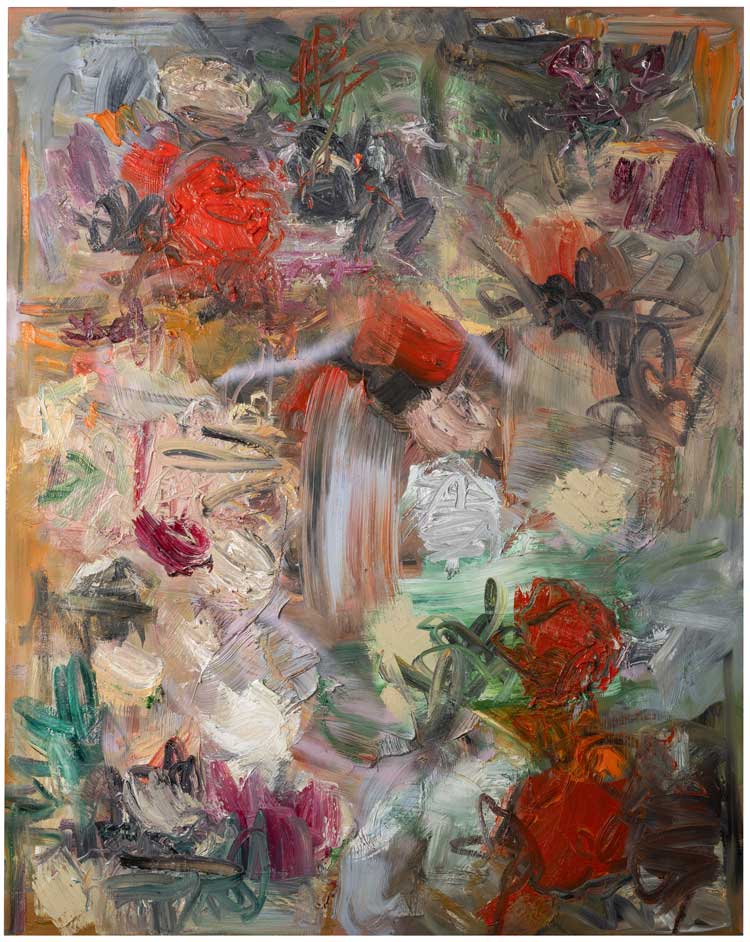
Miranda Boulton, Wild Flower Riot, 2025. Oil and acrylic spray paint on canvas,150 x 120 cm. Image courtesy of the artist and Patricia Fleming Gallery. Photo: David Kirkham.
AMc: Do you have one specific work in mind that you are responding to when you paint, or is it a mixture of more than one?
MB: That’s a really interesting question, because I really changed my practice about a year and three-quarters ago. I had quite a cathartic experience which changed what I was doing. I used to always try to have just one memory and cling to it …
AMc: … And that was from looking online, wasn’t it?
MB: Yes, more online, because it was about slowing the pace of the images that we’re being fed. But then I started doing more in-life slow looking, which changed things. I had an experience when I saw a Joan Snyder exhibition, Body and Soul, at Thaddaeus Ropac in December 2024. It was one of those experiences that just hit me. I found her work so visceral, so intriguing – she is punk and rebellious, her visual language is incredibly complex, and her use of material to evoke feeling is so sophisticated. There’s an ancient-contemporary clash. I got to know her, because I interviewed her for Turps Magazine, and she really affected me. Looking at her work gave me confidence – it was like taking the stabilisers off a bike. The flow of the painting process became much looser, and now I just go with whatever comes to me. I start with a painting, I think all artists have to find their way in, but then I’m much more relaxed, maybe more confident. I don’t know if the work is any different, but the process is more developed. Allowing the memories to surface. I have absorbed so many different artists, as all painters do, men and women. It might be Morandi, Manet – I spent more time looking at Manet paintings last week at the Musée d’Orsay. It can be completely random, or it could be a memory of my grandfather’s work when I was six in his studio that comes to me.
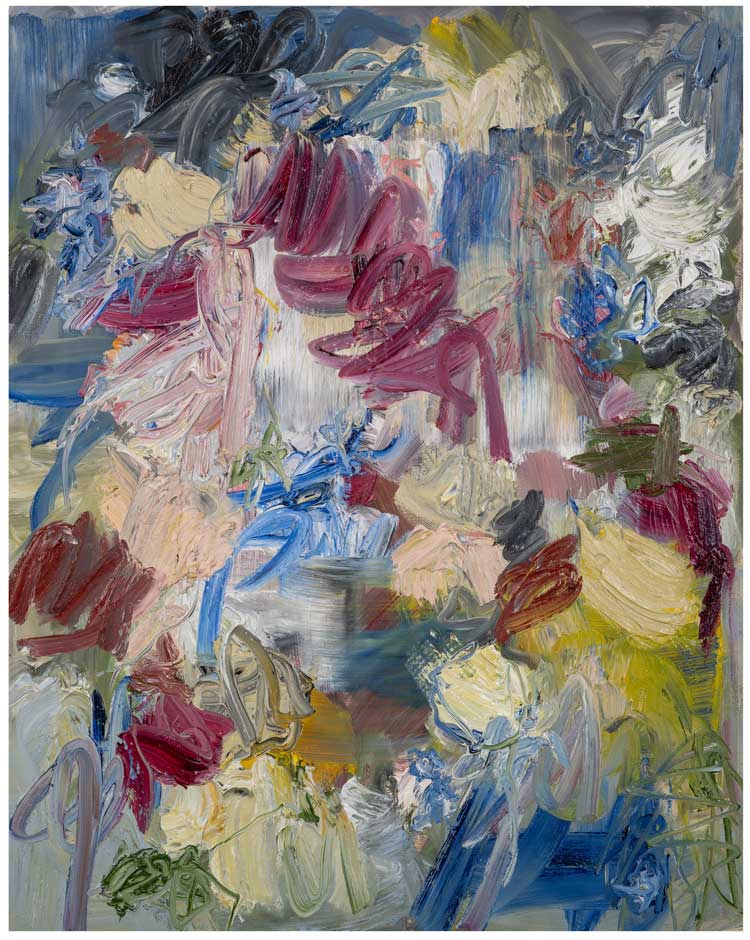
Miranda Boulton, Quietude, 2025. Oil and acrylic spray paint on canvas, 76 x 61cm. Image courtesy of the artist and Patricia Fleming Gallery. Photo: David Kirkham.
AMc: Was your grandfather an artist?
MB: He was a painter, and that was very much where my love of painting began. And why floral still-life painting means a lot to me personally, because he did a lot of floral still-lifes.
He died before I was born, and my granny kept his studio the same as it was when he died. I used to sneak in, and nobody knew I was in there, and I used to stare at the paintings on the easels. Some were finished, some weren’t, and they really stood in for him. So, there’s very much a poignant, personal aspect. There are personal histories within the wider realms of art history.
AMc: In the time that I have known you, your works have certainly become more abstract.
MB: Yes, I think I have let go. It’s like a muscle memory, when you do something over and over again: the vase is still there, it’s just exploded, and it had to explode at the right time. That’s basically what happened with the Snyder influence. I can go to the edges, I can let go of the memories, but the vase is still in there. Sometimes it comes back more. I think maybe the works on paper have more of a figurative element. Scale does make a difference: the brushes are bigger, the gestures are bigger, it’s more expansive.
AMc: The canvas must respond to the oil paint differently from the paper as well.
MB: Yes. The works on paper are a vital part of my practice. I never do preliminary drawings; it is all from memory and it’s in the moment. I work very much in series, looking at a new painter or thinking about a new environment that I’m responding to. I see the works on paper as a kind of root system to the whole thing. They’re very spontaneous, they’re free, I don’t mind when they rip, they’re very experimental. Then the minute you get to canvas, there’s a slight weight, an expectation that you have to make it work, you have to push through, whereas the works on paper are intuitive, and I find lots of new mark-making comes to the forefront. I find them really exciting.
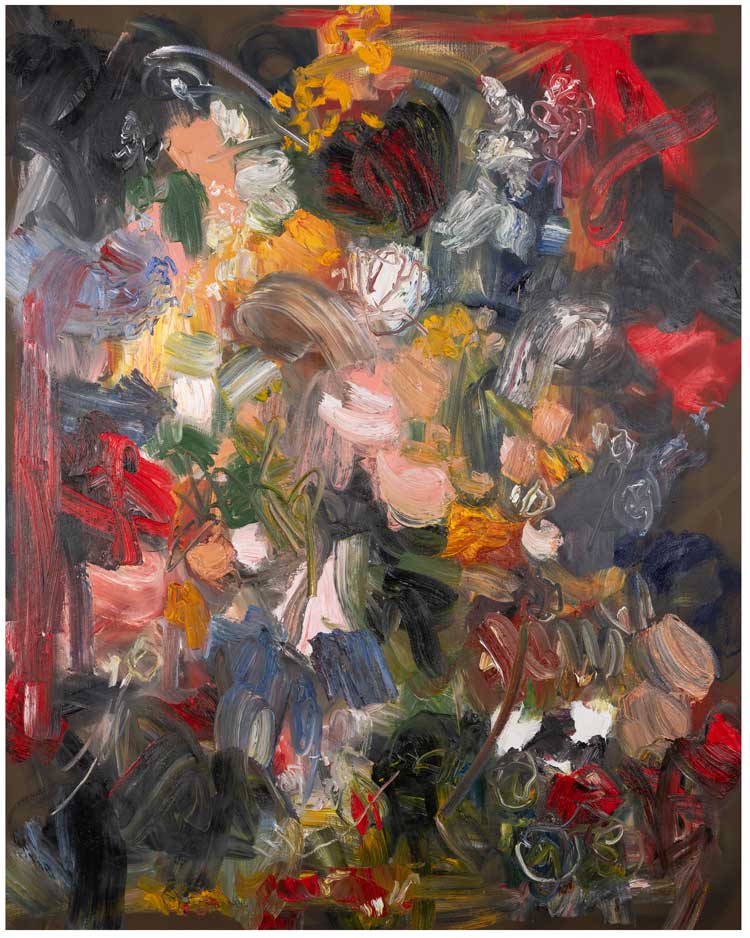
Miranda Boulton, Garlands & Wreaths II, 2025. Oil and acrylic spray paint on canvas, 150 x 120 cm. Image courtesy of the artist and Patricia Fleming Gallery. Photo: David Kirkham.
AMc: Do you go back to your paintings, or do you create them in one big burst of energy?
MB: Usually, I go back to them. Occasionally a painting will come through when it’s really fresh, and I can’t work back into it because it just works and clicks. I find those frustrating, although I love them. They have very different energy. Celia Paul talked about this in her book Self-Portrait; she said a painting that has been done quickly is like a newly decorated room and the air is fresh empty and echoing, whereas a painting that has been done slowly is like a room that has been quietly lived in, it acquires a mysterious stillness. I love this way of thinking. Of the paintings here, I think Garlands and Wreaths II (2025) has just two or three layers, whereas Wild Flower Riot (2025) was five or six different paintings during its making. I don’t think it changes how you react to the paintings, but I think the more-layered ones possibly give a little bit more over time.
AMc: I love that smudge in the middle of Wild Flower Riot. Is it all brushwork, or do you use other implements?
MB: It’s mainly brushwork. Occasionally I’ll use my fingers and rags. I get incredibly messy and covered in paint. I also sometimes use spray paint. There’s a little bit in Wild Flower Riot. This series I haven’t used it so much, but I’ve really enjoyed that clash between a contemporary material and a subject matter that’s very traditional. I also love the buttery surface.
AMc: Do you buy your paints individually?
MB: Yes, and a lot of them! I have embraced colour a lot more recently, as well. It’s taken me time to conquer it, to find a way that I can work with it. I think that underpainting, that real texture there, reveals itself as you keep looking. Something I have been interested in recently is trying to find some way to visually, in paint, expose my thought process. I looked at Gerhard Richter’s paintings and his “big whoosh”, it’s those slippages that say so much. The paint is sliding across the canvas, it’s coming out at you, and it’s giving you more of a visceral experience. I’m looking back to the likes of Frank Auerbach, who has real depth to his paintings. An event can happen and everybody sees it differently, and I’m trying to somehow visually represent that in paint. With the blurred marks, there might still be some kind of clarity and some crispness, but it’s also slippage, it’s slipping through your fingers, it’s fluid.
AMc: And there’s also still some hint of fragility and ephemerality because of the nature of flowers.
MB: Absolutely. The traditional vanitas; there’s a poignancy to them as well. And I think that’s something to really celebrate, and it’s very relevant now. That’s probably why flowers are so popular, because they poetically encompass what’s going on in the world on a wider scale and how we’re probably feeling below the surface.
AMc: You have touched on what is it about flowers and floral still-lifes that attracts you to them. Can you say anything more?
MB: I think coming from an art history background – my degree is in art history – it was about finding something that I could really explore and get to know. I had an amazing tutor on the Turps course, who told me that I had to commit to one thing, and that is the best advice I have ever been given, because the more and more you go around in circles, the deeper you get into an enquiry, the questions and the understanding. It’s really important to me that there’s a background in history, given my own background and my interests. So, I have the personal history, and then I think it’s quite challenging as a woman to be painting flowers as well. I feel quite subversive. But it’s a subject that is being very much re-evaluated at the moment. There is a huge number of flower shows: two just in East Anglia (Handpicked: Painting Flowers from 1900 to Today at Kettle’s Yard, Cambridge, and my own). But it still has an association with femininity and women being amateur, men being geniuses, even if it’s the same subject matter. It feels like it’s a challenge because of that; it’s something to get my teeth into and really address. And my paintings are confrontational, they’re in your face, they’re busy, they’re not shy. There are no wallflowers here. It’s taken me a long time to come to terms with that, but I really enjoy the problematics of it, it’s taken me years and years of going back and looking at the history again and again to really understand it. I think this feeds into the paintings: they are open, it’s an enquiry. I’m asking questions. I’m not saying there are definite answers. It’s about exposing the inequalities and questions within the genre.
AMc: Where do you see yourself going next?
MB: I am working on a show for a museum in Amsterdam. It’s early days, but it’s really exciting. It will be different work from Chain of Flowers, but it started with Emily going to Amsterdam, I’m extending that and responding to works over there. Art history isn’t flat or linear. There are all these local pockets to it – and a cyclical element. And that’s what I’m trying to represent, to create some sort of a semblance of within my work. I’m incredibly lucky. I’m absolutely passionate about painting. I’m a complete geek. If I haven’t painted for a few weeks, I get really cranky. The enjoyment of the process definitely comes through in the paintings. There’s a lot of joy, but then there’s a darkness to the subject as well. There’s a process of transformation and becoming. I don’t think anything’s finished. It’s all in a state of flux.
• Miranda Boulton: Chain of Flowers is at Norwich Castle Museum & Art Gallery until 6 December 2026.
Click on the pictures below to enlarge

Copyright © 1893–2026 Studio International Foundation.
The title Studio International is the property of the Studio International Foundation and, together with the content, are bound by copyright. All rights reserved.
 |
 |
 |
|---|
-300.jpg)
-300.jpg)
 Joseph Beuys: Actions, Vitrines, Environments
 Gerhard Richter Portraits
 Gerhard Richter: Panorama
 Mediators and Messengers: Contemporary Art in the Landscape
 Douglas Gordon: Superhumanatural