




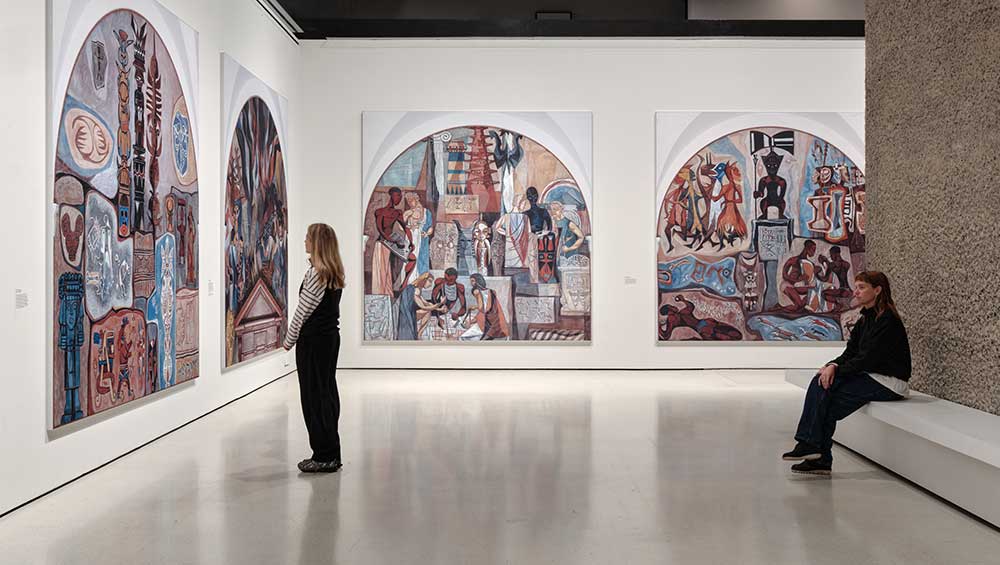
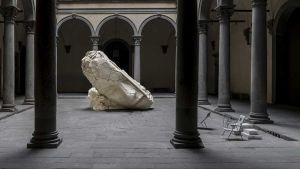
Project a Black Planet, The Art and Culture of Panafrica, Installation view, 11 Jun – 6 Sep 2026 © Thomas Adank, Barbican Art Gallery.
Barbican Art Gallery, London
5 June – 6 September 2026
by JOE LLOYD
In July 1900, a few dozen people gathered at Westminster town hall for a three-day conference. Their subject was nothing less than an emancipation of an entire race. One attendee, the American sociologist and activist WEB Du Bois, drafted an address to the nations of the Earth. “The problem of the 20th century,” he wrote, “is the problem of the colour line, the question as to how far differences of race … are going to be made, hereafter, the basis of denying over half of the world the right of sharing to their upmost ability the opportunities and privileges of modern civilisation.” Pan-Africanism – a movement aiming to create solidarity between Africans and the African diaspora – was launched on to the world stage. Over the century that followed it became an intellectual underpinning of anticolonial struggles.
Curated by four experts across art and cultural theory, Project a Black Planet purports to be the first major exhibition devoted to the influence of Pan-Africanism on artistic and cultural production. This is an enormous topic, as well as a slippery one. Pan-Africanism is a political and a cultural endeavour. It is historically bound to the anti-racism and anticolonial movements of the first half of the 20th century, yet it is also an idea that persists today in art, music, literature and contemporary thought. It can manifest as a call for improved prosperity or a belief that all Africans should be unified, whether in polity or in spirit. And it is a node in a network of interlocking ideologies – négritude, Quilombismo, Black power, Garveyism, Afrocentrism, among others – many of which have irreconcilable differences.
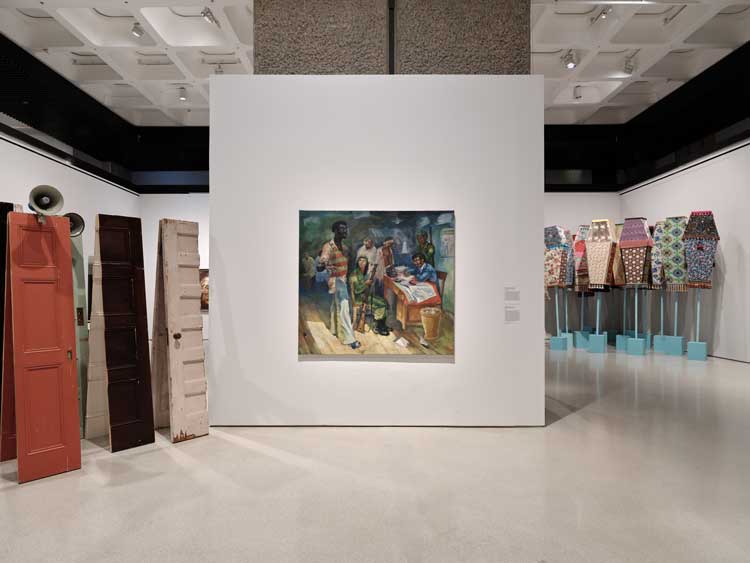
Project a Black Planet, The Art and Culture of Panafrica, Installation view, 11 Jun – 6 Sep 2026 © Thomas Adank, Barbican Art Gallery.
The exhibition features much to admire. There is a profusion of contemporary marvels, which spotlights the vitality and diversity of art produced by African and diasporic artists. Highlights include El Anatsui’s collection of carved wooden sticks (1995), which have the charge of religious idols; Kiluanji Kia Henda’s eerie photographs of an Angolan orthopaedic rehabilitation centre (2020-21); and a fragment of Kader Attia’s Asesinos! Asesinos! (2014), an assemblage of folded-up doors and megaphones that captures the anger of a frenzied protest. The exhibition closes with a room devoted to a new sequence of paintings and drawings by Lynette Yiadom-Boakye depicting both contemporary diasporic Africans and their imagined traditional ascendants, querying Pan-Africanism’s claim for a generation-spanning continental identity.
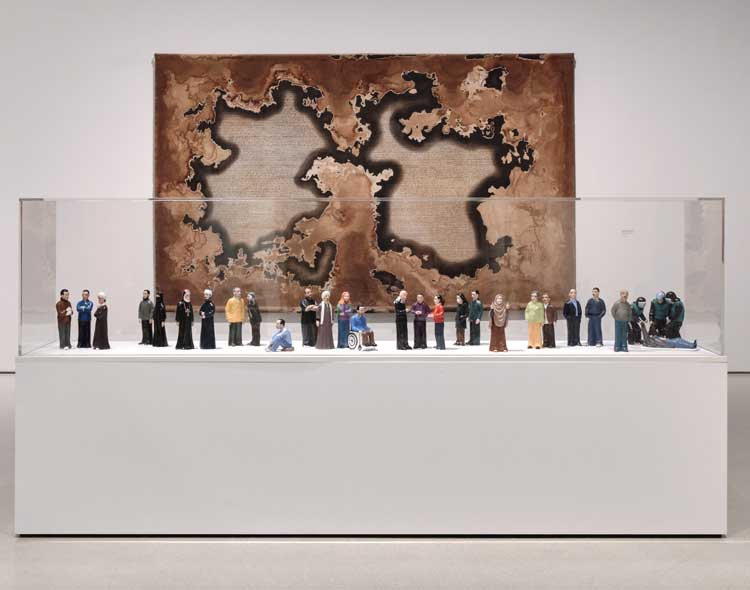
Project a Black Planet, The Art and Culture of Panafrica, Installation view, 11 Jun – 6 Sep 2026 © Thomas Adank, Barbican Art Gallery.
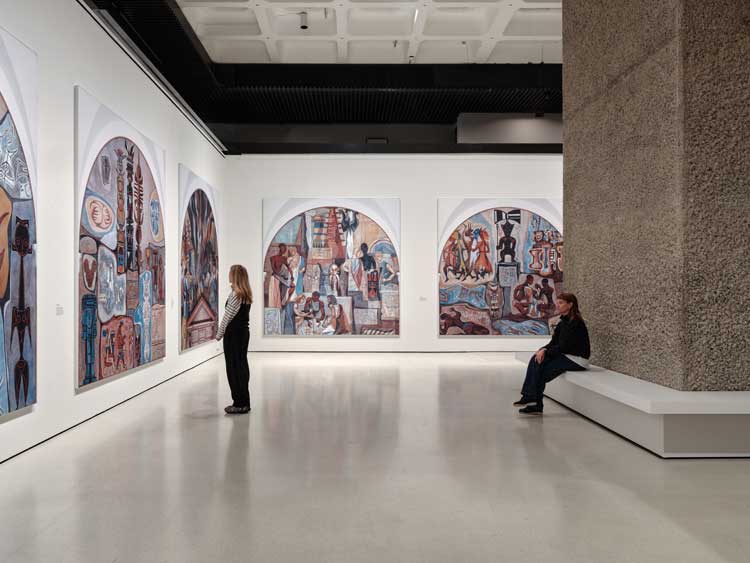
These contemporary pieces are spread across several loosely themed sections, interwoven with historic works. The most monumental of these is a reproduction of Hale Aspacio Woodruff’s painting series Art of the Negro (1950-51), a six-part epic commissioned for Clark Atlanta University. Hale had trained under Diego Rivera, and his work here is public painting on the grandest scale, albeit on canvas rather than mural. Woodruff begins with ancient tribal art, then a harmonious interchange between civilisations. This harmony is shattered with colonialism, represented by the 1897 destruction of Benin by the British Royal Navy. A later panel shows how modernists have themselves looted African motifs, before a finale celebrating (entirely male) African intellectuals and artists. While Woodruff may lack painterly flair, he is an adept imitator of different modes, and has a distinctive knack for storytelling the drama. It is a shame the original could not travel.
Pan-Africanism sought to unify the many varied peoples and traditions that share an African background, and the exhibition is particularly interesting when it prompts comparisons between otherwise culturally and disparate groups. One room juxtaposes Brazilian and Moroccan artists who separately turned to abstract symbols as a way of expressing a non-European cultural identity. A section on Négritude – a largely Francophone literary movement that celebrated “blackness” and African heritage and symbolism, and its contribution to universal humanity – brings together Brazilian and Nigerian sculptors who sought to find a new path. The stand-out is Agnaldo Manoel dos Santos, with his towering wooden soldier (1960) and a bust of a freakish pangolin-man hybrid (c1950s).
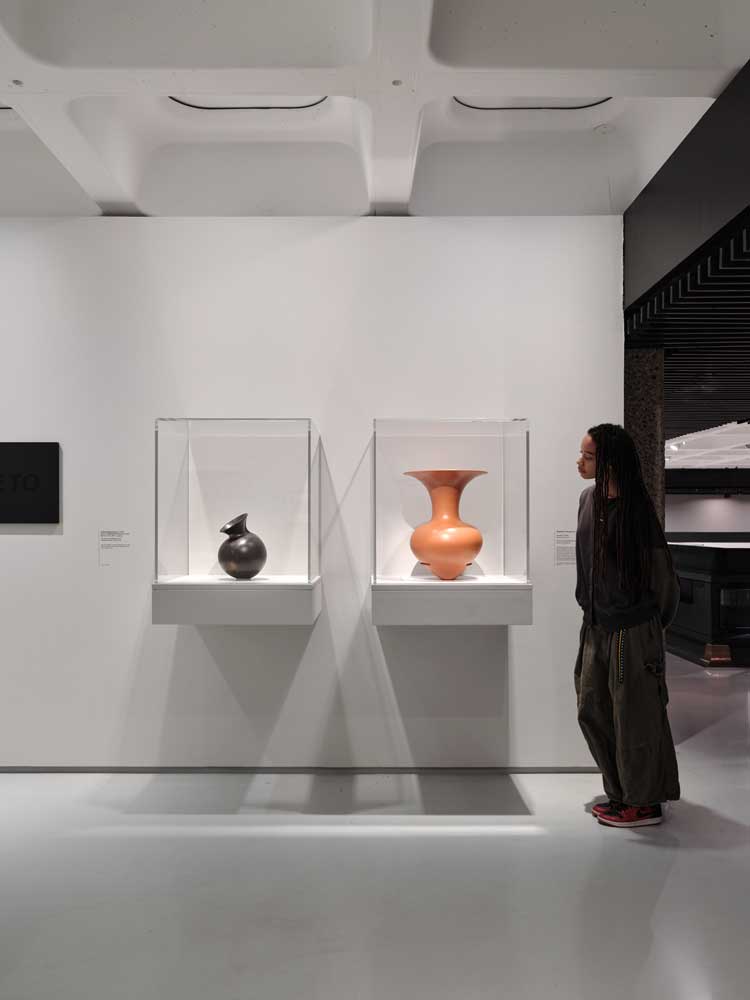
Project a Black Planet, The Art and Culture of Panafrica, Installation view, 11 Jun – 6 Sep 2026 © Thomas Adank, Barbican Art Gallery.
This section also features two artists, Nigeria’s Ben Enwonwu and Cuba’s Wifredo Lam, who both produced work explicitly inspired by négritude writers. Enwonwu had significant contact with Léopold Sédar Senghor (later president of Senegal), and created a series of paintings imagining the concept as a dancing nude, simultaneously a lithe dancer and a universal mother. The great Lam, represented here with two paintings, was inspired by the company and writings of Aimé Césaire. His Autel pour Elegua (1944) applies cubist and surrealist ideas to a depiction of the Yoruba deity Elegua.
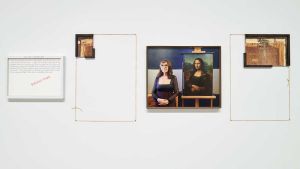
These are artworks conceived in direct dialogue with Pan-African ideas. Some contemporary pieces serve to depict the artists’ own relationship to Pan-Africanism. Christopher Cozier’s mixed media work Stepping (2024), for instance, visualises his journey of discovery through listening to reggae and calypso. Cauleen Smith’s Human 3.0 Reading List (2015-16) is a series of drawings of texts that form “a basic library of colour and consciousness”. But there are many parts of the exhibition where the thread is less clear – a sensation not helped by academic-speak wall texts and an unclear organisational principle. It is not obvious why some artworks have been placed side by side, or even in the same section. And it would have been helpful to learn about how each artist relates their work to Pan-Africanism, if at all.
Some selections are downright baffling. The French-Algerian Attia’s work often meditates on his postcolonial identity. But Asesinos! Asesinos! specifically refers to a chant used by protesters after the disappearance of a bus of students – in Mexico. Yná Kabe Rodriguez Olfenza’s 2023 poster uses a jaguar as a symbol for transgender people, unthreatening and yet attacked and endangered. Jaguars are native Americans. The inclusion of Pakistan-born, UK-based Rasheed Araeen makes some sense: he was a tireless and pioneering advocate for all artists with postcolonial heritage. Yet the work chosen – Five Blues (Punj Neelay) (1970), a series of geometric abstractions that shift as the viewer does – seems out of place. The gallery text reads: “Here, perception mirrors a social outlook in which gender, race and other forms of identification emerge as fluid or indeterminate rather than fixed.” Fair enough. But we have travelled quite far from Du Bois, and from the central Pan-African idea that people of African descent have a shared identity and destiny.
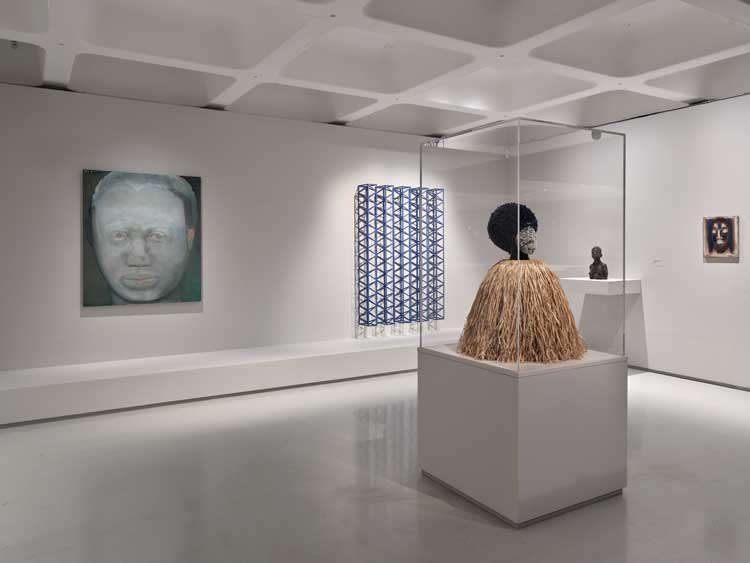
Project a Black Planet, The Art and Culture of Panafrica, Installation view, 11 Jun – 6 Sep 2026 © Thomas Adank, Barbican Art Gallery.
There are important issues that are but briefly touched on. High-minded Pan-Africanists largely came from the diasporic bourgeoisie, far removed from the realities of life in many parts of the continent; Yiadom-Boakye aside, this gulf is unexplored. The exhibition contains several artists of North African descent, but it only alludes to the uneasy status they enjoyed in the movement, especially in those aspects that lionised “blackness”. Africa is a continent of vastly diverging identities, often within the same political entities. The diaspora is similarly sundry. Project a Black Planet seems to efface these differences under a cloak of Africanness. Do come for the art – but be careful about paying too much attention to the framework.
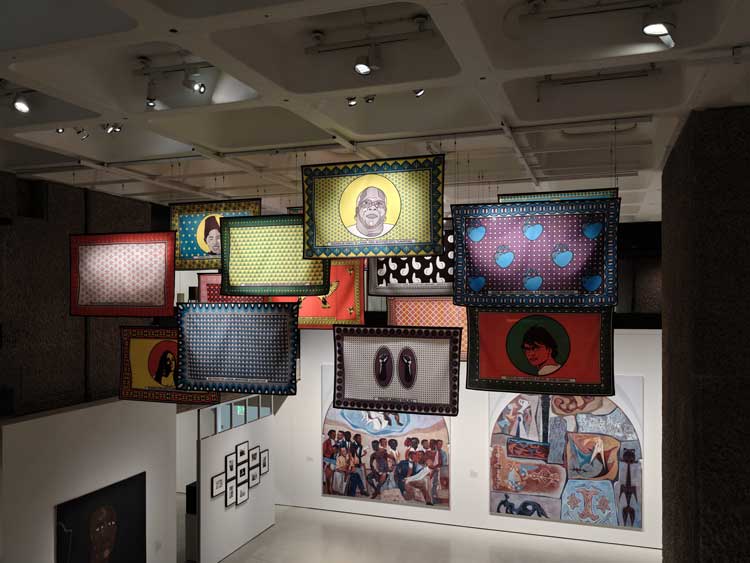
Project a Black Planet, The Art and Culture of Panafrica, Installation view, 11 Jun – 6 Sep 2026 © Thomas Adank, Barbican Art Gallery.
Click on the pictures below to enlarge

Copyright © 1893–2026 Studio International Foundation.
The title Studio International is the property of the Studio International Foundation and, together with the content, are bound by copyright. All rights reserved.
 |
 |
 |
|---|

-300.jpg)
-300.jpg)
-detail-300.jpg) Souls Grown Deep Like the Rivers: Black Artists from the American South
Souls Grown Deep Like the Rivers: Black Artists from the American South Billie Zangewa – interview: ‘I realised that I had chosen to embody the most disempowered human form’