




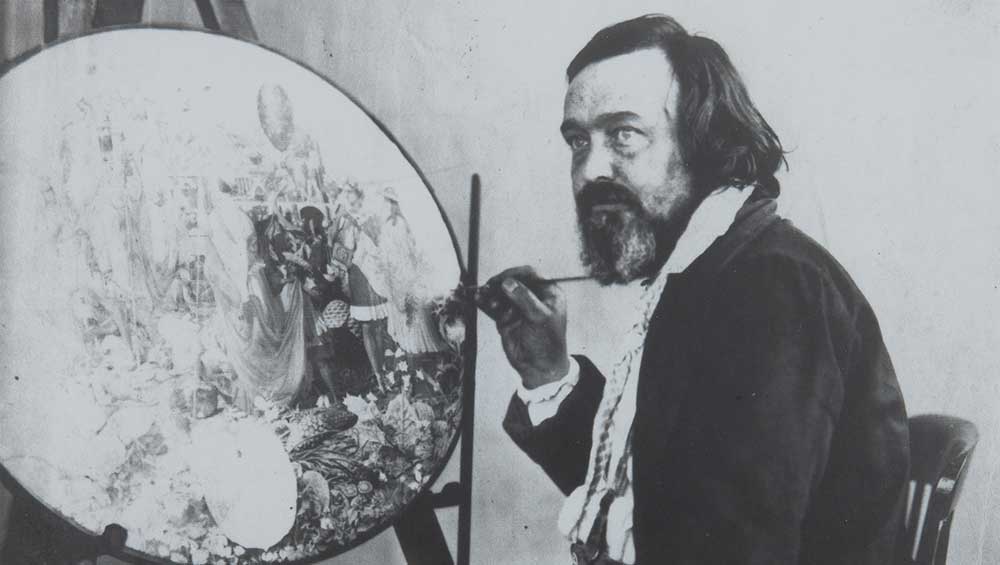
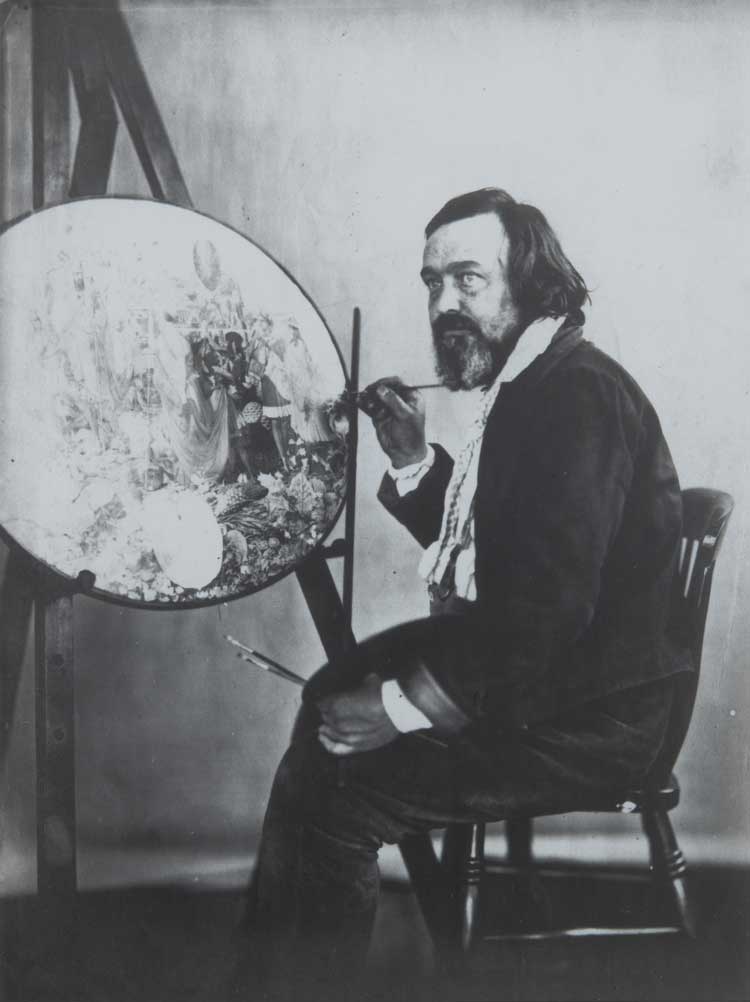
Henry Hering, Portrait of Richard Dadd, c1857. Photographic print, 20 x 15.5 cm. Courtesy of Bethlem Museum of the Mind. Alex Fox (Roy Fox Fine Art Photography).
Royal Academy of Arts, London
25 July – 25 October 2026
by ANNA McNAY
If you have heard of Richard Dadd (1817-86), it will doubtless be on account of his fairy paintings, but these number only five out of a much wider catalogue raisonné. His is another case of biography taking over from art, with the artist spending 42 years locked up in asylums after killing his father in an outbreak of psychosis, caused by what today would be recognised as schizophrenia. Nicholas Tromans, the curator of this exhibition at the Royal Academy, sets out with the clear goal, as suggested by the subtitle “Beyond Bedlam”, of “rescuing the art from the story”. As such, little mention is made of Dadd’s madness, which can be read about further in the exhibition catalogue,1 as well as an excellent previous volume by Tromans from 2011,2 and, while it certainly adds to the understanding of the works, it is no great loss, and having the focus placed solely on the artistic value of his work is a worthwhile and rewarding undertaking.
Dadd was born in Chatham, Kent, one of seven children. His mother died a few days before his seventh birthday. When he was 17, his father took the family to live in the centre of London, around the corner from what was about to become Trafalgar Square, and, three years later, Dadd, who had been drawing since he was 13, entered the Royal Academy Schools. Here, he became one of the most feted students, attending the antique school more often in 1838 than any other student, and winning medals for his work in the life drawing and painting schools. Among the visiting tutors at that time were JMW Turner and Daniel Maclise, whose literary and mythological imagery was a decisive influence on Dadd’s early work. He and his friends, who became known as “the Clique”, would meet to invent pictorial compositions from texts by Byron and Shakespeare, and Dadd created a “gothic rococo” persona for himself.
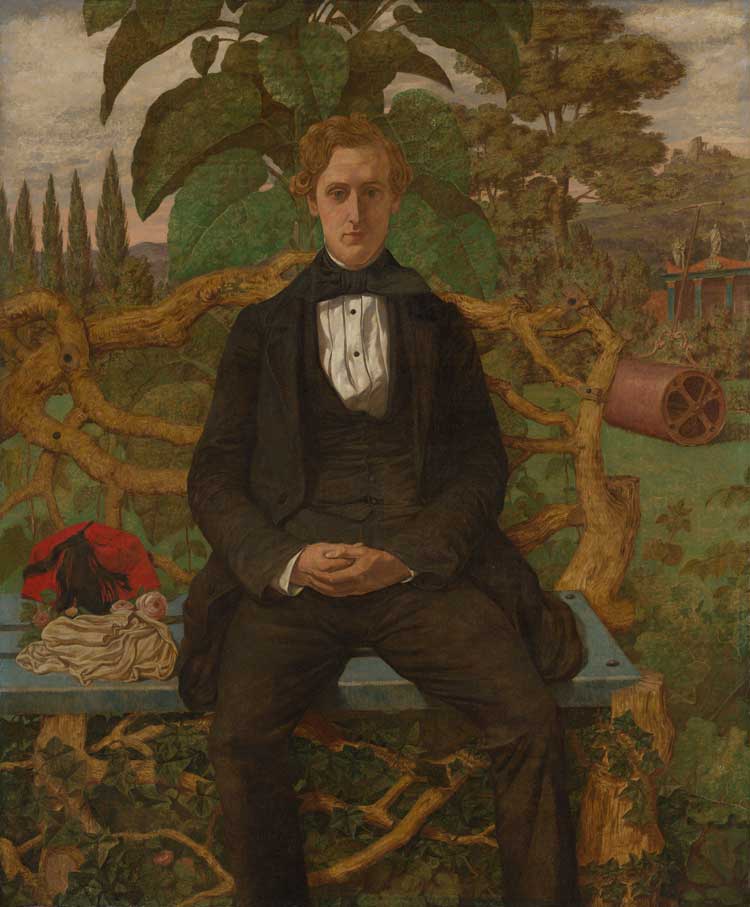
Richard Dadd, Portrait of a Young Man, 1853. Oil on canvas, 60.6 x 50 cm. Tate: Bequeathed by Ian L. Phillips 1984, accessioned 1992. Photo: Tate.
The exhibition begins with some of Dadd’s early works, including exquisitely sensitive watercolours of his family, and oils with stunning passages of light, such as the dot of white on the edge of his friend’s iris in Portrait of Augustus Egg in Character (1838/40). A dramatic self-portrait (c1841) shows the artist white-faced and with an intent gaze. Also on show is Scene from Hamlet (1840), in which the characters depicted have wonderfully and exaggeratedly theatrical expressions and postures.
The ultimate challenge for a literary painter was to invent visual translations not just of Shakespeare, but of the fairy images to be found in Shakespeare, and British painting had included the world of fairies since the 18th century. Nevertheless, this alternative universe was never too far from the realms of delusion. Of Dadd’s three early fairy paintings, Titania Sleeping (1841) is certainly the greatest. The dark sky is stippled with bright stars, and there are glistening droplets of dew on the convolvulus. Set in the middle ground are four figures (including Titania), whom Cora Gilroy-Ware suggests, in her catalogue essay,3 were influenced by William Etty, an artist born 30 years before Dadd, who made a name for himself by transposing the bodies of real women from his studio into his mythological canvases. She also cites Maclise’s The Disenchantment of Bottom (1832) as an inspiration for the bower of entwined, grotesque, goblinesque figures, described vividly by the poet and sculptor John Lucas Tupper as “like sleep-jumbled memories of things”.4 Angela Carter takes this one step further when, in her radio play about Dadd, she describes his fairyland as comprising “the quaint pornography of never-never land”.5 This trio of fairy pictures was shown in London in 1841-42 and brought Dadd considerable critical recognition, albeit not much money.
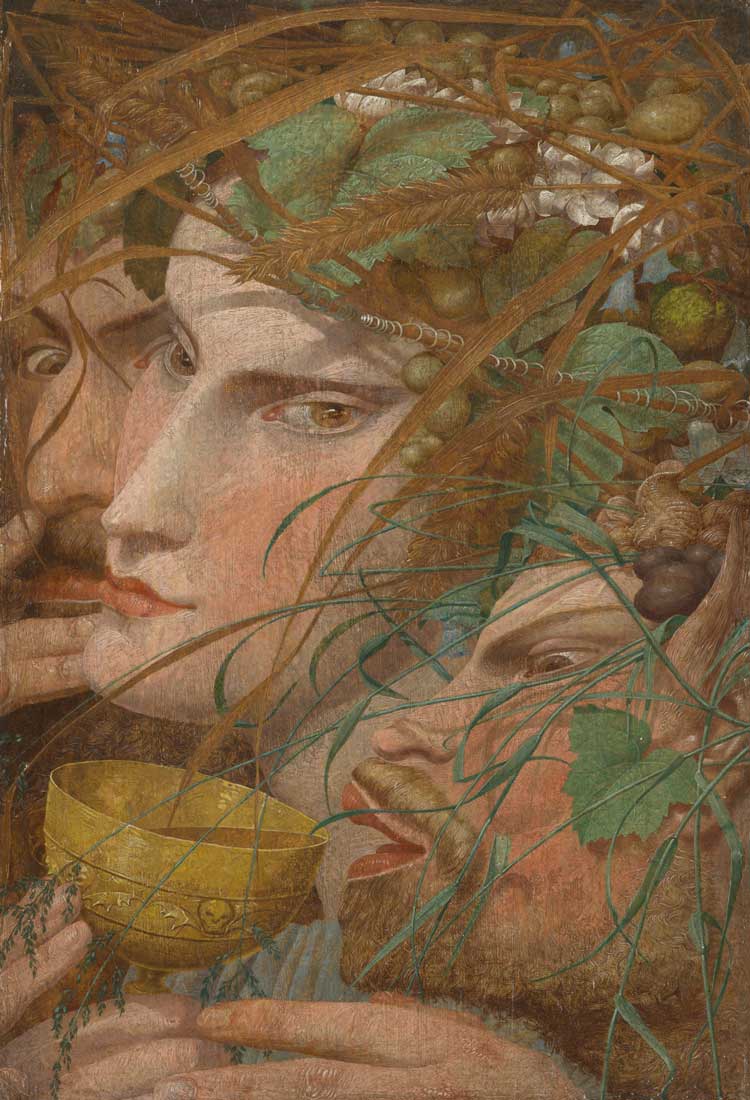
Richard Dadd, Bacchanalian Scene, 1862. Oil on wood, 35.6 x 24.1 cm. Tate: Lent from a private collection 1993. Photo: Tate.
That year, however, he decided to abandon his fairy paintings to become an orientalist, and he set off with the Welsh lawyer Sir Thomas Phillips for a Grand Tour of Europe and the eastern Mediterranean. Initially all was well, and Dadd noted: “For my part I walked about the streets with my eyes and mouth wide open, swallowing, with insatiable appetite the everlasting succession of picturesque characters.”6 Dadd’s surviving sketchbooks from the trip record architecture, ruins, people, clothing, animals, landscapes, harbours, boats, cityscapes and street views – all made with exceptional observational skill. However, by the end of the tour, Phillips was expressing concerns, and soon after his return to England, on 28 August 1843, Dadd killed his father with a knife. From what he later said, he had come to believe that his father was a devil, and that he had had to kill him to set free the Egyptian god Osiris, at this time understood to be god of the sun. The stars – which Dadd had painted so beautifully in his fairy pictures – were the intermediaries in the communications between him and Osiris.7 The body was found at the edge of a deep ravine, circled by elms; it had been dragged towards the drop but not thrown over.8
After running away to France and subsequently spending some time in an asylum there, Dadd was discharged to British authorities on 26 July 1844 and admitted to Bethlem 27 days later. Despite the dingy conditions, he was able to continue his painting once his siblings sent him his materials. His works now forcibly drew a lot on memory, but sometimes he would refer to his travel sketchbooks as well. As he wrote in a very curious Franglais about the entrancing painting Halt in the Desert (1945): “peignè des recollections qui existent dans la tete du peinteur, et des certains marques et lines dans la livre petit que je crois de n’avoir pas ète dans le possession du Sir Thos Phillips.”9 The little book referred to is thought to be a now-lost sketchbook.
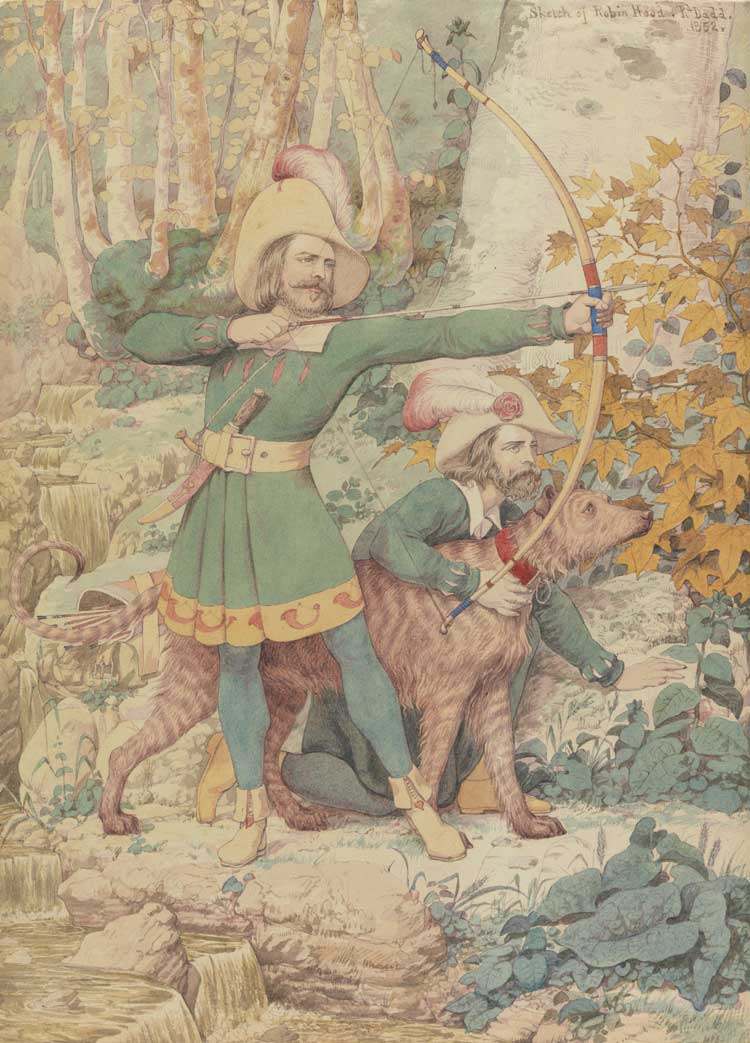
Richard Dadd, Robin Hood, 1852. Watercolour and pencil on paper, 35.9 x 25.7 cm. Yale Center for British Art, Paul Mellon Collection.
Dadd never make art explicitly about his illness or his asylum home, but some pictures have been interpreted with a psychological spin, such as Robin Hood (1852), which depicts not one but two Robins. “Do these doubles relate to the split personality generated by the contending spirits?” asks Tromans. “Is Dadd once again finding a parallel between an ancient myth and a modern medical paradigm – the ‘central truth of a two-faced being’?”10
One of Dadd’s most significant paintings made during his two decades in Bethlem is Contradiction: Oberon and Titania (1854-58), which returns to his theme of Shakespearean fairies. Throughout the picture, especially around the periphery of the oval canvas, a saga of minute micro-narratives is being enacted, as lesser beings – fairy-sized warriors, centaurs and bacchanalians – play out their dramas in contrast to the tense standoff among the lead players.11 Much like with Titania Sleeping, he flouts the basic rules of composition – namely those of conjuring up a convincing three-dimensional space with a surface pattern of balanced weights of light and shade. Instead, Dadd gives the canvas over wholly to an invented world without stable proportion. Tromans describes this as: “[L]ike something vast, perhaps a baroque ceiling painting of apparently infinite depths in which some tremendous but mysterious central scene morphs around the edges into a busy flurry of centrifugal activity.”12
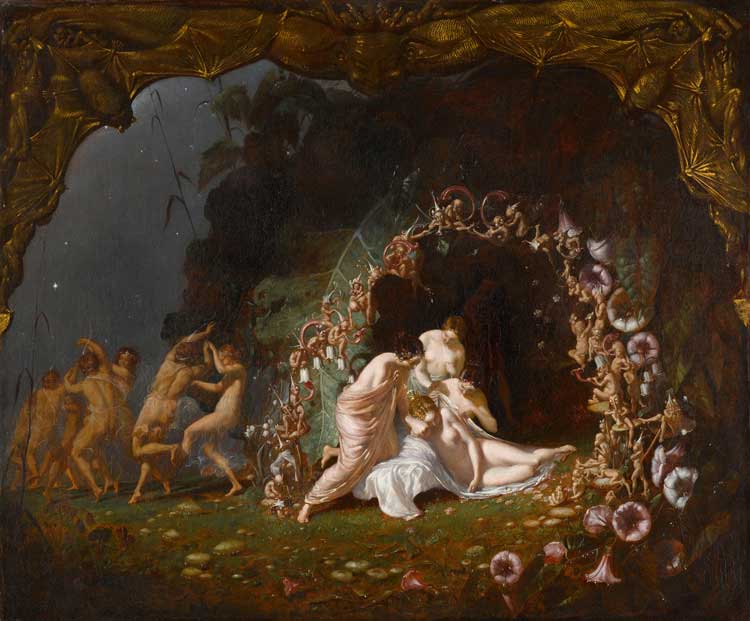
Richard Dadd, Titania Sleeping, 1841. Oil on canvas, 64.8 x 77.5 cm. Paris, Musée du Louvre, Department of Paintings. © GrandPalaisRmn (musée du Louvre) / Jean-Gilles Berizzi.
His other great fairy work from this period is The Fairy Feller’s Masterstroke (c1855-65), which was made for George Henry Hayden, the steward at Bethlem, who had admired Contradiction and requested a similar work for himself. Dadd spent a decade on the painting before leaving it unfinished when he was transferred to Broadmoor in 1864. Once there, he set about creating a watercolour version from memory – no easy task when dealing with such a layered and complex composition, or, in Troman’s words, “a bewildering compendium”.13 As in Contradiction, there is an unnatural confusion of time as well as of measure. For example, the dark-grey background in the top left suggests a night sky, yet the daisies are open not closed.14
Another member of the Bethlem staff for whom Dadd made pictures was Dr William Charles Hood, the pioneering superintendent. Portrait of a Young Man (1853) is thought to depict him. Hood also acquired a great number of Dadd’s works, including 16 of a series of 32 watercolours known as Sketches to Illustrate the Passions (1853-57). Once again blending a mixture of Shakespearean imagery and characters from his own mind, Dadd made pictures exemplifying the most harmful human emotions, characteristics and experiences, including, for example, jealousy, melancholy, treachery and anger. It is thought that Hood may have had in mind a treatise on the pathology of the emotions, categorising insanity and its causes. The pictures are executed in the print-like character of the Aesculapius drawing, composed with solid lines and an uncomplicated use of colour; many seem to emulate aquatints, a method common in bookplates. Of Dadd, Hood noted: “[H]e can be a very sensible and agreeable companion, and shew in conversation, a mind once well-educated and thoroughly informed in all the particulars of his profession in which he still shines and would it is thought have pre-eminently excelled had circumstances not opposed.”15
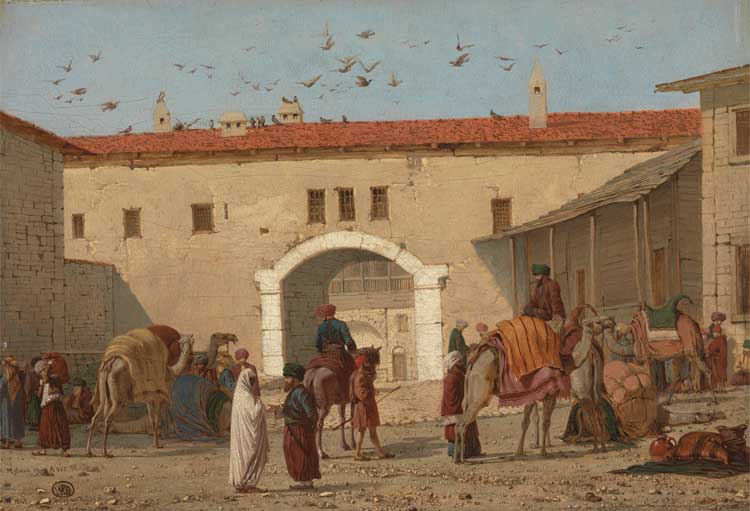
Richard Dadd, Caravanserai at Mylasa, 1845. Oil on panel, 21.3 x 30.5 cm. Yale Center for British Art, Paul Mellon Collection.
After his move to the new and pioneering Broadmoor, Dadd continued to work from a mixture of memory and imagination. Still-Life Study (1874), for example, combines fruits of the forest with some of the produce (cucumber and spring onions) of the Broadmoor gardens. His seascapes of this time – The Pilot Boat (1858-59), Sailing Ships (1861) and The Diadonus (1861-62) – demonstrate the long-lasting influence of the maritime town of Chatham where Dadd grew up, while a couple of his last major oil paintings to survive – A Lady with a Minstrel (1874) and Wandering Musicians (c1878) – are set in ambitiously classical Arcadian landscapes. What Dadd never lost was his eye (even when imagined) for minute detail, which can render realistic even the most oneiric of scenes. His later works may be looser and freer than the early academic ones, but he maintains his sense of intimacy and sensitivity to the subject.
Dadd died of tuberculosis in January 1886. I want to give the final word to him: “Perhaps the artist is himself the greatest victim of delusion – self-delusion. Pleasing oneself is like trying to be satisfied with a gross mistake. If you try to please the devil, a more implacable customer you cannot meet. And as he is more subtle than most artists – and all men or women have the devil in them – how can they please themselves except by fallacies? And what lies, what fallacies pictures are – in the grand style of art especially.”16
References
1. Richard Dadd: Beyond Bedlam, exhibition catalogue, Royal Academy of Arts, London, 2026.
2. Richard Dadd. The Artist and the Asylum by Nicholas Tromans, Tate Publishing, London, 2011.
3. A Deadly Inheritance by Cora Gilroy-Ware in exh cat (op cit), pages 38-45, page 41.
4. Ibid, page 39.
5. Cited in Tromans (op cit), page 21.
6. Ibid, page 51.
7. Exh cat (op cit), page 16.
8. Tromans (op cit), page 61.
9. Cited in ibid, page 83, and translated in exh cat (op cit), page 18, as: “painted from recollections that exist in the head of the artist, and from certain marks and lines in the little book that I believe not to have been in the possession of Sir Thomas Phillips”.
10. Tromans (op cit), page 121.
11. Ibid, page 126.
12. Ibid.
13. Exh cat (op cit), page 22.
14. Tromans (op cit), page 136.
15. Ibid, page 111.
16. Ibid, page 89.
Click on the pictures below to enlarge

Copyright © 1893–2026 Studio International Foundation.
The title Studio International is the property of the Studio International Foundation and, together with the content, are bound by copyright. All rights reserved.
 |
 |
 |
|---|
-300.jpg)
-300.jpg)

 Anj Smith: ‘The figure is a device on which to hang my concerns’
 Mad, Bad and Sad: Women and the Mind Doctors