
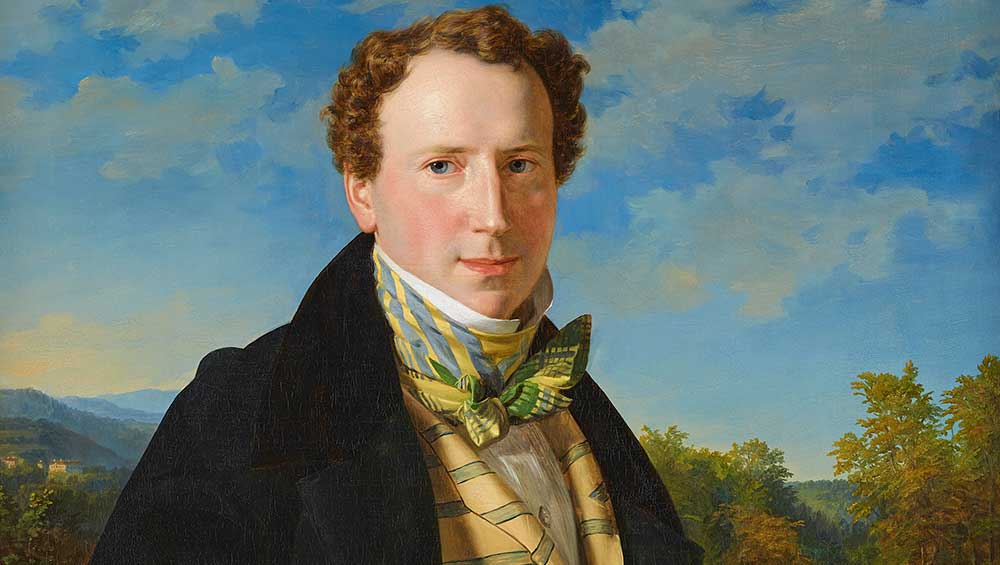
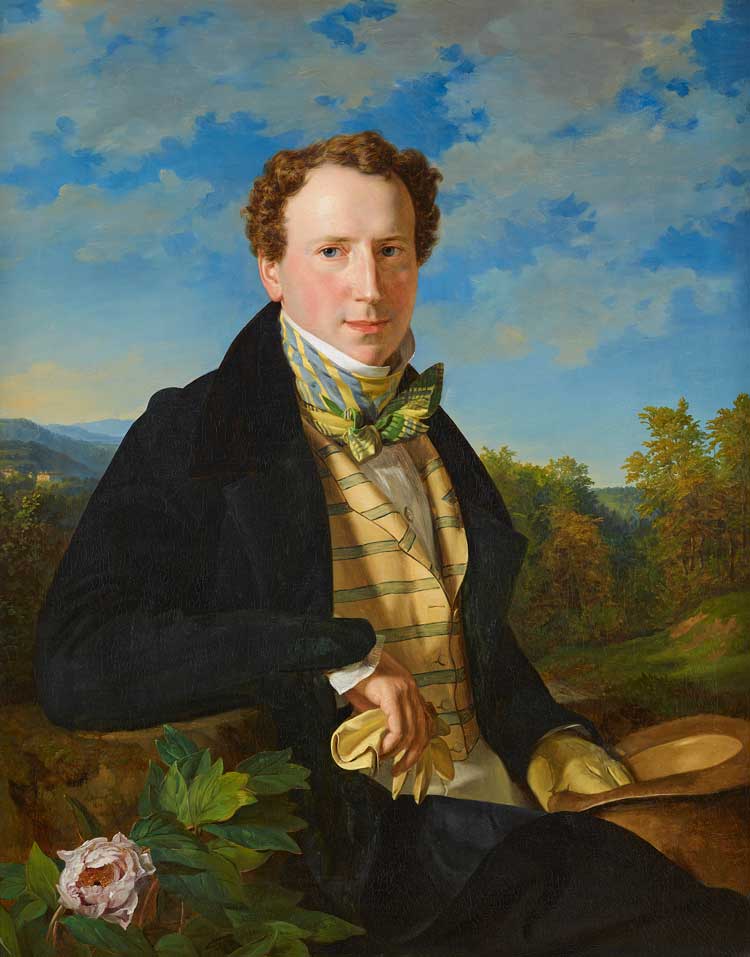
Ferdinand Georg Waldmüller, Self-portrait as a Young Man, 1828 (detail). Oil on canvas, 95 x 75 cm. © Belvedere, Vienna.
National Gallery, London
2 July – 20 September 2026
by JOE LLOYD
Biedermeier is not a word that provokes wide enthusiasm. Used to describe the culture of the quietly prosperous post-Napoleonic decades in German-speaking Europe, it connotes bourgeois respectability, sickly sentimentality and an unchallenging, even dull aesthetic. While the Romantics conjured passionate visions of heroism, melancholy and universality, Biedermeier was elegant, restrained and provincial. Even its name fails to flatter it, derived from a parody of a pompous poet in a Bavarian satirical magazine. I doubt many passions will be inflamed by the prospect of an exhibition of Ferdinand Georg Waldmüller (1793-1865), one of the most successful Austrian painters of the period – particularly as the National Gallery compares him to the pre-Raphaelites, whom Waldmüller would have encountered on an 1856 trip to London. On that visit, he sold 34 works to collectors including Queen Victoria and Prince Albert, themselves – perhaps unfairly – now regarded as paragons of crusty mid-19th century taste.
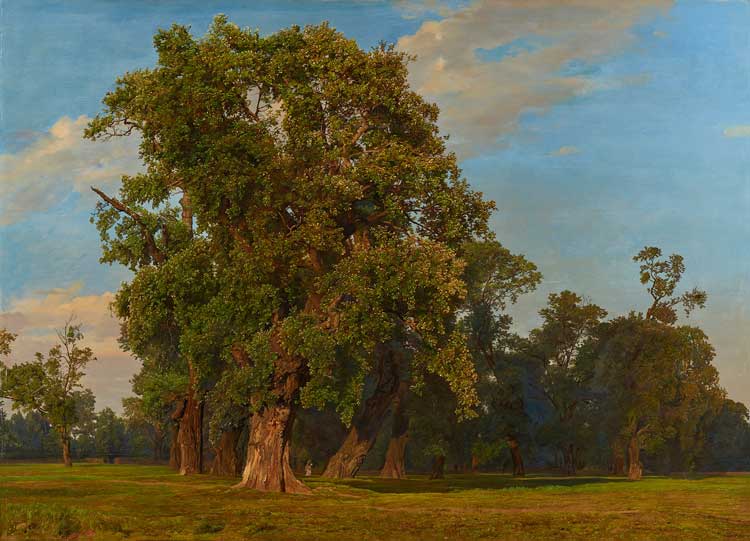
Ferdinand Georg Waldmüller, Large Prater Landscape, 1849. Oil on panel, 70 x 93 cm. © Belvedere, Vienna.
The National Gallery’s succinct exhibition of Waldmüller, the first in the UK, focuses on his landscapes: an aspect of his oeuvre that takes us away from stuffy drawing rooms and twee villages. Although he was trained in classical subjects and rose to success as a portrait painter, he had a passion for capturing the great outdoors. He taught himself landscape painting by copying the Dutch landscapes of the 17th century, in particular the wide-sky works of Jacob van Ruisdael and his forest-fixated pupil Meindert Hobbema. Later, Waldmüller’s long career at Vienna’s Academy of Fine Arts came to a premature end after he blasted the state-sanctioned academic teaching methods. He called for an end to neoclassical idealisation in favour of close observation of nature – perhaps inspired by the Paris Academy, where students had to paint an assigned variety of tree while locked in a cubicle.
Waldmüller began by sneaking nature into the background of his portraits. A self-portrait of 1828 shows Waldmüller as a rose-cheeked squire sitting on a wooden hill, Raphael-blue sky behind him. Paintbrush and easel are nowhere to be seen; instead, his gloved left hand holds his hat, while its delicate twin is exposed. There is a single peony in the foreground, advertising its artist’s affinity for still life. Soon after this, Waldmüller embarked on his first pure landscape. He began near home in the Prater, the Habsburg hunting ground turned public park, then on the edge of Vienna. An 1831 painting depicted in the exhibition, but not on show, shows a forked tree. One trunk rises up alive; the second is clipped and frayed, as if bits have been hacked off for timber. Workers scythe in the background, a sign that this park was not entirely a pleasure ground. This unsentimental depiction sits somewhere between his Dutch inspirations and the realist tendency of France’s Barbizon School.
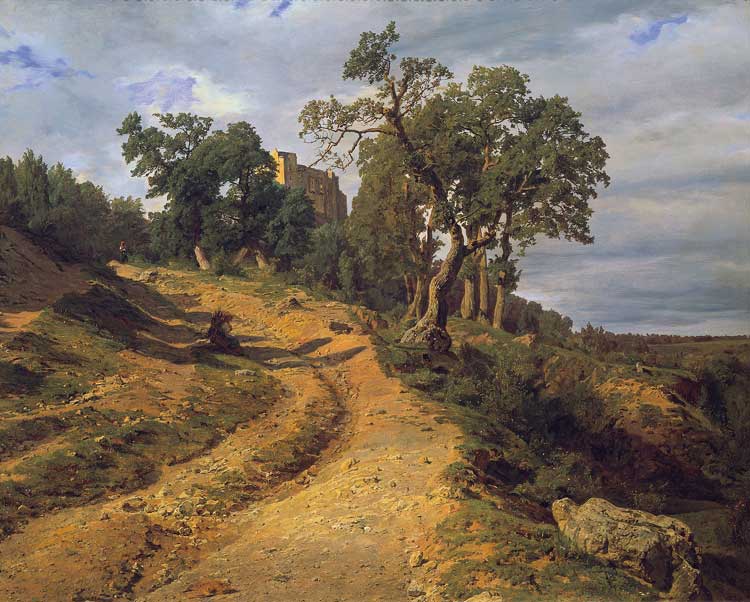
Ferdinand Georg Waldmüller, Early Spring in the Wienerwald, Violet Pickers in the Wienerwald, 1861. Oil on wood, 52 x 66 cm. © Belvedere, Vienna.
From 1833, Waldmüller summered in the Salzkammergut, a region to the east of Salzburg, where he set about capturing the dramatic Alpine landscapes. Waldmüller’s education had involved training in miniature painting, and for his landscapes he adapted the miniaturist’s technique of laying down a white ground, creating much of his picture with a thin layer of paint and then adding thicker paint for texture. His Hohenzollern Waterfall (1832) presents every craggy bump of a rock face. He also has the miniaturist’s eye for compression: none of the paintings in the National Gallery are large, yet they often feel expansive. One small 1835 work shows the Dachstein glacier from Bad Ischl. Waldmüller neatly differentiates between the sloping mountains, greens fading to blue in the distance. Most astonishing are the trees that rise in the foreground. Almost every brushstroke is visible, yet this artifice feels more real than real, down to the flashes of sunlight on some leaves.
As with many great landscape artists, Waldmüller has a striking affinity for rendering minute differences in the quality of light. Another 1835 work depicts Lake Wolfgang in delicate horizontal strokes of blue and white, capturing the reflection of the sun, the water’s depth and its rippling surface. In the mid-1840s Waldmüller began spending autumns in Sicily, giving him a chance to swap Alpine light for the simmering glow of the Mediterranean. An unfinished depiction of the town of Mola (c1844) is almost concealed atop a rocky hill, like a trick of the glare. The Temple of Juno Lacinia (1846) stands above a sunburned landscape. Austria’s thick woodland is replaced by a sparser, looser sprawl of olive trees, each of which the artist takes care to distinguish, rugged survivors against late summer aridity. This work, as well as an 1844 view of Taormina, show an enhanced propensity for capturing the way our perspective changes over the distance.
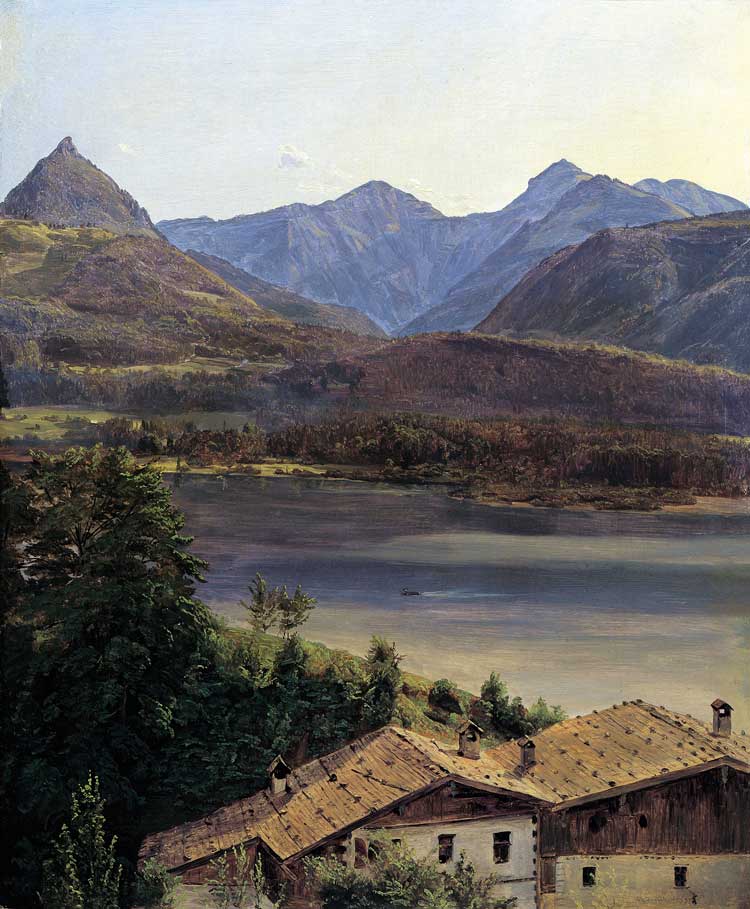
Ferdinand Georg Waldmüller, Ruins of the Juno Lacinia Temples near Agrigento, 1845. Oil on wood, 31 x 39 cm. Belvedere, Vienna, on permanent loan from a private collection (Lg 2103). © Belvedere, Vienna.
As the Salzkammergut gradually transformed from rural backwater to Biedermeier tourist hotspot and the market became saturated with twee images of rustic life, Waldmüller turned his eyes on the Vienna Woods. The latest works in the exhibition show him applying his lessons from Sicily to this local landscape. In 1848, he painted Mödling – now a commuter town just outside the capital – as a vision of provincial tranquillity, with its austere gothic church piercing a cloudy firmament. Plains and foothills stretch towards the horizon, while before the town we can see a subtle gradation of sunlight over the woods. A woman lounges on a ridge, helping to scale this majestic view, as well as affirming humanity’s place in the natural world. The latest work in London, from 1861, features an entire band of children gathering flowers in the early spring, with bare branches turning the sky into an intricate lattice. It is this work’s soft luminosity that bears comparison with the best of the pre-Raphaelites, especially William Holman Hunt, though Waldmüller swerves that movement’s tendency towards kitsch as well as its brilliant coloration. It also stands apart from the more austere landscapes of Jean-François Millet.
Waldmüller fell out of fashion towards the end of his life. But he was lauded in the early 20th century by Vienna’s avant garde as a “primal secessionist” for his advocacy for plein air. A generation later, he won admiration from a different quarter: he was one of Hitler’s favourite painters, and his works were seized for the dictator’s planned Führermuseum. His clear adoration for Austrian landscapes made him an ideal icon of pan-German nationalism. Yet viewed today, Waldmüller’s art seems neither revolutionary nor conservative, but an important link in the development of landscape painting between the Romantic and the realist. Though I expect this exhibition will quicken few pulses, it offers an oasis of serene beauty – and shines a light on an artistic milieu seldom encountered outside Austria.
Click on the pictures below to enlarge

Copyright © 1893–2026 Studio International Foundation.
The title Studio International is the property of the Studio International Foundation and, together with the content, are bound by copyright. All rights reserved.
 |
 |
 |
|---|

-300.jpg)

-300.jpg)