
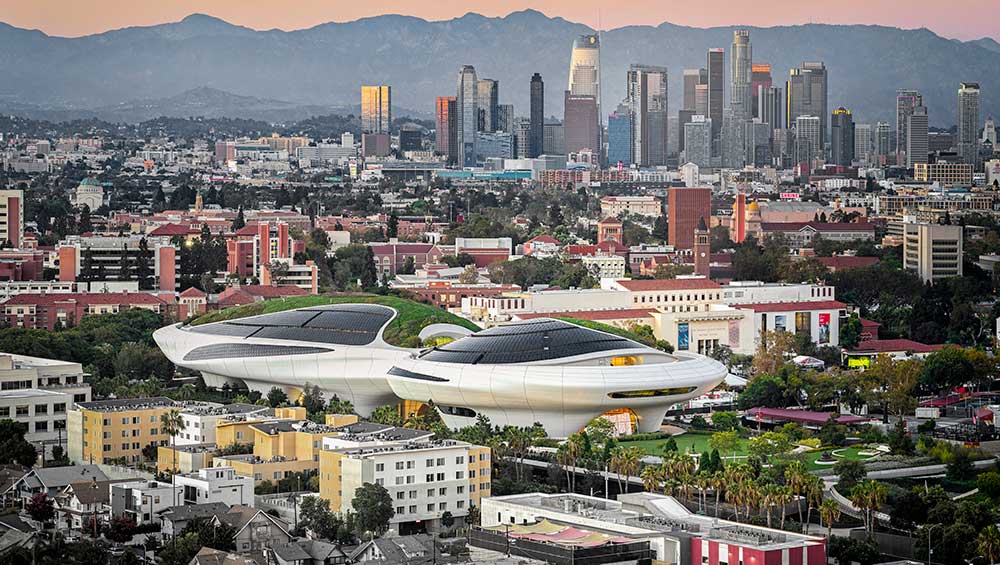
The Lucas Museum of Narrative Art, Los Angeles. Photo by Hufton Crow, courtesy Lucas Museum of Narrative Art.
by JILL SPALDING
Conceived as a cloud, perceived as a spaceship, this $1bn- (£747m) plus galaxy funded by Star Wars has been pulling in record attendance. Intended as a crowd pleaser, it delivers – as Hollywood would say – big-time.
Beloved R2-D2, conceived when robots were endearing, greets you at the entry. Cheerful attendants guide you to tubular, no-pushbutton glass lifts (the acrophobic can opt for an enclosed one) controlled by their iPads. All shoot up to the circular main-event fourth-floor galleries of themed alcoves titled like magazines – Family, Motherhood, Romance, Adventure, Work, Play, School, Comics, Community, and so on – that line up works drawn largely from George Lucas’s extensive collection, and build, finally!, to the stunning raison d’etre Cinema Gallery that unfolds, panel by painting by diorama by object, the famed director’s fabled galaxy. Ready for closeups that open to selfies are lifelike replicas of Darth Vader, Luke Skywalker, Han Solo, Princess Leia Organa, Obi-Wan Kenobi, Yoda and Chewbacca.
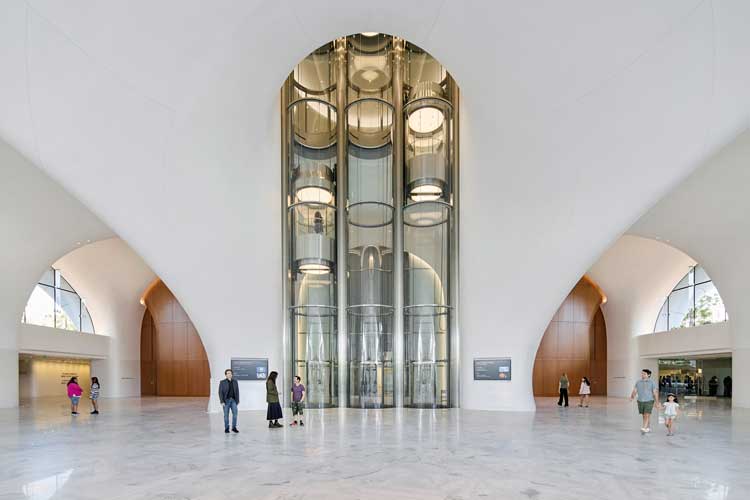
The Lucas Museum of Narrative Art, Los Angeles. Photo by Hufton Crow, courtesy Lucas Museum of Narrative Art.
Narrowing in on the building and it’s intention, the fantastical structure by MAD founder Ma Yansong shares his architectural firm’s aesthetic, as laid out in the Architecture gallery and which manifests here as a grass-capped, beam-me-up oculus rising from space-age arcades and brightly lit walkways. Easy on viewers is the prevalence of wood floors and the refreshing stop-start rhythm occasioned by interspersing long walls of art with six one-artist galleries. Gladdening, the one given Norman Rockwell, which for ever raises his work to the level of fine art.
Much else appeals; the 13-acre campus includes gardens featuring an amphitheatre, a waterfall, Yoda flanking a fountain and plenty of seating, and under the watchful eye of the oculus all can access the entry-free gardens and courtyard.
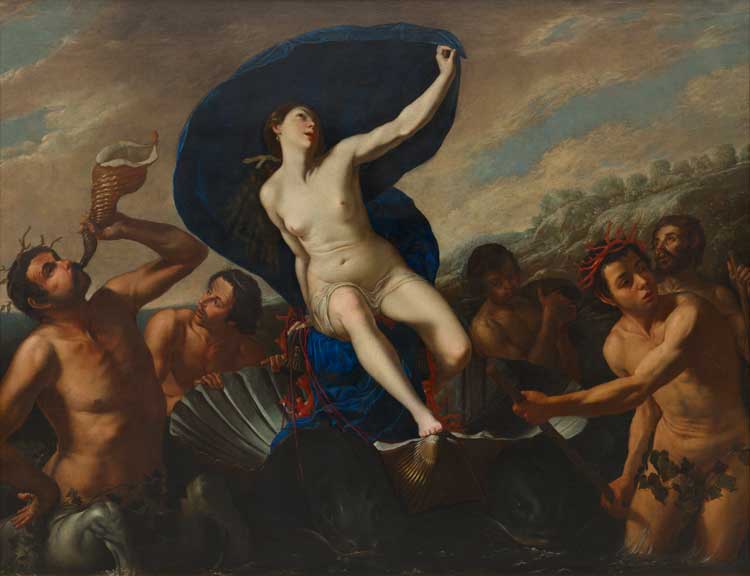
The Triumph of Galatea, painted by Artemisia Gentileschi and an anonymous associate, 1648/49.
Focusing in on the art, welcome, the nod to our growing Latino community – albeit inconsistent – of bilingual captions. Impressive, the traditional works, though it’s not evident what connects them. The goal of an arching narrative gathers such disparate luminaries as Lucas Cranach the Elder, Artemisia Gentileschi, John Singer Sargent, Lawrence Alma-Tadema, Vincent van Gogh and (in yet another self-portrait) Frida Kahlo.
More germane are the modern American masters, ranging from Howard Pyle to Alice Neel. Putting paid to the western cannon are strong showings of Romare Bearden and Jacob Lawrence; a superb George Bellows; Robert Colescott’s cause celebre George Washington Carver Crossing the Delaware (1975) and several of Kadir Nelson’s subtly revised histories.
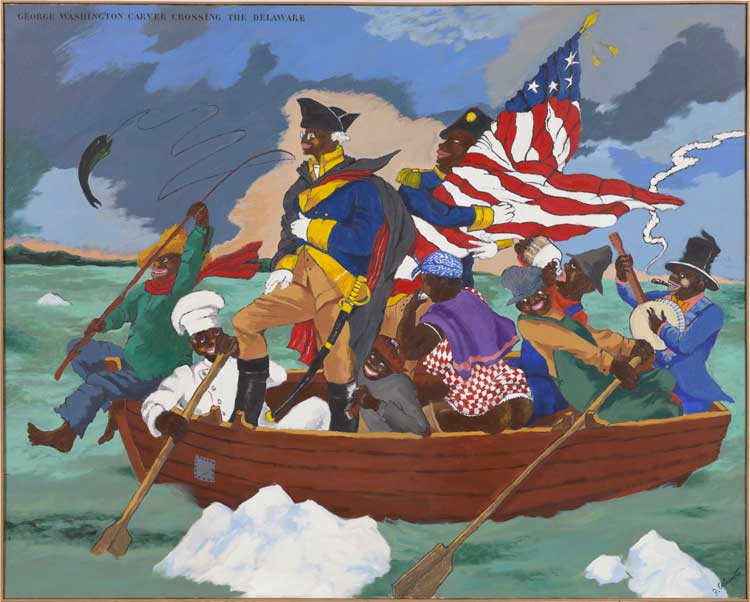
Robert Colescott, George Washington Carver Crossing the Delaware: Page from an American History Textbook, 1975. Acrylic on canvas, 78 1/2 x 98 1/4 in (198.1 x 248.9 cm). Lucas Museum of Narrative Art, Los Angeles © 2025 The Robert H. Colescott Separate Property Trust / Artists Rights Society (ARS), New York.

Kadir Nelosn, Black Gothic, 2017. Photo : Courtesy Lucas Museum of Narrative Art, Los Angeles © Kadir Nelson.
The single-artist galleries confirm the mastery of Maxfield Parrish’s neoclassical dreamworlds, the swashbucklers illustrated by NC Wyeth and sci-fi tales by Frank Frazetta that livened many a boyhood. The one dedicated to Jessie Willcox Smith raises her to the level of Mary Cassatt (also shown here) and the one given Thomas Hart Benton’s powerfully subversive depictions of American life will stop you in your tracks.
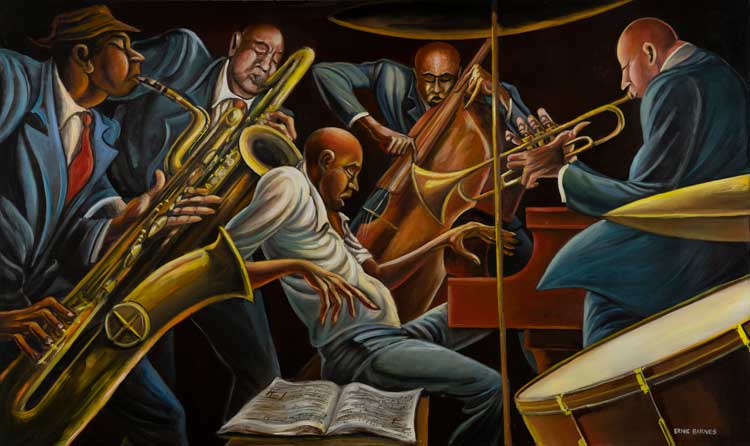
Ernie Barnes, Quintet, c1989. Acrylic on canvas. 36 x 60 inches (91.4 x 152.4 cm). Photo : Courtesy Lucas Museum of Narrative Art, Los Angeles.
Among the few nods to music is the famed acrylic painting Quintet (c1989), by the great Black artist Ernie Barnes. Photography (the traditional works oddly confined to one gallery) is represented somewhat randomly by such as Dorothea Lange, Henri Cartier-Bresson and the French photographer and street artist JR. More extensive is the space given to nostalgia.There are charming nods to Winnie-the-Pooh, Peter Rabbit and the idealised, thankfully dated, blond/blue-eyed sweetness of an untroubled childhood that gentled many a nursery wall. Highlighted, too, are Hilary Knight’s cherished Eloise, Charles Schulz’s timeless Peanuts, and the primal worlds conjured by Maurice Sendak. Unexpected omissions include such pop-culture phenomenons as The Katzenjammer Kids and Dr Seuss’s whacky tales. Oddly, too, the marking legacy of the Wizard of Oz is relegated to the movie costume of the Cowardly Lion. There is, however, a wall-long tribute to manga and Pokémon Trading Cards, starring Naoyo Kimura’s famed Pikachu and Takashi Murakami’s pop-culture fibreglass sculpture Miss Ko2.
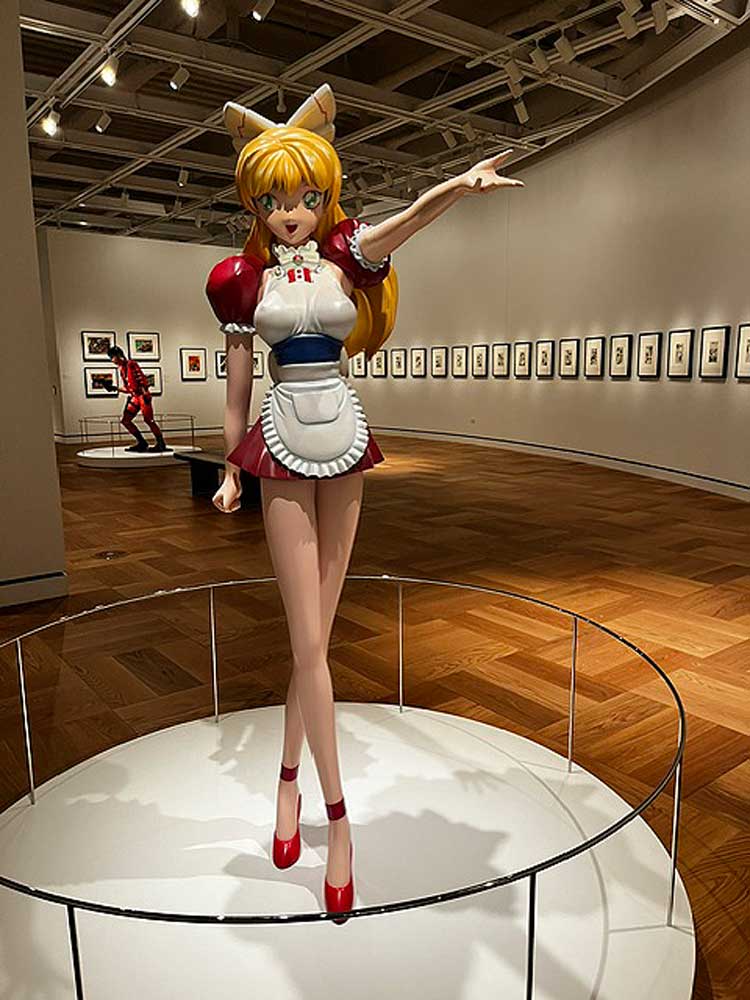
Takashi Murakami, Miss Ko2, 1997. Installation view in the Manga Gallery, Lucas Museum of Narrative Art, Los Angeles. Photo: Jill Spalding.
That so few paused to view even these may be that the promise of the Galactic Empire is held out until the end. Although totalling only 7% of what’s showing, so immersive are its backdrops and so beloved its avatars as to lessen the impact of the works building up to them. Even the jaded will succumb to what unfolds in this inaugural Star Wars in Motion exhibit as the ultimate story.
Find here the Starship’s landing platform, the original land and transit vehicles and, rendered life-size, the principal characters in their original costumes. Out came the phones to share and record. The boys clustered around Luke's landspeeder, the girls around Princess Leia. Even parents herding small children paused for selfies and those of an age to have attended the premieres seemed lost in reverie.
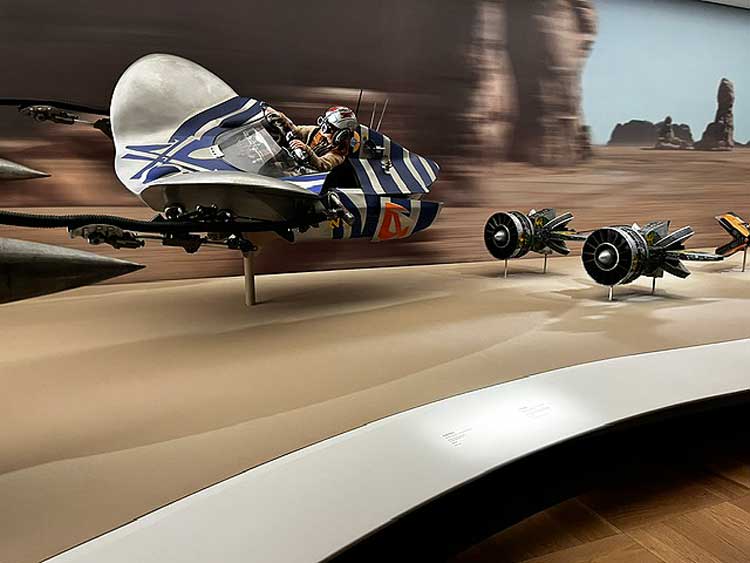
Luke Skywalker's landspeeder from Star Wars, installation view, Lucas Museum of Narrative Art, Los Angeles. Photo: Jill Spalding.
Those opting for more regrouped in the fairytale multilevel library stocked with shiny new picture books before finding their way to the southern wing for the lift to the fifth floor’s long-line cafe, pricey rooftop Skywalker Grill, powerful activist murals by Diego Rivera and Judith Baca, and two walls of Banksys flourished with an original stencil.
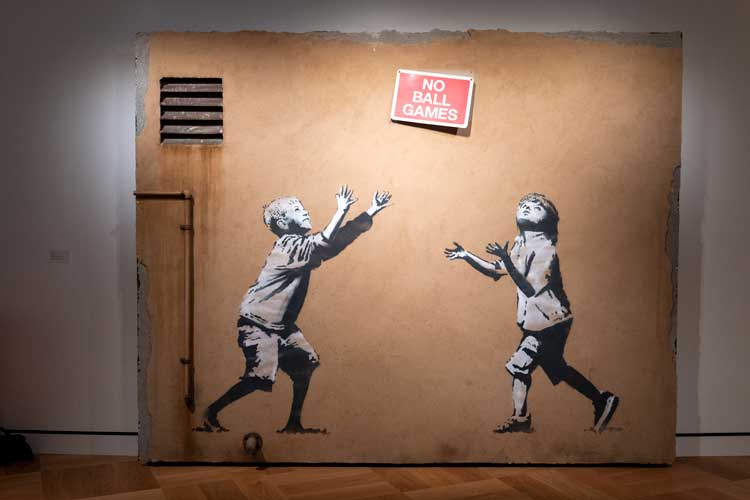
Installation view of Banksy gallery 2, courtesy Lucas Museum of Narrative Art. Photo: Lou Caltabiano.
What to make of it all? I was not alone in thinking the layout confusing, the lift system tricky, and access lines too long. The larger question is whether this disparate assemblage constitutes a museum as heretofore understood – an institution that conserves, interprets, educates and collects in depth. Formed, rather, as a personal collection, intended to delight not instruct, this seemingly haphazard array presents more as an entertaining display – a richly pictured kaleidoscope of times past and present – thereby joining the new idea, most strongly suggested by Dataland, of a museum as a skilfully curated “experience”.
Although Lucas has assembled some compelling material, that Star Wars is the expected attraction adds “vanity” to “museum”. What in the latter would constitute classical main-event masterworks present here as irrelevant lead-ins to the promised trans-galactic fantasy. More notably prioritising enchantment over enlightenment, none of the galleries, although thoughtfully appointed, offers a wall text detailing what is exhibited, and the captions reveal only the artist’s name and date.
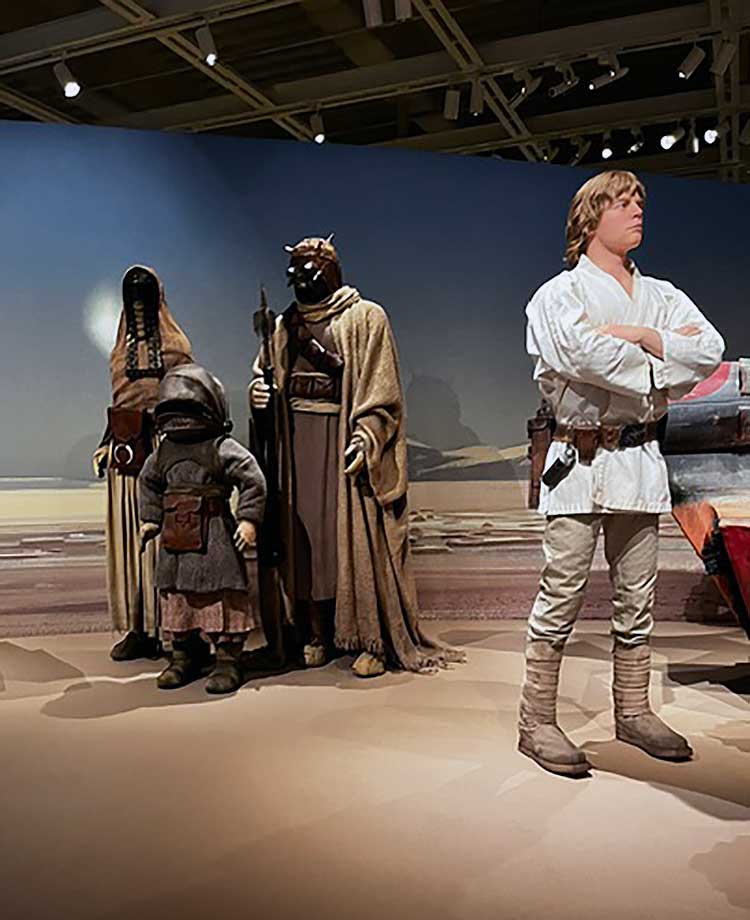
Installation view, Lucas Museum of Narrative Art, Los Angeles. Photo: Jill Spalding.
Unclear, too, the titular umbrella of “narrative art” that joins painted canvas to comics, videos and posters but omits ceramics and sculpture. Storytelling is an ancient art form, and mid-19th-century modernist efforts to dissociate narrative (lowbrow) from art (fine) have been put to rest by the mastery of such as Kerry James Marshall. But that much of what is shown here is reproduced (the Cave of Altamira and the Sistine Chapel) or on loan (Baca’s Great Wall of Los Angeles), why then no ancient Greek vases, which were all about narrative? And what of sculpture – here represented only by life-size galactic creatures, anime’s paper mache Shotaro Kaneda, a towering wooden KAWS signature Companion character, haphazard reproductions of the Louvre’s famed Mesopotamian eighth-century BC Human-Headed Winged Bulls from the Palace of Sargon II and a 16th-century Aztec calendar stone? Doesn’t historical narrative animate Renaissance marbles, such 19th-century marvels as a Antoine LouiseBarye animalier bronze and the American neo-classicist Hiram Powers’ Greek Slave? Or Elizabeth Catlett's 1956 Mother and Child, and the richly sculpted worlds of Nancy and Edward Kienholz and Charles Ray? The thought lingers that the curation was directed by the taste and preferences of Lucas and his wife, Mellody Hobson, and that much of the work here is included or excluded because they do or don’t own it.
Even the choice of loans baffles. Many a master painting tells a story, so why, for example, settle on Lucas Cranach the Elder’s disturbing The Judgment of Solomon (from the Gemäldegalerie in Berlin) that depicts two women, a dead infant at their feet, each claiming to be the mother of a living one?
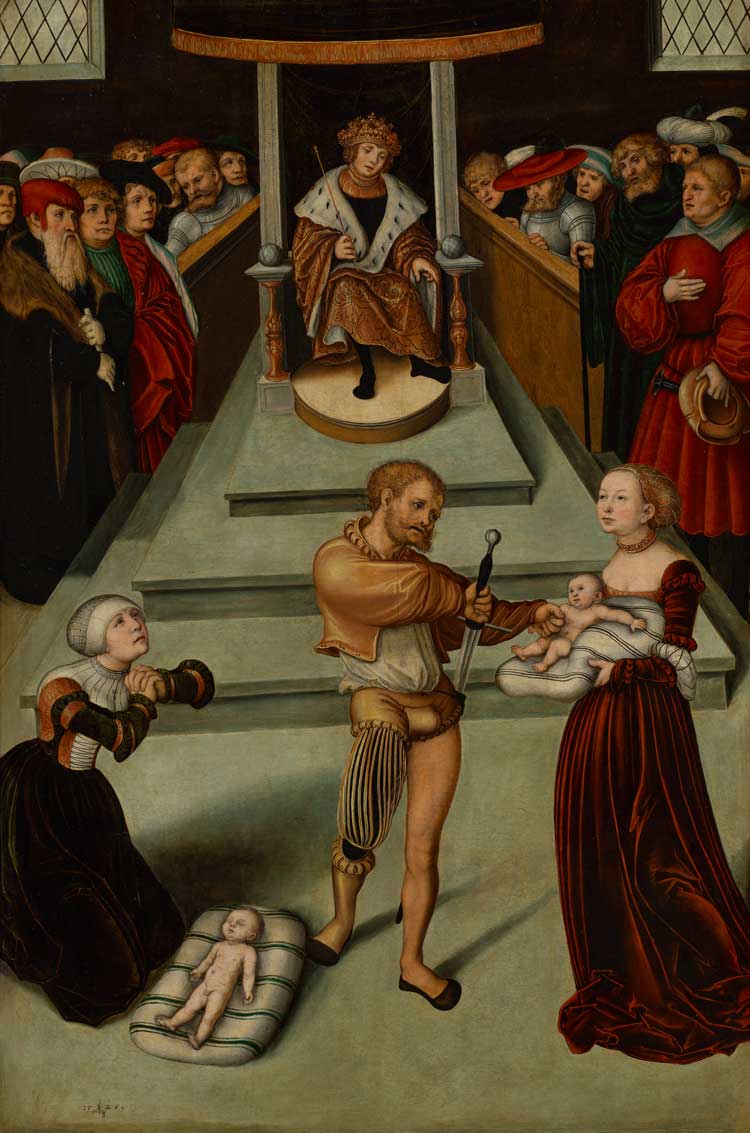
Lucas Cranach the Elder, The Judgment of Solomon, c1537, Gemaldegalerie, Berlin. Photo : Courtesy Lucas Museum of Narrative Art, Los Angeles.
My final reservation, as with Dataland and the Los Angeles County Museum of Art’s Geffen Galleries, is the cost. Although free on certain days to locals and to all under 17, the $25 ticket price per adult, or $140 annual membership, and $20 parking still feel excessive. Happily though, between its amphitheatre, extensive library and two movie theatres, a timed visit could extend to a day. And it’s but a short walk to the free-entry California African American Museum and Samuel Oschin Air and Space Center, the art and Jurassic skeleton furbishing the Natural History Museum, and an affordable Metro ride home.
Also of note now is the spotlight on ceramics. Exhibited as craft long after Los Angeles had become a major centre of the studio ceramics movement, work in clay came into its own here about 20 years ago and has never since danced around the perimeter of fine art. Its current surge, therefore, is not a moment but a crowning.
One would be hard pressed this season to visit a gallery or museum that has not recently profiled clay – raw, fired, glazed, painted, moulded, pieced, assembled or monumentalised. At Marc Selwyn, the vitreous, shamanic totems wrought by the former marine and Black Panther Akinsanya Kambon, and at David Zwirner the subversively mock-cartoon deities by the going-strong 97-year old artist Magdalena Suarez Frimkess, and a crowd-pleasing high-tea tableau by ceramist Sonia Boyajian comprising a table laden with sparkly vessels and faux-foods (think hot dogs, guacamole, a fruit bowl and cake) fashioned from a tour de force mix of terracotta, earthenware, stoneware and porcelain.
On view now, at Carpenters Workshop Gallery until 10 October, Roger Herman’s massive glazed pots and tables; at Craft Contemporary until 25 October, the activist adobe architect, Rafa Esparza’s unsettling 20ft-long adobe brick walkway Vuela Vuela (2021), depicting a fallen (gunned down?) man from the queer community. Not to be missed, the great Tony Marsh. Find his 1990’s clay forms and astounding 2022 multiple fired Neo-Crucible at In These Times: Recent Acquisitions at MOCA, until 3 January. And – a curiosity – at the Wönzimer gallery until 9 October, Earth Elements: Paint and Fire pairs the paintings and pottery of self-taught ceramicists to scuttle set ideas of art versus craft. Although each work details a different transition to shaped structure, they share the unbridled exhilaration of the leap to a new medium. Not all are convincing in execution or intention, but there is much to glean from their efforts. Exceptions in that they pivoted from clay to canvas, Galia Linn’s paintings succeed as narrative wall vessels and Cybele Rowe’s handling of flatness does suggest volume. Given the overall eccentricity, "fine” art may be a reach, but you will leave with a wider understanding of clay’s possibilities.
Purists are eagerly awaiting The Eternal Quality of Aesthetic Joy: Laura Andreson and Her Legacy, at Craft in America (10 October - 9 January 2027), to revisit the refinement of the shimmering bowls and vases wrought by this widely influential founder of the 1930s UCLA Ceramics programme.
-135.jpg "Doyle Lane, blue textured weed pot, c1960s. Glazed ceramic, 4 3/8 x 3 ¾ x 3 ¾ in. Photo: Jeff McLane. Rudolph Estrada Collection. © Estate of Doyle Lane.")
Doyle Lane, blue textured weed pot, c1960s. Glazed ceramic, 4 3/8 x 3 ¾ x 3 ¾ in. Photo: Jeff McLane. Rudolph Estrada Collection. © Estate of Doyle Lane.
Enthralling us now, the pioneering achievement of Doyle Lane, the master ceramist well-known to his community but not to the wider world, that has finally been given its due in this first major museum retrospective, Doyle Lane: Master of Clay, at the Huntington Museum in San Marino until 1 March. A celebration of sorts, this exhibition reconsiders Lane’s importance in the history of California modernism, confirms his belief that ceramics share equal standing with painting and sculpture, and places him at the centre of a circle of noted Black artists such as Charles White, John Outerbridge, and Betye Saar.
-171.jpg "Doyle Lane, sculptural fish from Pantry Food Markets fountain, Pasadena, 1964. Ceramic on wood mount, 24 × 16 1/2 in. Photo: Jeff McLane. Collection of Juan Salazar and Luis Corona © Estate of Doyle Lane.")
Doyle Lane, sculptural fish from Pantry Food Markets fountain, Pasadena, 1964. Ceramic on wood mount, 24 × 16 1/2 in. Photo: Jeff McLane. Collection of Juan Salazar and Luis Corona © Estate of Doyle Lane.
Would there were a grander word than “mastery” for Lane’s creativity and deep understanding of his materials. Bubbled, mottled, stippled, dimpled, blistered, incised, his chemically volatile glazes riff on tapestry, quilting, netting, marquetry, hieroglyphs and mahjong tiles. And such was Doyle’s versatility that no form eluded him. Fashioned into more than 100 murals (of which the museum owns a famous one) and such disparate objects as sgraffito-styled bowls, lamps, jars, masks, ashtrays and fish, clay served both as a storyboard and, as so fully on show here, this seminal artist’s autobiography.
Wondrous, too, Lane’s command of obdurate hues – with red the most intractable – that renders clay into colour-field paintings. Prodigious, the trompe l’oeil assemblages marrying found wood and ceramic. Captivating, the carefully worked beads he hawked around for $1 to sustain him through lean times. Unexpectedly moving, the signature single-stem wildflower “weed pots” – tiny, variously glazed and textured vessels that present here as talismans.
Speaking to reach are elements of the famed sculptural fish fountain that Lane crafted in 1964 for a market in Pasadena and, in the courtyard, the Huntington’s famed 17ft x 8ft mural composed of nearly 5,000 rainbow-red tiles.
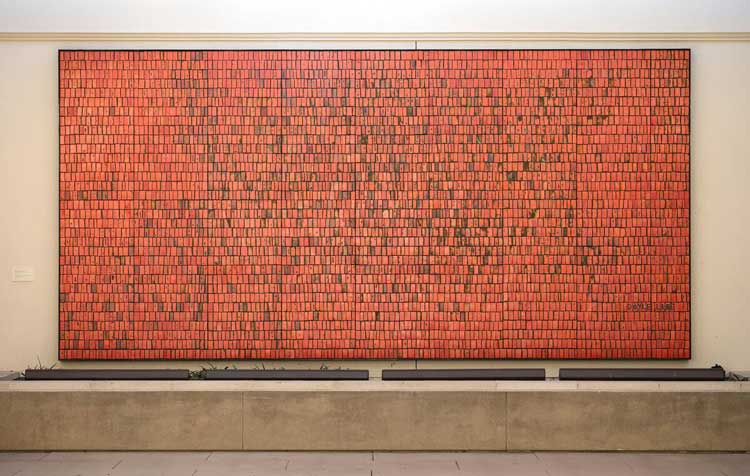
Doyle Lane, Mutual Savings and Loan Mural, 1964. Glazed earthenware, 100 ×216 in. Gift of MS Property Company. The Huntington Library, Art Museum, and Botanical Gardens.
Click on the pictures below to enlarge

Copyright © 1893–2026 Studio International Foundation.
The title Studio International is the property of the Studio International Foundation and, together with the content, are bound by copyright. All rights reserved.
 |
 |
 |
|---|



-300.jpg)