




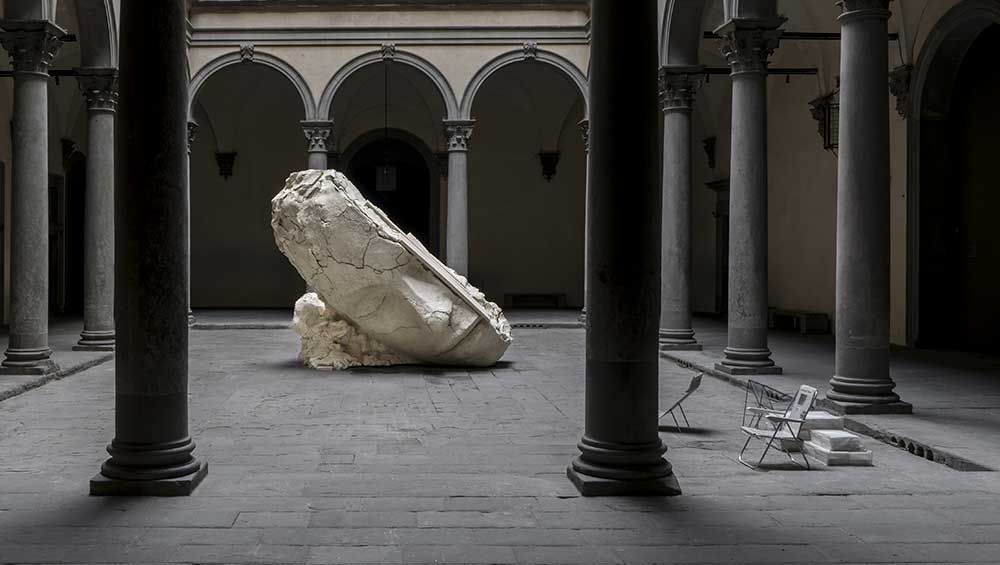
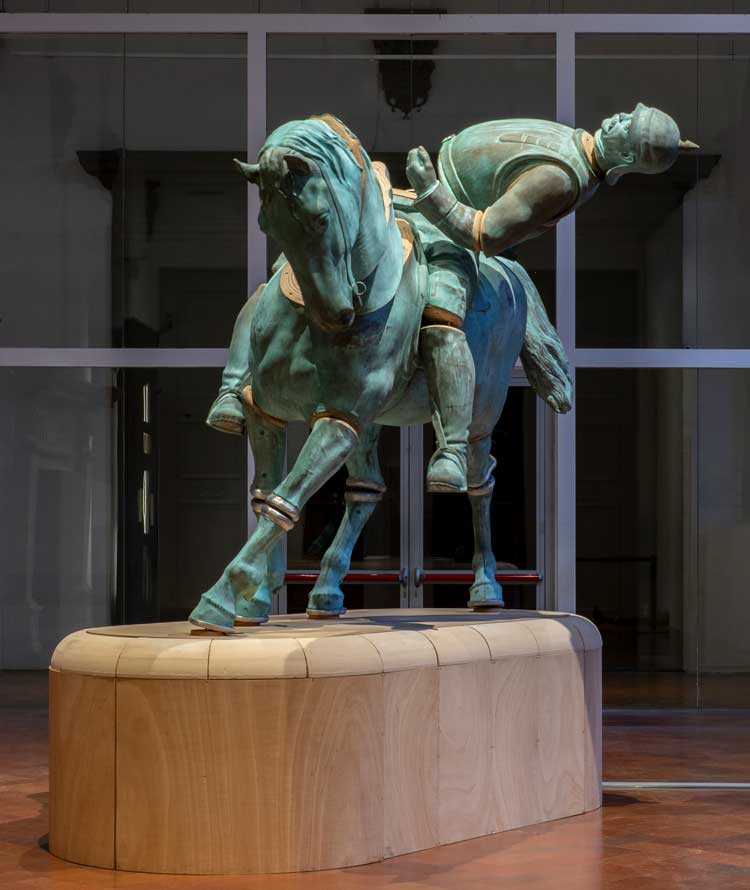
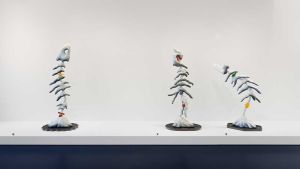
Mark Manders, Tilted Head, 2015-26. Installation view, Broken. The Power of the Fragment, Palazzo Strozzi, Florence, 25 September 2026 – 24 January 2027. Photo: Ela Bialkowska, OKNO Studio.
Palazzo Strozzi, Florence
25 September 2026 – 24 January 2027
by VERONICA SIMPSON
Anyone who has spent time in Europe’s ancient cities – such as Rome, where I was lucky enough to live in my early 20s – will have had cause to stop and stare at the ancient fragments that pepper the urban landscape; sections of crumbling wall erupting in the middle of a roundabout; remnants of statues, fountains, tombs that emerge along backstreets or parks, usually unattributed; anonymous pieces of a bygone civilisation. And yet our museums are filled with often similar-looking elements, a very different value signalled by their placement on plinths and pedestals, lovingly lit and labelled. What power and significance lie in the fragment?
It was exactly that kind of musing – while strolling through the streets of Rome with a colleague – that planted the seeds of this show in the mind of CD Dickerson, dean of the Center for Advanced Study in the Visual Arts, at Washington’s National Gallery of Art (NGA). He took a deep dive into the topic, with background reading including Pliny the elder and “his encounter with the Colossus of Rhodes lying on the ground, in pieces. He expressed awe and wonder about this fragment … [which] made me think there was a story to be told,” said Dickerson, at the opening of the show.
Installation view, Broken. The Power of the Fragment, Palazzo Strozzi, Florence, 25 September 2026 – 24 January 2027. Photo: Ela Bialkowska, OKNO Studio.
The more Dickerson delved, the more he realised that this story resonates not just across “art history, archaeology and conservation, but philosophy and literature. The fragment had become an urgent topic in its own right … but there had not been an exhibition that put that theorising to the test and made that fragment come alive to the public.”
Pulling this show together, and making it interesting, intelligible and relevant must have been quite the journey for Dickerson and his fellow curators, Andrew Sears, assistant curator of Northern European paintings at the NGA, and Arturo Galansino, director general of Fondazione Palazzo Strozzi.
A major collaboration between these Florence and Washington institutions, the show features about 75 sculptures, drawn from across the globe and almost the history of human civilisation. It entailed navigating collections and negotiating with an impressive variety of lenders, including the Louvre in Paris, the British Museum, New York’s Metropolitan Museum of Art, Athens’ National Archaeological Museum, the National Roman Museum, Florence’s National Archaeological Museum and the National Museum of Anthropology in Mexico.
Installation view, Broken. The Power of the Fragment, Palazzo Strozzi, Florence, 25 September 2026 – 24 January 2027. Photo: Ela Bialkowska, OKNO Studio.
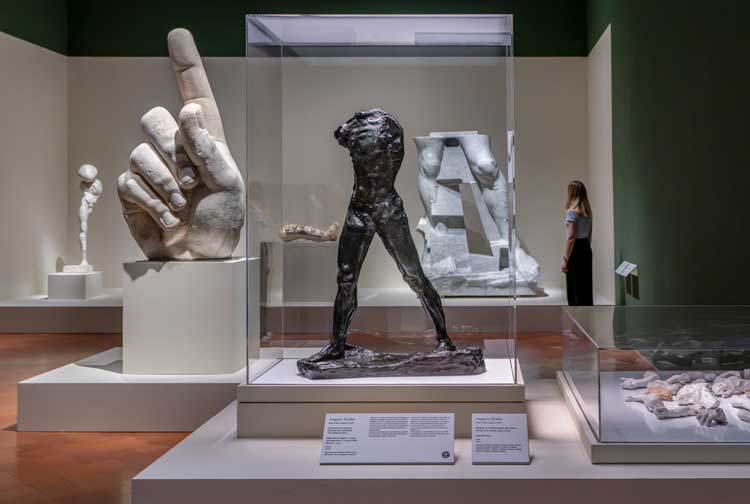
Themes emerged, according to the origin of the sculptures or the cause of damage – through accident, acts of vandalism, war or erosion. But, Sears said at the preview, the closer they looked into contexts, the more “the categories … started to undo themselves. What is a fragment? What is a sculpture? What is a figure or body? And most importantly … what is breakage?” Questions around the latter multiplied as they explored the aesthetic of the ruin, as deployed by Rodin – the purpose and energy of his statue shown further into the show, L’Homme qui Marche (The Walking Man) of 1899-1900, seems, if anything, to be exaggerated by the deliberate omission of a head. And for some of the contemporary artists featured – Louise Bourgeois, Alberto Giacometti, El Anatsui, Huma Bhabha – fractures and absences are the point. As Sears said: “The line between breaking and creating is not as clear as one might think.”
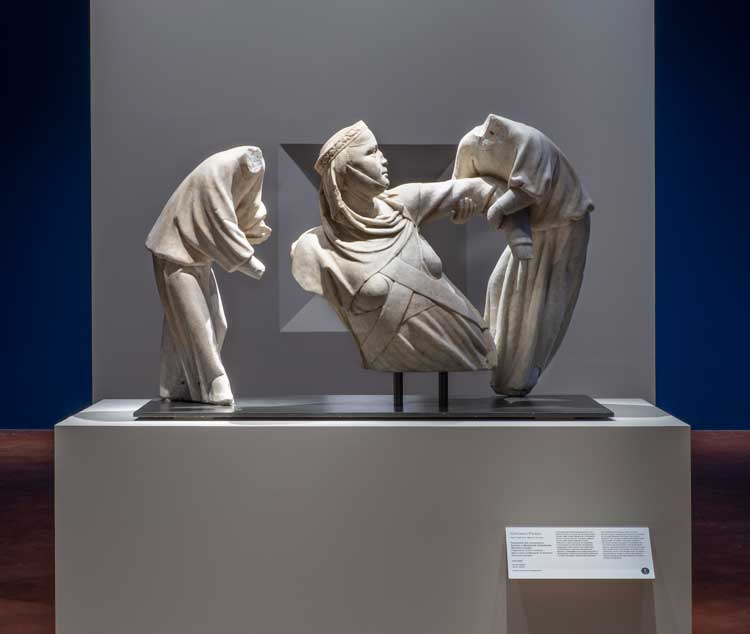
Giovanni Pisano, Fragments of the Funerary Monument of Margaret of Brabant (Elevatio animae), 1312–1314, Apuan marble, 78 × 118.2 × 33.8 cm. Genoa, Museo di Sant’Agostino. Installation view, Broken. The Power of the Fragment, Palazzo Strozzi, Florence, 25 September 2026 – 24 January 2027. Photo: Ela Bialkowska, OKNO Studio.
The exhibition starts with the glowing white marble body of Margaret of Brabant, wife of Emperor Henry VII, part of a funerary monument he commissioned from Giovanni Pisano after her death in 1311. Pisano renders her hopeful, upturned face eerily human as she is lifted from the tomb by two crouching figures (angels, now headless and wingless) aiming to guide her soul to heaven. Made in about 1315 and installed in the church of San Francesco di Castelletto, it was later dismantled and reinstated elsewhere in the church, before being relocated to the garden of a villa. As the caption states: “Its transition from a funerary and devotional image to a decorative element reflects changing attitudes towards and uses of sculptural fragments.”
Beyond Margaret is a tall, double-sided plinth, containing a series of heads. They are placed at eye level – the better for us to empathise with them, according to the curators. “Their varying states of brokenness reflect many forces: natural erosion, political upheaval, iconoclasm, excavation, looting, restoration, and reuse,” states the accompanying caption. “Breakage focuses attention on their features, expressions, and the traces of history.” It certainly brings their expressions and textures into focus.
A head of a goddess, probably Aphrodite, from the amphitheatre the Odeon of Herodes Atticus in Athens, dated the second century AD, appears to have “tears” running down one of her cheeks; streaks of oxidisation caused by rain on the sculpture’s bronze eyelashes. A crowned head of a Vietnamese Bodhisattva Avalokiteshvara in bronze (from 700-800AD) reveals multiple scratches and scars, making the deity look vulnerable and earthly. We are told the scratches come from farming tools being used in the fields where the statue had lain buried for centuries.
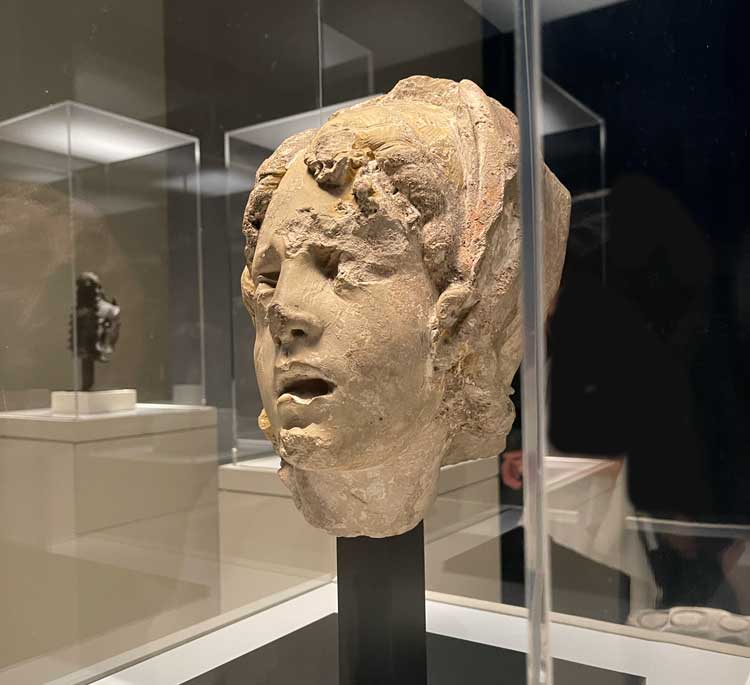
Head of a female saint (from an Entombment) – French statue, c1500-55. Installation view, Broken. The Power of the Fragment, Palazzo Strozzi, Florence. Photo: Veronica Simpson.
I am more struck by the look of suffering on the stone face of a woman – a female saint, from an entombment, from Nevers in France. Her pain seems justified and magnified by the erosion of her eyes, forehead and chin. Sears points out that sometimes burial can be a distinct advantage (to an art historian, anyway), as with the Roman Head of an Amazon (c25BC to 15AD), from Herculaneum, whose centuries-long interment under volcanic material meant that the original, painted, coppery colour of her hair has been preserved.
As Dickerson says at the preview, these are not just any fragments. “You can see some of the highest masterpieces of these cultures from around the world. We are not only looking at very interesting stories, part of a larger history but we are in front of really important artworks.”
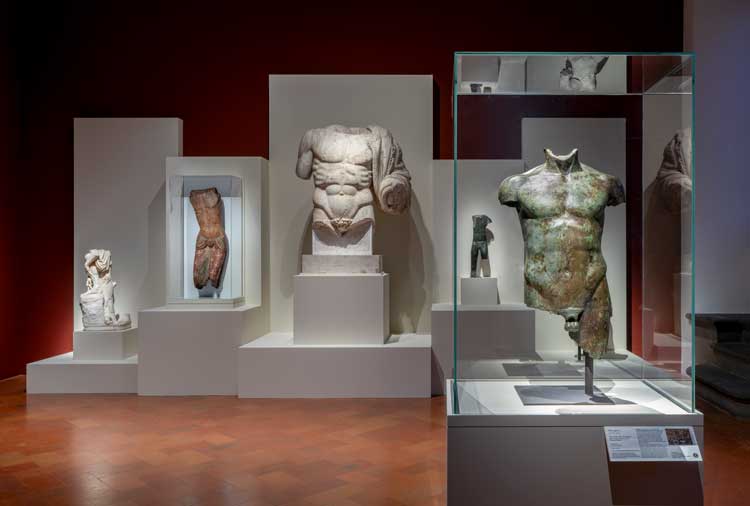
From heads we move, naturally enough, to torsos, or “bodies”, as Gallery two is titled. For me, there are two standout pieces. One is a headless Crouching Venus. Found in Rome, by the Palazzo del Viminale, this mid-second-century AD marble figure glows with serene grace: the skill that conjures her perfect proportions, the curve of her thigh, her waist, the soft fold of her belly is not diminished by the absence of head, hands or one arm. The remaining, partial arm reaches protectively across her chest. Her beauty and vulnerability are expressed perhaps all the more clearly for these omissions.
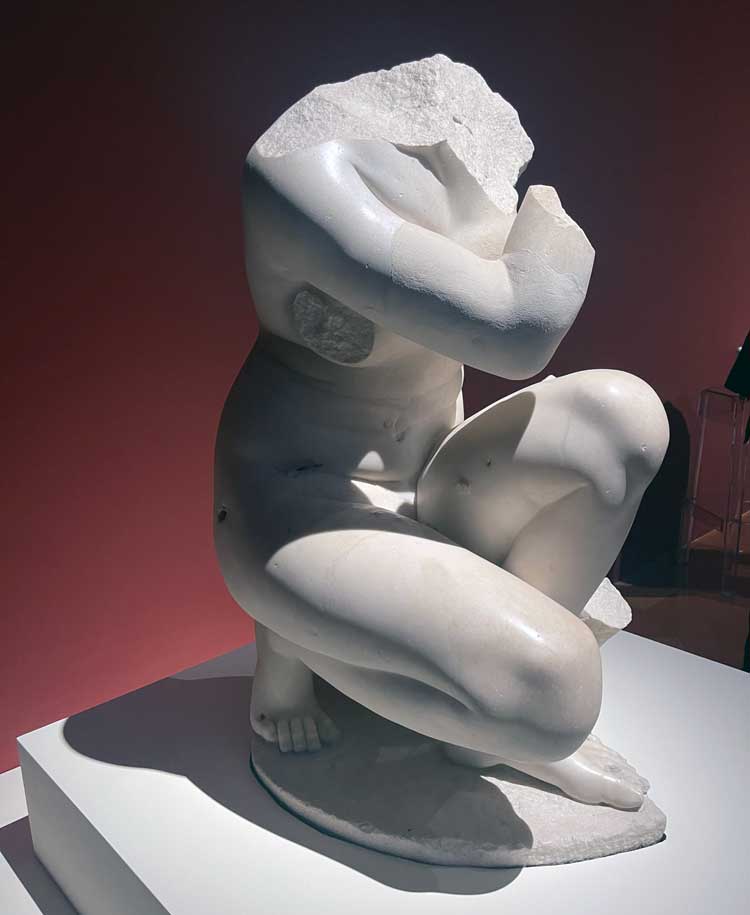
Crouching Venus, mid-second-century AD. Installation view, Broken. The Power of the Fragment, Palazzo Strozzi, Florence. Photo: Veronica Simpson.
The Livorno Torso is also quite the find. Its delicately patinated metal body floats in a free-standing case, the better for us to admire its musculature – a classically Greek kind of macho man, even his pubic hair is lovingly detailed. (And his plight is perhaps rendered more moving by the presence of two bronze testicles, but no penis). The Livorno Torso dates back to the first century BC, and apparently entered the Medici collections in the mid-16th century, “at the behest of Cosimo I, after probably having been brought ashore at the port of Livorno”, according to the caption. Recent restoration removed shell remains, which confirmed the belief that it had lain underwater for centuries, as well as its Greek origins. It was apparently one of the most prized works in the Medici collection.
Gallery three is dedicated to “iconoclasms” – sculptures erected to commemorate key figures or events, but destroyed, dismantled or left to rot due to shifts in political allegiances. There is a large, bronze foot from an equestrian monument to Louis XIV once placed prominently in Paris (designed by François Girardon and cast by John Balthazar Keller, c1692-94) and a single bronze hand from a monument to Louis XV (by Edme Bouchardon, dated 1758). Both these statues were dismembered during the French Revolution. As Sears points out, it takes a huge amount of effort and “great determination” to destroy a bronze monument. What is just as interesting is that these lonely bronze appendages were the body parts that someone felt worth preserving for posterity.
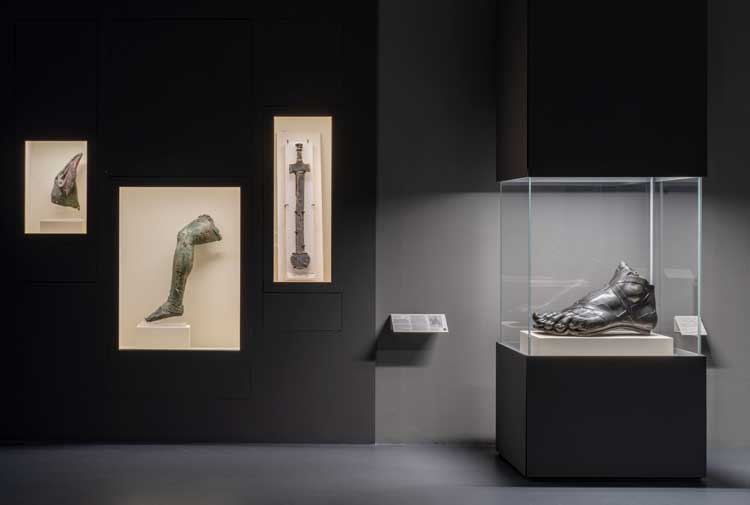
Far right: bronze foot from an equestrian monument to Louis XIV, designed by François Girardon and cast by John Balthazar Keller, c1692-94. Installation view, Broken. The Power of the Fragment, Palazzo Strozzi, Florence, 25 September 2026 – 24 January 2027. Photo: Ela Bialkowska, OKNO Studio.
Also torn down during the French Revolution was the elegant, intelligent face belonging to one Head of a Magus, half of which remains, taken from Notre-Dame cathedral, which ended up being “reused in the foundations of a building”. One man’s monument is another man’s rubble … This was the room that perhaps resonated longest after I had left the exhibition. It was worth taking time to sit – grateful for one of very few seats around the exhibition, provided by a deep stone ledge below a window – and ponder the violence that split these bodies apart. What perhaps made this room more impactful was that four or five of the exhibits were placed within the room space, rather than ranged along the perimeter. This meant viewers could circulate freely, and perhaps be reminded that human choices and actions, by people not unlike us, brought these works of art to their grisly end. Most menacing of all, perhaps – because the history is recent – was the head and shoulders of Italian dictator Benito Mussolini (from a 1923 statue made by Adolfo Wildt). When this monument was taken down at the end of the second world war, his bronze face was hacked and gouged – as if the intention had been to do real violence to the man.
The exhibits in Gallery four met similar ends, as indicated by the theme War and Colonialism. One of the most interesting pieces here is a headless Khmer statue of Rama, made for the Chen Temple in Cambodia in about 900AD. It was cut from its pedestal during the Cambodian civil war, and the legs and torso were circulated on the illegal art market. It found its way to the Denver Art Museum, which repatriated it in 2016, once it was proved – by tracing a line around the statue’s ankles, which remained embedded in the original plinth, in Cambodia – that the body and plinth belonged together.
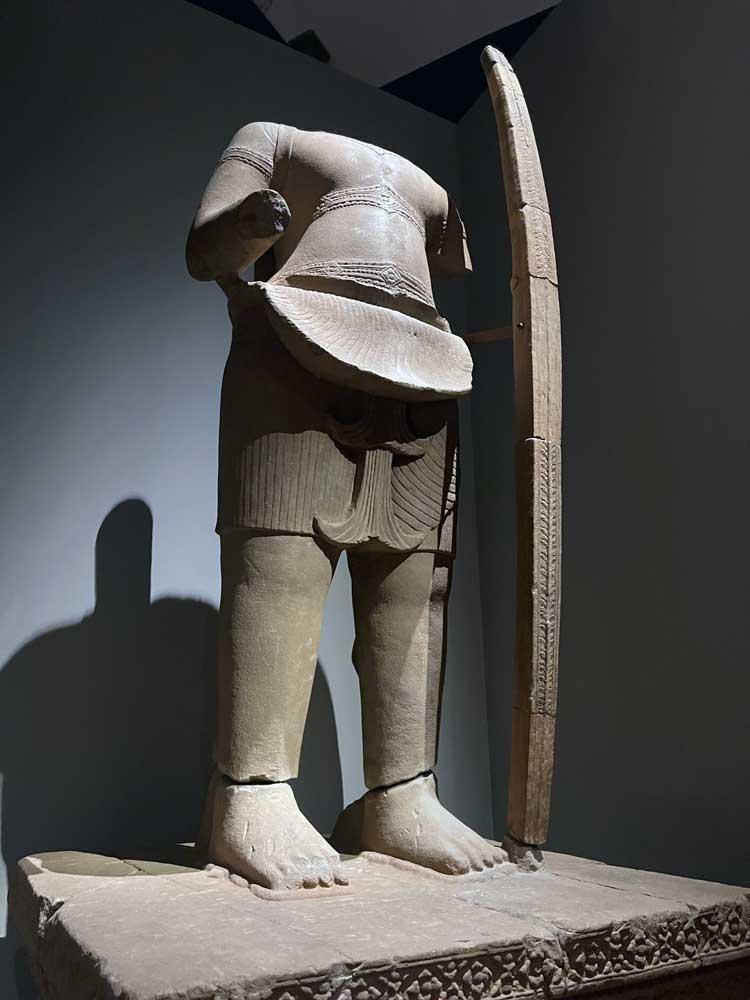
Khmer statue of Rama, made for the Chen Temple in Cambodia in about 900AD. Installation view, Broken. The Power of the Fragment, Palazzo Strozzi, Florence. Photo: Veronica Simpson.
Do the stories of rediscovery sometimes eclipse or distract from the art? Occasionally, but they also enrich the experience, as with the insight the curators share of the Egyptian bronze face that is displayed at the end of the gallery. It would have been placed in a royal tomb to house the spirit of the deceased in case they should decide to return. When looters broke into the tomb, they destroyed part of its nose and mouth “so it couldn’t breathe and claim vengeance”, says Sears.
Interestingly, looting is an issue that is touched on only lightly in this exhibition (as is restitution), even though we know that, for all the exhibits in the world’s museums that have been “rescued” from dereliction or neglect – with or without legal permission – there are probably a dozen times as many looted masterpieces still on the illegal art market. The recent news stories about more than 2,000 items going “missing, lost or stolen” from the British Museum collection (in 2023), as well as the robbery of priceless artefacts from the Louvre in 2025, reinforce the fact that there can be many afterlives for the world’s precious treasures.
Moving swiftly on to Gallery five, we contemplate the toll that events such as earthquakes, floods, fire or shipwrecks can take on once-precious items. A standout exhibit in here is The Crouching Boy: the figure of a young man, carved out of marble, his hunkered stance implying he is either preparing to leap for safety or to be lifted, though his raised left arm has decayed to a grizzly stump, as has most of his left leg. Found in 1900 by sponge-divers, this statue – and a bronze Left Arm of a Boxer, displayed nearby – sank when a ship foundered near the Greek island of Antikythera in first century BC. The still-pristine marble elements were preserved because they were buried in the sand. It’s the exposed elements that nature has ruined – but how moving the contrast, in this context.
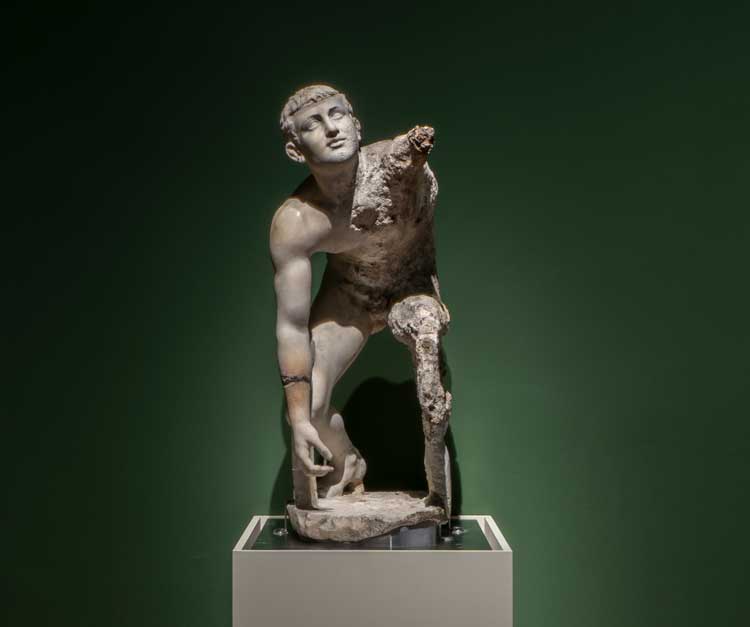
The Crouching Boy, Greek statue, early 1st century BCE. Installation view, Broken. The Power of the Fragment, Palazzo Strozzi, Florence, 25 September 2026 – 24 January 2027. Photo: Ela Bialkowska, OKNO Studio.
Sometimes fragments are deployed to make something new, as we find in Gallery six, titled The Reassembled Body. We have a Byzantine Arm Reliquary of Saint Anna – perhaps containing the arm of the same saint. Pieces of saints – arms, fingers, toes, hair, even heads – were traded feverishly among the clergy in the middle ages, as it was thought that the presence of a piece of saint in your church would ensure the prayers of the faithful might be conveyed more swiftly to heaven. Now there’s a fragment sub-category to delve into. It’s a beautiful relic, all the same.
In the same showcase, there is a hand “made of hammered sheets of gold, with inlaid turquoise and silver fingernails”. It was made by a Peruvian tribe called the Lambayeque, who lived on the northern coast. As in many other civilisations, gold was associated with the sun, silver with the moon, and turquoise with the water or sky. Luxury objects that resembled body parts were apparently often placed in royal tombs alongside the mummy, “serving as an extension of the deceased’s body”.
As intriguing, but for different reasons, is the “Restored head and right arm of sleeping Ariadne”, made in the 1540s to 1580s. According to the caption: “Ferdinando I de Medici acquired fragments of the statue of Sleeping Ariadne for his villa on Rome’s Pincian Hill.” This head and right arm were carved to complete the sculpture, but on a slightly reduced scale – the suggestion was that they were made from “parts of the statue that were beyond repair”. It was rediscovered in storage in 1883.
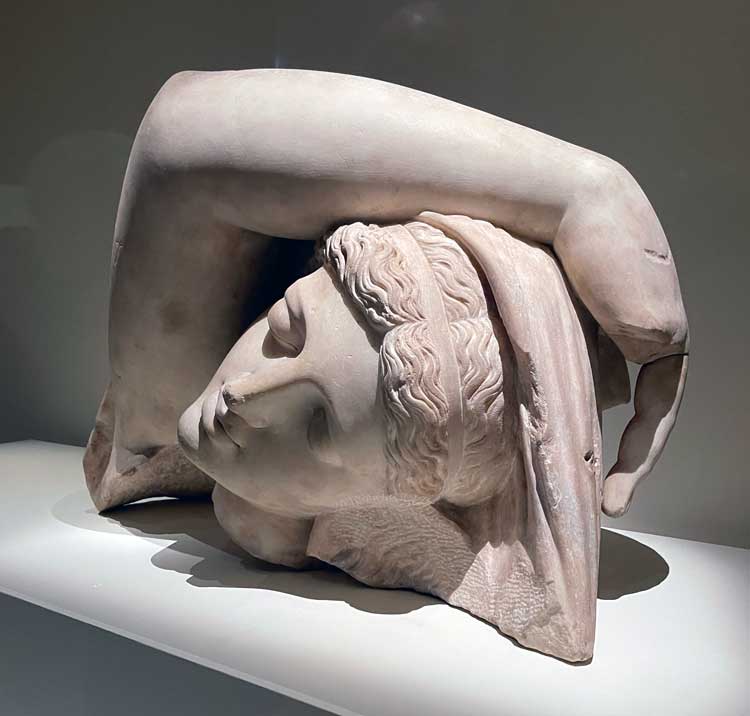
Restored head and right arm of sleeping Ariadne, made in the 1540s to 1580s. Installation view, Broken. The Power of the Fragment, Palazzo Strozzi, Florence. Photo: Veronica Simpson.
I was also drawn to an African Youth statuette – the head is Egyptian, c180-150BC, but the body is from some time before 1590. The head is extraordinary – upturned eyes vivid in a skilfully carved face. Paradoxically, the level of detail in this much older head contrasts strikingly with the cracks and rough-handling evident in the newer body.
Gallery seven is a small room dedicated to Vietnamese artist Danh Vo. At first glance, the three works here seem rather less than the sum of their parts: a c16th-century cupid, for example, is attached to a piece of flimsy wood. Some stone fragments are tucked away, out of sight, in a Rimowa suitcase. However, the suitcase refers to a work he made in 2008: to transport a 16th-century wooden statue of Saint Joseph without paying shipping costs, he cut it into pieces so that they could be carried on as hand luggage, later exhibiting them in the suitcase.
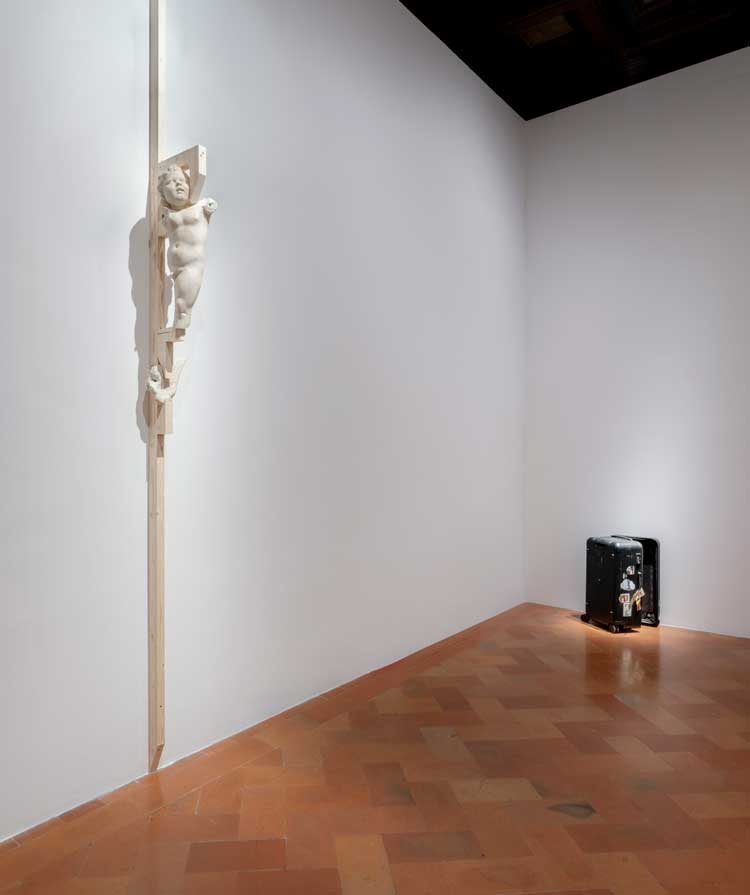
Danh Vo gallery, installation view, Broken. The Power of the Fragment, Palazzo Strozzi, Florence. Photo: Veronica Simpson.
Gallery eight is themed Sculpting the Fragment. The dominant element – physically and symbolically – in the room is the Roman Right Hand of a Colossal Statue, dating from the first to fourth century. The hand, discovered in the 18th century, entered the collections of the Capitoline museum. It was once thought to be the hand of Colossus of Constantine, but its wrist is too narrow to join the surviving forearm.
In this room is the aforementioned Rodin Walking Man and Model of a Nude Woman (c1533), a terracotta model of an incomplete female figure by Michelangelo, to show that fragmentation was an aesthetic many desired. The caption states: “Michelangelo was fascinated with fragments. He drew them, wrote about them, and created sculptures that evoked them – including this one. While the left arm is definitely broken, fingermarks under the edges of the other arm indicate that he deliberately created that arm to stop where it does. The figure was meant to look like a fragment.” The curators mark this as “the very beginning of a dominant trend in western sculpture: the broken figure as a complete work of art”.
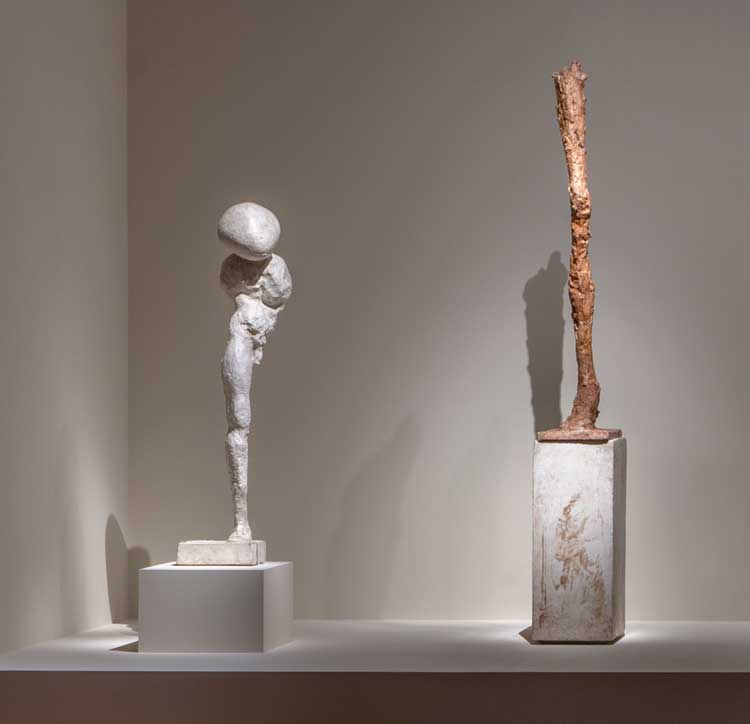
Left: Alina Szapocznikow, Filosofo/Philosopher, 1965. Right: Alberto Giacometti, La Jambe, 1958. Installation view, Broken. The Power of the Fragment, Palazzo Strozzi, Florence, 25 September 2026 – 24 January 2027. Photo: Ela Bialkowska, OKNO Studio.
Nearby, as if in evidence, we have striking fragmented heads by Bhabha and Anatsui. At the opposite end of the room a bloated white head – all cranium – lurches forwards, on what appears to be one extended limb. Filosofo/Philosopher (1965), a disturbing plaster work by Alina Szapocznikow, a Polish-born artist who survived the Holocaust and settled in Paris in the 1950s, it appears to be a less than flattering statement on the exponents of this discipline. Beside this is a long and sinewy, brown leg (La Jambe, 1958) by Giacometti, conceived as an “autonomous fragment”. Nearby is Bourgeois’s soft, fabric leg displayed in a plastic and metal brace, like the splints once used for wounded soldiers. Called Foot (1997), this fragment, we are told, is “vulnerable and protected”.
Julius von Bismarck, The Elephant in the Room (Otto von Bismarck), 2023. Installation view, Broken. The Power of the Fragment, Palazzo Strozzi, Florence, 25 September 2026 – 24 January 2027. Photo: Ela Bialkowska, OKNO Studio.
Taking up most of the space in the penultimate Gallery nine (also called Sculpting the Fragment) is Julius von Bismarck’s The Elephant in the Room (Otto von Bismarck) (2023). The artist is a descendent of Otto von Bismarck, who in 1871-89 was the first chancellor of the German Empire. He has replicated a life-sized figure of his ancestor on horseback, but attached each segment to a rope structure that allows it to almost disintegrate, and then slowly reform – like the classic “push puppet”. The creaking of these ropes, on its slow descent and ascent create an eerie backdrop.
The final room is dedicated to a bizarre but compelling work by Paul Pfeiffer, from a series called Incarnator (2018-), in which he explores the fetishisation and deification of the modern celebrity. To make this work, Pfeiffer commissions incarnadores – practitioners of ancient techniques of craftsmanship who create realistic flesh-like body parts for crucifixes and shrines. Here, incarnadores from Mexico, Spain and the Philippines have fashioned individual components of Justin Bieber: his head, torso, legs and arms. It is intriguing that the finished models, worked from the same original materials, are similar but not identical. These parts are scattered across two walls, looking – albeit without the gore – more like an explosion or bizarre accident in a mortuary, and less like a form of worship. It is certainly less poetic than the resting, Buddha-like, partially finished head by the Dutch-Belgian artist Mark Manders that sits in the courtyard of this handsome Renaissance building, part of his Silent Studio (Reduced to 88%) (2005-26) installation.
Manders places this Tilted Head (2015-26) – which looks like clay but is a resin cast of an original clay model – at the centre of what he calls “a temporary studio”. To evoke this studio, we see office furniture, but reduced by 88% – two lounge chairs and two lightweight studio chairs. They trigger feelings of familiarity and, due to their scale, mild displacement. These are accompanied by piles of newspapers also created by the artist, in which he has used every word in the English language – but only once, and randomly arranged. So, they remain unreadable. It is a scene and work that invites contemplation and closer investigation and is thus an apt amuse-bouche for the visual pleasures and wide-ranging historical and philosophical challenges of the works awaiting you in the gallery upstairs.
• Broken: The Power of the Fragment will be presented in a newly conceived version at Washington’s National Gallery of Art from 13 March to 27 June 2027.
Click on the pictures below to enlarge

Copyright © 1893–2026 Studio International Foundation.
The title Studio International is the property of the Studio International Foundation and, together with the content, are bound by copyright. All rights reserved.
 |
 |
 |
|---|
-300.jpg)


-300.jpg)
 Jill Spalding talks to American sculptor Alice Aycock
 Rodin
Rodin Louise Bourgeois
 Michelangelo Pistoletto: The Mirror of Judgment
 Interview: Kim Thomas Reflects On Art, Music, Poetry and Life