




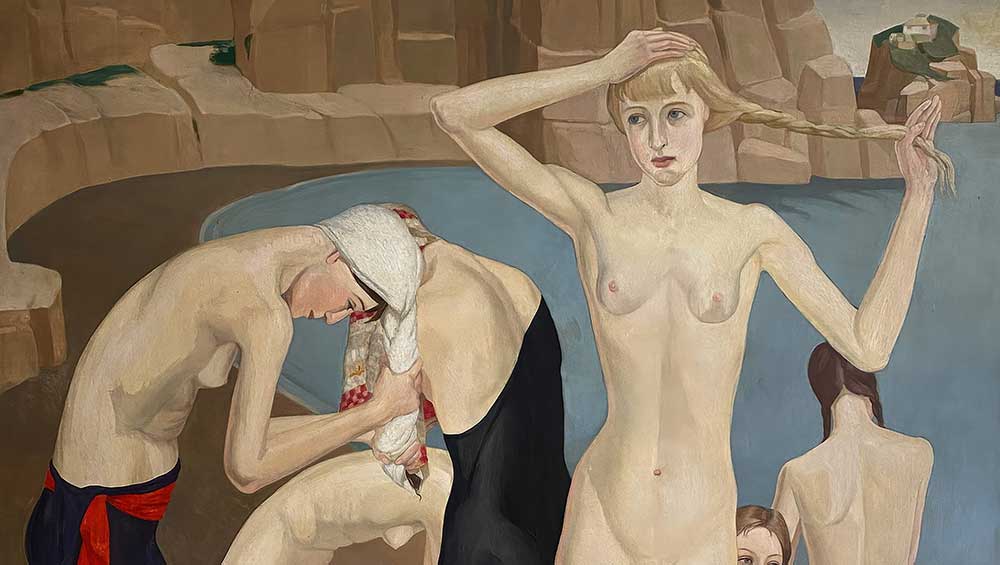
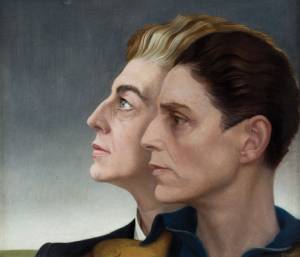
Gladys Hynes, Morning, 1916 (detail). Oil on panel, 117 x 98 cm. Collection RAW. Photo: Sacha Llewellyn, with permission from Jonathan Young.
Charleston in Lewes
2 May – 11 October 2026
by ANNA McNAY
Despite being involved in many of the key artistic groups and movements of her time – the Newlyn School, the Omega Workshops, Frank Brangwyn’s London School of Art – Gladys Hynes (1888-1958) has remained an unknown. Doubtless this is due in part to the loss of the majority of her works (she was far better known during her lifetime for her wood carvings than for her paintings) and in part to her gender (in 1950, Hynes said: “I believe part of the trouble is that the world is controlled only by men.”), but why else might someone so connected and well-known fade into obscurity? She was even omitted from the (auto)biographies of her closest friends (including Nina Hamnett’s memoirs and Patricia Hutchins’ biography of Ezra Pound). Whatever the reasons, this exhibition seeks to bring Hynes back into the spotlight. This might have proved difficult, with only a handful of paintings to work with, but the team at Charleston in Lewes has done Hynes proud. Yes, the show is primarily made up of works by Hynes’ contemporaries, but – and I say this only rarely – it really works. If anywhere were to pull it off, this, the companion to the home of the Bloomsberries, where friendships and love affairs were as important as the art itself, would be the place. And Hynes lived by the ethos of making art life and life art. Accordingly, the exhibition highlights Hynes’ close relationships with her artist cohort, including Hamnett, Jacob Epstein, Vanessa Bell, Cedric Morris, Laura Knight, Gluck and Dod Procter.
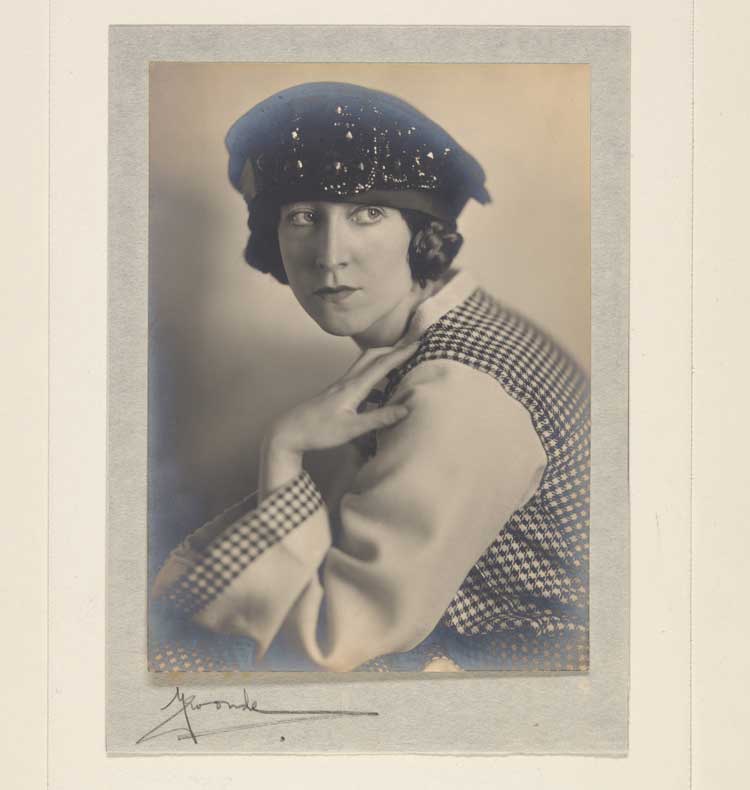
Dod Proctor, Pencil drawing of Gladys Hynes with hat, 1919. Photo: Sacha Llewellyn.
The exhibition is divided into five sections, each focusing on a key facet of Hynes’ life and career: the Newlyn School, the Omega Workshops, wartime work, sacred art and illustration and design. These themes are then fleshed out with works of her own and ones that speak to, contrast with, or complement these, thus giving us much more detailed insight into Hynes as a person and artist.
Born in India of Anglo-Irish descent, Hynes moved with her family first to London and then, following the death of her mother, to Cornwall in 1911, where she was introduced to the avant-garde Newlyn School and thriving artists’ colony. Here, Hynes was described by one contemporary as “the most beautiful and the most promising” student. In her work from this period, we can see Hynes adopting a strong sense of design in her simplified compositions. For example, The Fowler (1917-19), which draws on an Aesop’s fable in which the innocent stork is trapped, and depicts the Three Graces as calm, observing figures – perhaps a statement on the stabilising presence of women. Similarly, in Boys Bathing in Harbour (Preliminary Study) (c1916), Hynes’ first Cornish work, the figures are long and attenuated, seen more as forms in relation to one another than as bodies as such. Whereas some of this calm and modernist simplification might be seen in Procter’s roughly contemporaneous Lilian (1922), it is wholly absent in her later, much sketchier Boy and Canary (c1952), whereas it remains throughout Hynes’ oeuvre. Another interesting comparison might be with Christopher Wood’s The Bather (c1926), which, although a simplified form, nevertheless remains very much about the female body and its sex appeal, the conical shell echoing her conical breasts, one of which has slipped out of her red bathing suit.
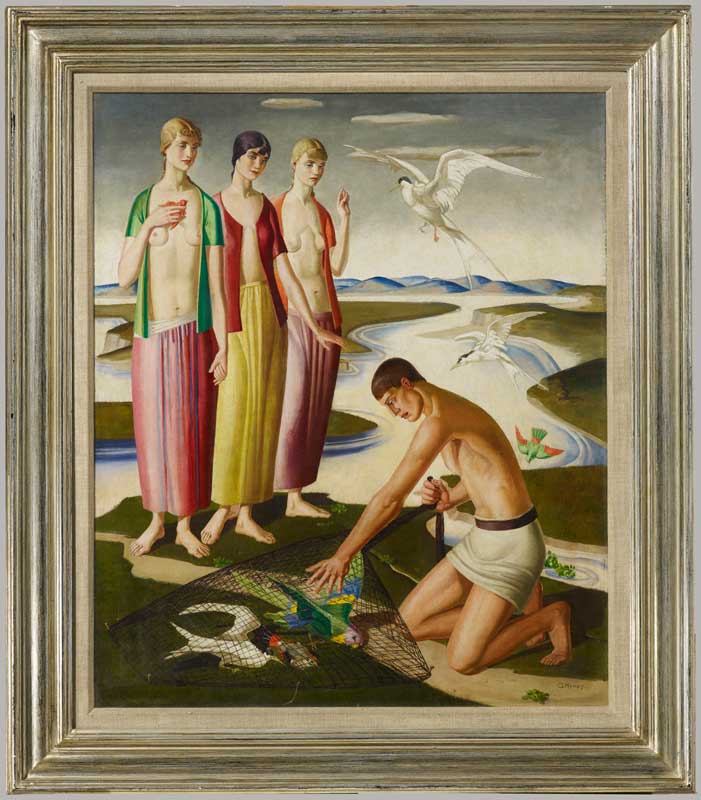
Gladys Hynes, The Fowler, c1917-19. Oil on canvas, 30 ¼ x 26 ½ x 2 1/8 in. The Wolfsonian–Florida International University, Miami Beach, Florida, The Mitchell Wolfson, Jr. Collection. Photo: Lynton Gardiner.
As mentioned, Hynes was better known for her sculptural works, but the sole example of these on display is the wooden head of Anthony Butts (1925), a smooth and beautifully executed piece, painted with bright red lips, which are suggestive of the sexually fluid, predominantly lesbian circle in which Hynes moved. Portraits of this circle, including Radclyffe Hall, Una Troubridge and Edith Sitwell, are included in her marvellous painting The Private View (1937), which looks like something straight out of a 1930s movie.
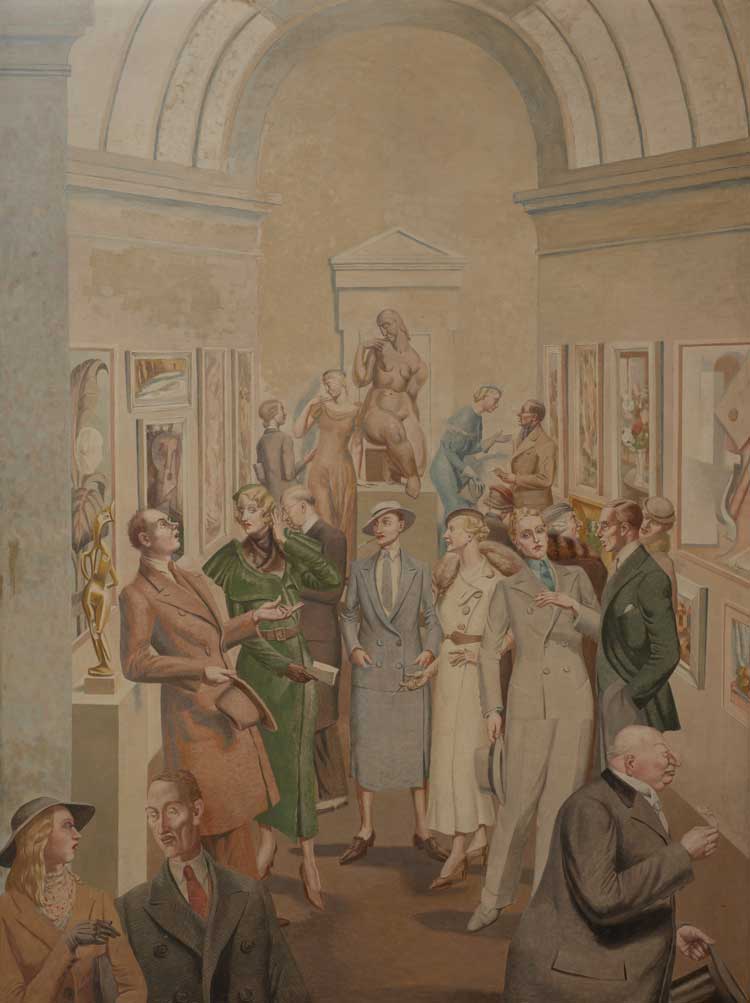
Gladys Hynes, The Private View, 1937. Oil on panel. Kindly loaned by the executors of the late Coral Samuel CBE. Photo: Sacha Llewellyn.
One of the best things about this exhibition, and its inclusion of a range of artists, is that it truly does conjure up the respective atmospheres, Morris’s Café de la Rotonde (1921) being a case in point. Another work capturing the essence of the scenario is Roger Fry’s portrait of Hamnett (1917), wearing a dress designed by Bell. We know that Hynes worked for the Omega Workshops – “making hats to go with their dresses” – but everything produced there was signed with only an Ω, so nothing can be accurately attributed. Later design works by Hynes include book jackets for Constable & Co (“damned jackets for novels that ought never to have been written”), painted screens, suffrage banners, decorative objects and a choir stall panel for St Hilary’s Church in Marazion. In 1989, her acclaimed, lacquered-wood Madonna and Child was stolen from St Dominic’s Priory in Hampstead. Speaking of both Bell and the Madonna, however, my favourite object in the show is decidedly a ceramic Madonna and Child by Bell (1913), which depicts the figures as if enclosed in a chrysalis, fully abstracted into form and colour, and yet still somehow fully recognisable for who they are.
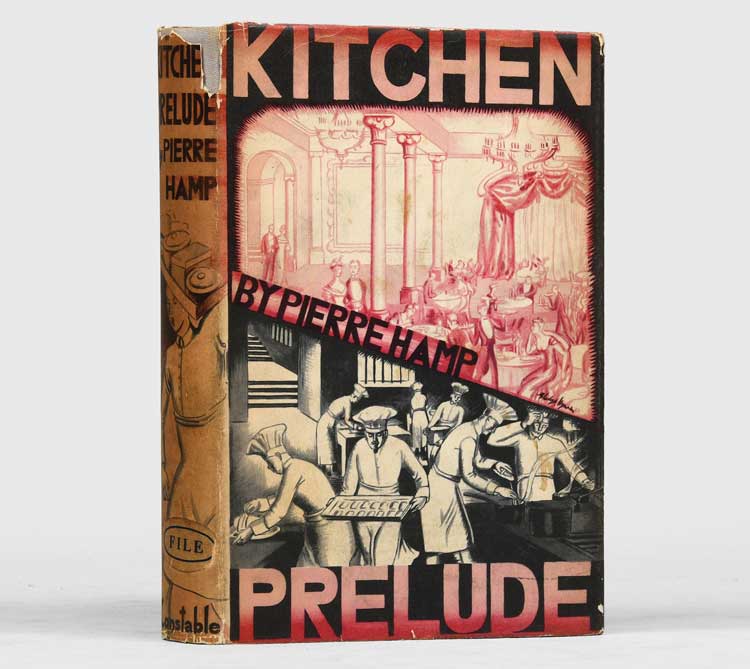
Pierre Hamp, Kitchen Prelude, cover designed by Gladys Hynes. Private collection. Photo: Sacha Llewellyn.
For a while during the second world war, Hynes focused on painting flowers, and Gladioli (1940) is a beautiful, watercolour example, reminiscent of both Morris’s and Gluck’s works. During the 1940s she converted to Catholicism, having intermittently attended Roman Catholic convent schools as a child. She was especially drawn to forms of religion aligned with her feminist beliefs, such as those espoused by the St Joan’s Social and Political Alliance. She described her fabulous painting of creatures queuing up in pairs to board Noah’s Ark (1921) as “great fun”, whereas Cherubs (1939), depicting a flurry of the heavenly beings amid a crowd of pink and white flamingos and parakeets, might only really be described as visionary.
Her portrait of Saint Martin de Porres (1953) blessing a man while a young boy looks on raises issues of race and racial representation. While Hynes admired Martin as a saint “concerned with the abolition of colour prejudice”, her picture nevertheless reflects stereotyped imagery. The exhibition closes with a section focused on “tropical fantasies”, which includes decorative paintings by Hynes depicting South American and African scenes in vivid, garish colours. She drew on the visual conventions of her time in representing “exoticness” and colonial encounters. Seen today, these works might seem problematic, but, once again shown in the context of her contemporaries (Mary Adshead’s romanticised depiction of “empire” in her Tea Plantation Fantasy (design for a canteen mural) (1940s) and Procter’s portraits from St Lucia in the 1950s, for example), I think we have to see them purely as a product of the time.
Equally controversially, Hynes had a long and deep friendship with the American poet Ezra Pound, who, in his latter years, became one of the most divisive cultural figures of the 20th century, owing to his support for fascism. Hynes, too, could be seemingly contradictory, as she was a pacifist who nevertheless maintained that violence was necessary to secure Ireland’s freedom, and, as the grandchild of a Fenian, she was ardent in her expression of her Irish identity in her work. As Philippa Conlon puts it in Apollo Magazine, however: “She is blazingly righteous one minute and almost whimsical the next.” Her relationship with Pound led to their professional collaboration, in 1927, on The Cantos, for which she illustrated a deluxe edition.
During the war, Hynes’ paintings confronted the darkness, contradictions and moral tensions, while also exploring the complexities of her own beliefs and vision. Unlike her contemporaries Laura Knight and Winifred Knights, who portrayed factory women and land army girls, Hyne’s Penny for the Guy (1940) is almost surreal with its masked automaton, dressed in a military jacket, pinstriped trousers and leather gloves, sitting astride a cannon, holding a grenade in one hand and a party popper in the other. Resurgimus (1941), on the other hand, presents a more hopeful picture of a foetus growing beneath the ground and trenches, waiting to arise once more.
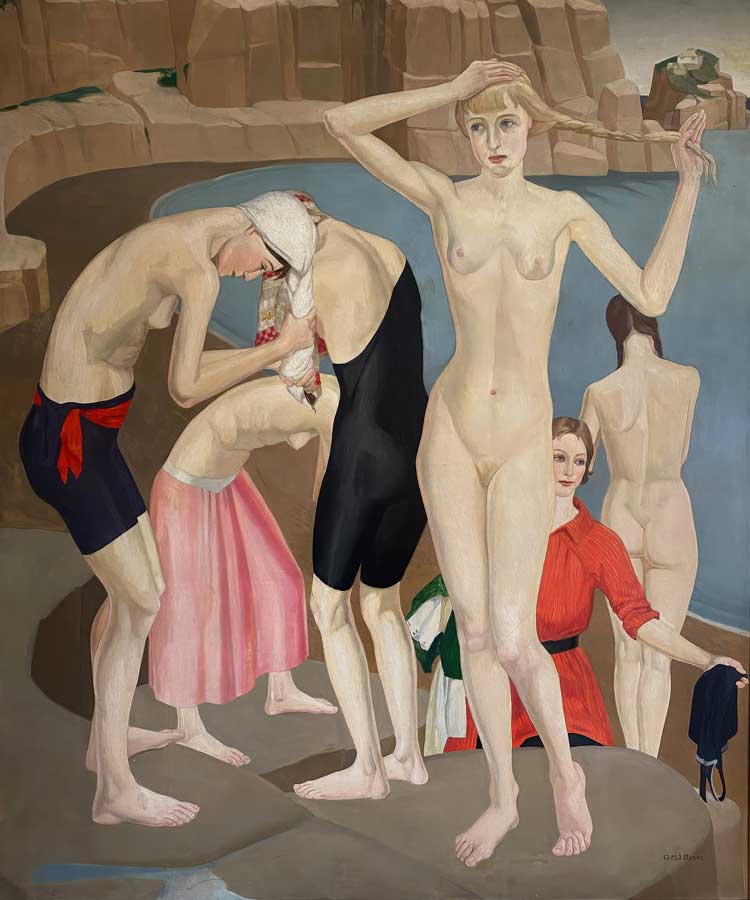
Gladys Hynes, Morning, 1916. Oil on panel, 117 x 98 cm. Collection RAW. Photo: Sacha Llewellyn, with permission from Jonathan Young.
My favourite work in the show, and the one I feel I have to end with, dates back to Hynes’ Newlyn days: Morning (1916). It is one in a series of paintings set at Lamorna Cove, a backdrop favoured by the painters of the Newlyn School, and it really sums up Hynes’ life and work, with its simplified Botticellian figures and, once more, representations of some of her circle, namely Gluck, drying her hair, and her sister Sheelah, with plaits. Some think the figure in orange might even be a self-portrait. And wouldn’t that be nice? It is certainly in just such a setting that I like to imagine Hynes, every bit as ardently righteous and flakily whimsical as she dared to be.
Click on the pictures below to enlarge

Copyright © 1893–2026 Studio International Foundation.
The title Studio International is the property of the Studio International Foundation and, together with the content, are bound by copyright. All rights reserved.
 |
 |
 |
|---|
-300.jpg)

-300.jpg)
 Cedric Morris – portraits, places and flowers: three exhibitions
 Virginia Woolf: An Exhibition Inspired By Her Writings
 Queer British Art 1861-1967
 Gluck and Modern British Women
 Jamie Crewe: Female Executioner