





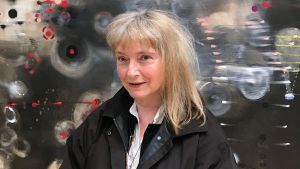
Liz Larner. Photo by Laure Joliet. Courtesy of the artist and Regen Projects, Los Angeles.
by JOE LLOYD
In Camden Art Centre’s wide-windowed Artists’ Studio, an elegant, upturned hand gropes towards the light. It rests above a curved, then flat base in shining bronze and the knotted branch of a tree, which segments into finger-like twigs. The bottom of this branch in turn balances on a replica of an owl’s foot covered in a tree pattern, from which protrude formidable talons. The whole assemblage suggests danger and desire, and a sprouting fecundity in the presence of death.
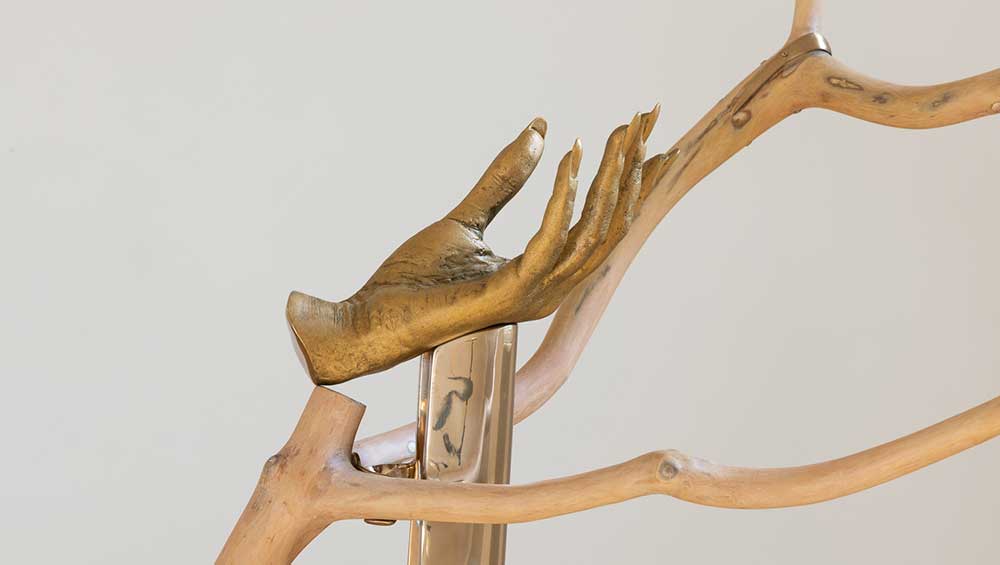
Installation view of Liz Larner, A hard line to bend at Camden Art Centre, 2026. Photo: Rob Harris.
Titled A Hard Line to Bend (2026), this sculpture is an anomaly in the Camden Art Centre’s survey of American sculptor Liz Larner (b1960), despite giving the exhibition its title. The majority of the 36 exhibited works centre around ceramics, often so heavily treated that they come to resemble other materials. Some look like lichen-slicked stones; others evoke the clay from which they were fired. The exhibition is an inventory of colour and texture. Larner’s work has been exhibited widely in the US and Europe, as well as at Galerie Max Hetzler in London and the Modern Institute in Glasgow. But A Hard Line to Bend is her first institutional survey in the UK.
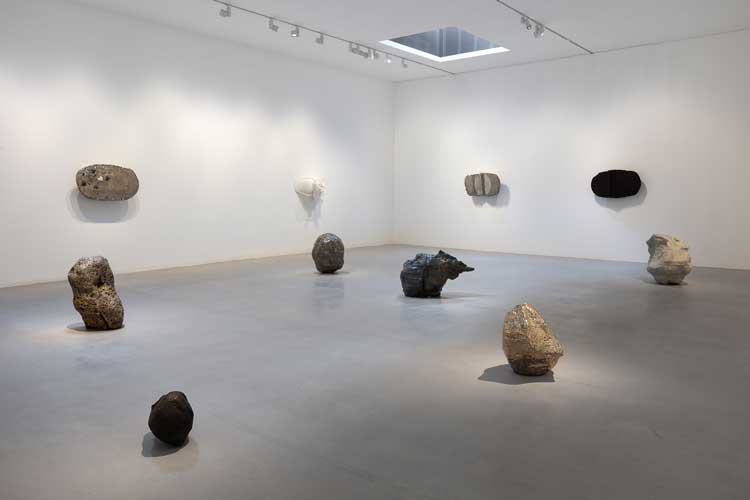
Installation view of Liz Larner, A hard line to bend at Camden Art Centre, 2026. Photo: Rob Harris.
Larner trained at CalArts in the 1980s under John Baldessari, where she specialised in photography. “Right before I graduated, I thought I don’t want to do this. I don’t want to take pictures of things. I want to make them,” she says. Larner started making things with some extraordinary materials. Damage Control (1987) is a block of dangerous substances enlacing TNT, saltpetre and ammonium nitrate; curators at the Hirshhorn Museum wanted to borrow it for its 2013 exhibition Damage Control, but it proved impossible to convince shippers to send it over. Larner says: “I’ve always felt that material has a great message, and so I work with a lot of different materials, and I always feel that it comes through in a psychic and physical way. I’m not saying it affects everybody the same way, but I just think it’s so powerful.”
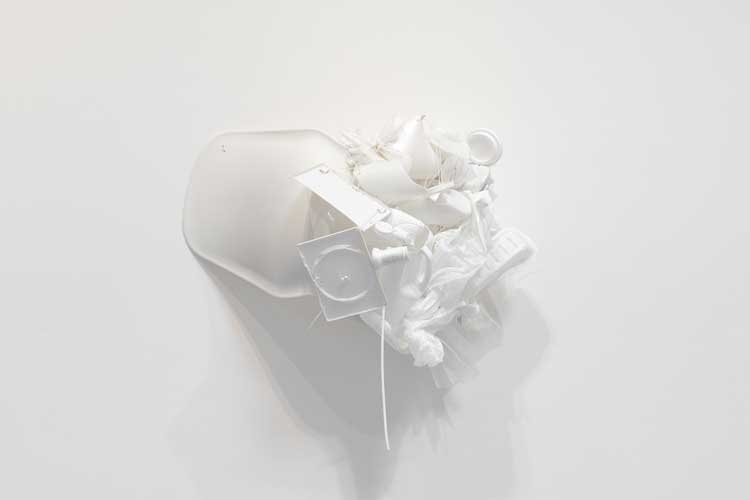
Installation view of Liz Larner, A hard line to bend at Camden Art Centre, 2026. Photo: Rob Harris.
Some of her materials seem an unlikely source for sculpture. One set of 2021 works gathers discarded single-use plastics – water bottles, coffee-cup lids, bin bags, food containers, electronic goods packaging – into teeming wall-mounted assemblages. Inspired by the discovery that much American recycling was sent to China until that country refused it, Larner gathered waste from friends, family and gallery staff. She acquired huge quantities and, after thoroughly scrubbing the material, began to tie it together by colour, recycling it into new forms. “I realised that these things are so beautifully designed,” she says. “But they’re also kind of invisible. It still blows my mind – I don’t know if it’s because the design is perfect, or because of our dread over the intense need we have for these disposable things.”
From early on, Larner also made works that enacted a process and interacted with the spaces in which they were displayed. Every Artist Gave a Breath (1988) required other artists to breathe on to an agar-filled petri dish; the resulting bacteria were then left to grow. The motorised sculpture Corner Basher (1988) hurls a metal ball and chain into the wall, leaving its mark. Beholders are allowed to choose the speed setting. Her 1980s oeuvre was not always so hazardous: Come Together (1989), reconfigured for the Camden show, sees a panoply of threads and strings – here ribbon, rope, measuring tapes, wires, lace, TV antennae and human hair – explode across the room from a central point. The floor, walls and ceiling become a necessary condition for the artwork’s existence.
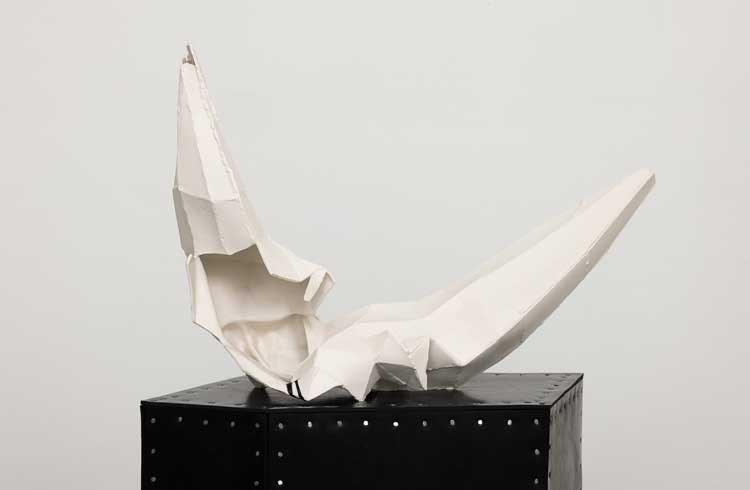
Liz Larner, smile (fangs), 1996-2010. Cast porcelain, epoxy, dry-process fibre board, rubber, steel, lead shot, 50.5 x 78.7 x 21 cm. Installation view of Liz Larner, A hard line to bend at Camden Art Centre, 2026. Photo: Rob Harris.
In the mid-90s Larner started to make ceramics a major plank of her practice. “I was never really educated in ceramics, though I took some classes,” she recounts. “It was not something I had technical prowess in – it was really this process of being led into it because of other ideas that I had.” Her first move towards the medium, on display at Camden, were Smiles (1996-2011), crinkly white porcelain sculptures based on depictions of facial expressions from literature. She says: “I had read this book [The Red, White, and Blue] by John Gregory Dunne, which made me think about how much the word ‘smile’ needs a modifier in front of it.” The process of their creation was tricky. “We had to cast them in three different parts and put them together. They were so insanely fragile. When you first put them in the kiln it’s just dust basically. I had so much lost just getting from the table to the kiln. And then when I fired them, because it was cone 10 porcelain, they would all deform.”
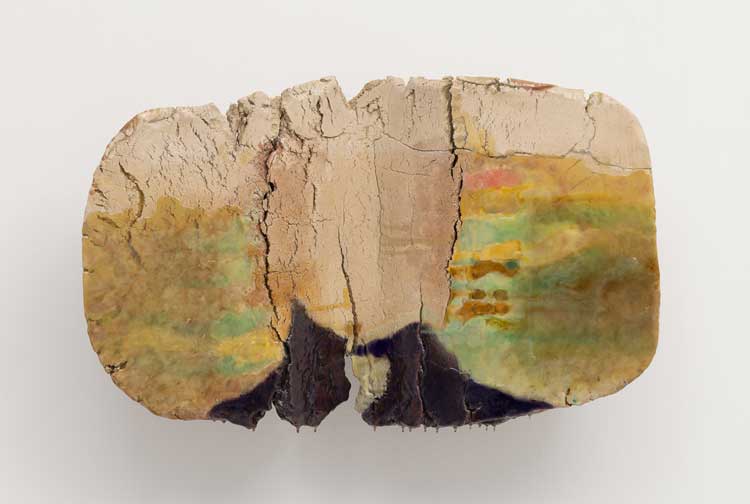
Liz Larner, Marthe, 2019. Ceramic, epoxy, 55.9 x 88.9 x 27.9 cm. Installation view of Liz Larner, A hard line to bend at Camden Art Centre, 2026. Photo: Rob Harris.
Now possessing a kiln, Larner quickly progressed towards other types of ceramic. “I was really interested in colour and form, and this was a great way to do it,” she says. Ceramic sculptures comprise the lion’s share of the work at Camden. Many are plate-like panels that protrude some distance from the wall, either by ceramic extensions of themselves or by polished metal plate backs. Larner explains: “I wanted them to not be like paintings on the wall, and I wanted them to have some space.” They range immensely in appearance and texture. Some evoke organic forms like flowers; some crumble and crack like dried-up earth. Marthe (2019), inspired by Pierre Bonnard’s paintings of his wife, has watery post-impressionist colours created from epoxy resin. i (calefaction) (2014-15) and Distomunge (2017) have stones and minerals embedded in their surface, creating an effect both terrestrial and cosmic.
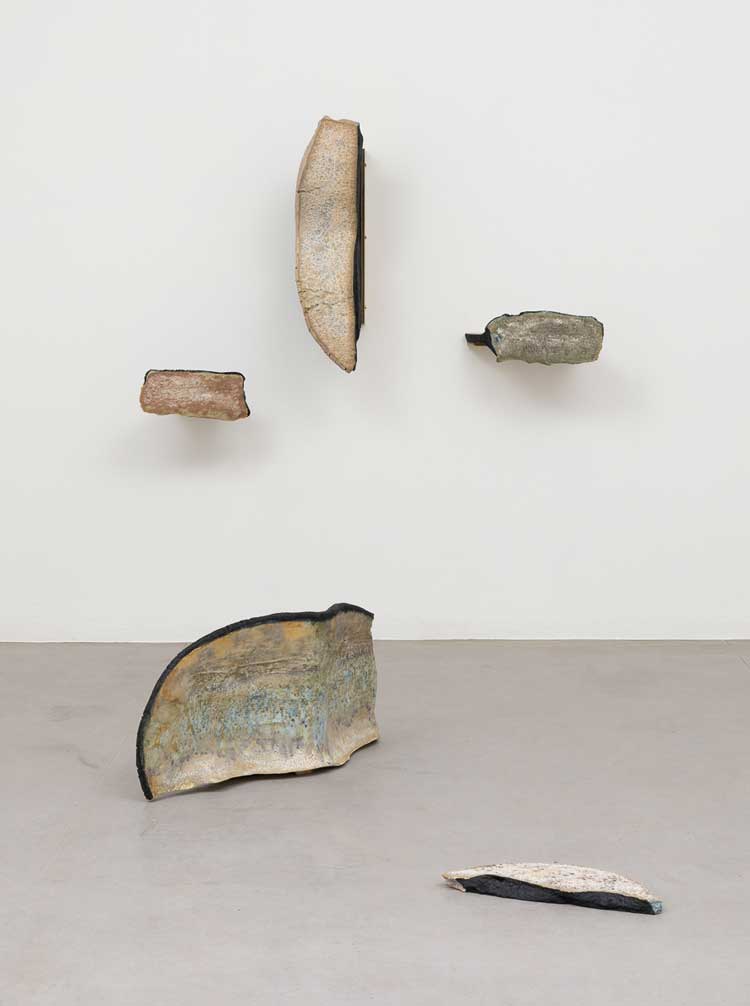
Liz Larner, Still and All, 2022. Installation view of Liz Larner, A hard line to bend at Camden Art Centre, 2026. Photo: Rob Harris.
They suggest an artist willing to experiment, rather than settle into an easy stream. Still and All (2022) is presented shattered into five separate pieces, three on the wall and two on the floor. Intended to be a single wall piece, it fell apart during firing. “It would be really hard for me to smash something because it was not what I intended,” says Larner, “but I really like that part of being an artist: something happens and it opens up a new avenue of thinking and making. At the time, though, I was sad that it had broken!” When Larner laid the pieces out in front of the kiln, however, she “realised [she] loved how it sat. I was thinking about how it encounters the plane that it is resting on, which is super physical. I’m very interested in humans being aware of our physicality, how we share space with other things.”
Another set of ceramics are orbs scattered around the gallery floor, which remind me of Lucio Fontana’s Natura series. Some have a metallic sheen, while others are matte and pockmarked like deep-sea rocks. They are modelled on asteroids photographed by Nasa. “I was blown away by the idea that the first asteroid was discovered by a Franciscan monk. He named the first asteroid Ceres after the Roman goddess,” says Larner. As more were discovered, their names went from those of deities to those of humans. Larner continues: “And then it got really weird: there was an asteroid named Beer. I like the idea of all these different earthly associations being projected up into space.”
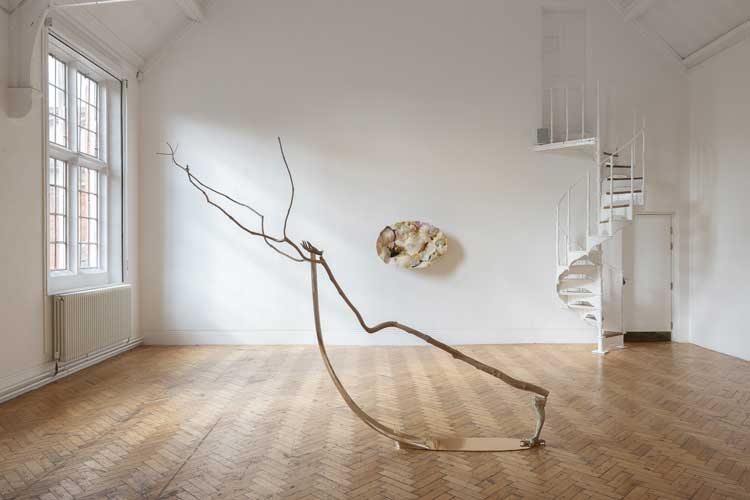
Installation view of Liz Larner, A hard line to bend at Camden Art Centre, 2026. Photo: Rob Harris.
The eponymous work A Hard Line to Bend also emerged from a fusion of matter and mythology. “I started that piece about two and a half years ago,” recalls Larner. “I found a branch that had fallen off a madrone tree, so I just brought it inside the studio to die.” Larner placed it in her covered yard, where she passed it every day, wondering what could be done with it. Sometime before, she had read a book by the Jungian psychoanalyst Barbara Black Koltuv about Lilith, a much-debated figure from Hebrew mythology. The sculpture was originally going to be called Lilith and the Morphic Field, a reference to the idea popularised by the parapsychologist Rupert Sheldrake which posits that nature holds a memory.
In Larner’s telling, the first human in the Garden of Eden requested to be split in two after being envious of animal procreation, leading to the creation of Lilith and Adam as the first woman and man. “So, there were two. But in terms of relationships there was a dominance question – Lilith did not want to be dominated – and Yahweh was upset that there was not an easy relationship, that there was refusal on one part of the duo. And so Yahweh said: ‘If you don’t do what Adam wants, I’m going to exile you and a third of your children will die.’ And so Lilith said ‘OK’ and laughed.” Other stories made Lilith the assistant of the Mesopotamian goddess Inanna who lived within a tree and the “screech owl”, a mother of monsters, demonised for causing infant mortality and inspiring adultery. “She’s the original Batgirl” – Larner laughs – “part-human and part-animal. And she’s a woman who refused to be dominated and chose her own path.” It seems a good analogy for Larner’s own practice.
• Liz Larner: A Hard Line to Bend is at Camden Art Centre, London, until 17 January 2027.
Click on the pictures below to enlarge

Copyright © 1893–2026 Studio International Foundation.
The title Studio International is the property of the Studio International Foundation and, together with the content, are bound by copyright. All rights reserved.
 |
 |
 |
|---|

-300.jpg)
-300.jpg)
 Mohammed Sami: The Point 0
 Forrest Bess: Out of the Blue
 Allison Katz: Artery
 Julien Creuzet: Too blue, too deep, too dark we sank …
 Adam Farah: What I’ve Learned from You and Myself (Peak Momentations/Inside My Velvet Rope Mix)