




.jpg)
Bayeux Tapestry, scene 57, King Harold being killed by an arrow in the eye. Image by Université de Caen Normandie - CNRS - ENSICAEN, based on the 2017 photographic campaign by La Fabrique de patrimoines en Normandie.
British Museum, London
10 September 2026 – 11 July 2027
by JULIET RIX
Bayeux mania has hit Britain. The first release of tickets for the British Museum’s Bayeux Tapestry display sold out the same day with a record £2.5m taken (more tickets go on sale on 21 October). We have seen nothing like this since the museum showed the treasures of Tutankhamun. The Bayeux Tapestry exhibition is, says curator Michael Lewis, “not just a once in a lifetime opportunity, but once in a millennium”. Well … yes and no.
This rare artwork and remarkable survivor has been on public show at the Bayeux Tapestry Museum in Bayeux, Normandy, since 1983. It was temporarily removed from view last year for the museum to be refurbished (the event that has allowed it to travel) and will return there in October 2027. The British Museum exhibition is, though, certainly the first-in-a-millennium chance to see it in England, the country of its subject and probably of its birth.
The Tapestry (capitalised because this is part of its name rather than a description, the work is, in fact wool embroidery) was probably made by English nuns known across Europe at the time for the quality of their needlework. It is believed to have been stitched within a decade or so of the events it depicts – the lead up to and actual Norman Conquest of England (1065-1066).
.jpg "Bayeux Tapestry Exhibition, British Museum, London, 10 September 2026 – 11 July 2027. © The Trustees of the British Museum.")
Bayeux Tapestry Exhibition, British Museum, London, 10 September 2026 – 11 July 2027. © The Trustees of the British Museum.
Most experts believe it was commissioned by Odo, Bishop of Bayeux and half-brother of William (“The Conqueror”). The story is told from a Norman perspective, but it is, especially at the beginning, not unsophisticated propaganda and surprisingly respectful of the English side. “Harold is initially shown as a good man and a brave warrior,” says Lewis, and crucially, despite William’s claim to the English throne, Harold is described as Rex (King). In the scene in which Harold takes an oath of allegiance to William (scene 23), which Norman sources insist included accepting William as Edward’s successor and English sources describe as under duress, Lewis sees Harold as “conflicted”. The tapestry text does not help us. The body language does seem ambivalent, but the sullen-looking face is just his moustache.
After William became king of England, he made Odo Earl of Kent and, in 1068, left Odo as regent during a return trip to Normandy. The Tapestry may well have been made in Kent – most likely in Canterbury – before being shipped across the Channel to Bayeux where Odo was building a cathedral consecrated in 1077. The Tapestry first appears in documentation in a Bayeux Cathedral inventory of 1476. And, although there have been repeated requests from the British to borrow it, the Tapestry has never since left France – until now.
.jpg "Ghent, table manufacture. Trustees of the British Museum.")
Ghent, table manufacture. Trustees of the British Museum.
It has been a controversial loan, with thousands of people signing a French petition to try to stop it on grounds of risk to the fragile artwork. At the British Museum, relief was clearly intense when the Tapestry arrived safely and the work has been exceptionally well displayed. Shown flat for the first time (it is usually hung vertically as it was probably designed to be), the lighting is perfect. And the glass covering it is entirely free of reflections (while also no doubt being proof against anything you can imagine and more. The British government has “insured”, the Tapestry for an estimated £800m).
The hype, though, has created a popularity problem. The visitor’s first view of the Tapestry is from a balcony above it and the British Museum is proud of this being the first time it has been possible to see the whole work at once. It is indeed impressive to view its full 68.3 metre (224ft) length, but of the artwork you see only glimpses between the heads of the viewing public. At least it is just heads, not also phones. The museum banned photography soon after opening to speed up the passage of the viewing public.
There is nonetheless queueing at every stage and once down at Tapestry level the atmospheric soundtrack of birdsong, horses and waves is overshadowed by one constant refrain (thankfully in a calm, non-aggressive tone): “Please keep moving … Please keep moving.”
It is understandable, but frustrating. This is a beautiful and complex work, with so much to take in: the historic narrative, the characters, the borders full of extraordinary creatures, and the 11th-century design and artistry.
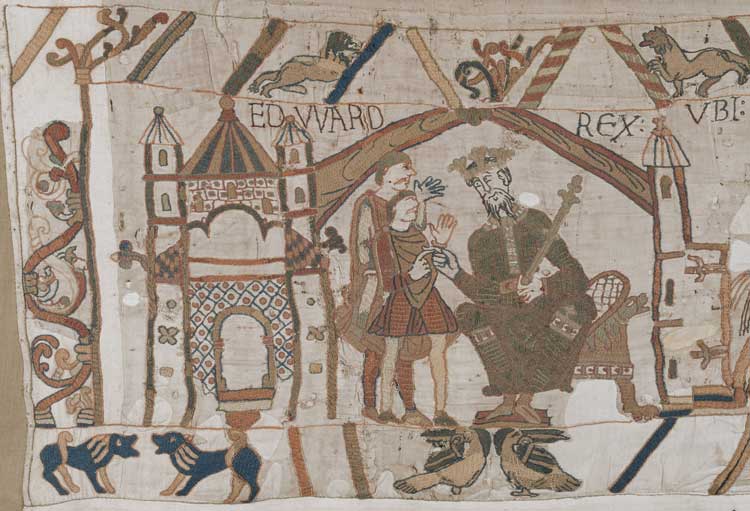
Bayeux Tapestry, scene 1, Image by Université de Caen Normandie - CNRS - ENSICAEN, based on the 2017 photographic campaign by La Fabrique de patrimoines en Normandie.
The Tapestry’s 58 scenes start with its most visually vivid and identifiable character, the shaggy-bearded Edward the Confessor, King of England, whose childlessness and disputed succession kicks off the story. He sits enthroned beneath the roof of the first of the Tapestry’s more than 30 fabulous buildings, all representative but each different, with turrets and tiles and carefully embroidered brickwork.
The first “tree” is close by, too, one of many winding sinewy organic forms that punctuate the narrative – like friendlier versions of multi-armed triffids. The horses are the most realistic element of the Tapestry. Their faces are as varied as the humans’ and they have an actual and narrative dynamism – a real sense of forward motion as they go into the attack, followed by falling and struggling at monstrous angles that vividly convey the chaos of battle.
The Tapestry is epic poetry in visual form. There is rhythm in the colours (red, ochre, blue) and forms – horses, stripy boats or soldiers layered together. The lighting makes the picture look like a painting, the embroidered texture like light brushwork; you have to really lean in to make out the stitching. And yet, the work’s technique naturally dictates its style and patterns recur in different contexts from castle walls to the net or rings of soldiers’ mail.
Key scenes stand out, though they are not always easy to precisely identify from the sparse information above the Tapestry. The British Museum has chosen to highlight important moments in the historical story, rather than translate each Latin title within the Tapestry, let alone comment on it. This is a shame (though no doubt more information would slow the progress of the shuffling hordes). The Tapestry’s own embroidered Latin text tells you what is happening – with no historian’s guesswork or curatorial assumption – and identifies key characters such as King Edward, William (“The Conqueror”), King Harold and Odo.
.jpg "Bayeux Tapestry, scene 37. Image by Université de Caen Normandie - CNRS - ENSICAEN, based on the 2017 photographic campaign by La Fabrique de patrimoines en Normandie.")
Bayeux Tapestry, scene 37. Image by Université de Caen Normandie - CNRS - ENSICAEN, based on the 2017 photographic campaign by La Fabrique de patrimoines en Normandie.
I particularly like the inscription at scene 37, in which ships are being loaded for the invasion of England. It ends “… and here they are dragging a wagon of wine and arms”. Wine that no doubt gets consumed during the barbecue feast the Normans are shown enjoying after landing at Pevensey on the south coast of England. Armies have always marched on their stomachs and here is a rich scene of the Normans cooking spit roasts and kebab-like skewers. The scene culminates in the image of a semicircular “high table” at which Bishop Odo blesses the meal.
The Tapestry’s original text is in the catalogue and in the British Museum’s online presentation (Explore the Bayeux Tapestry online – Bayeux Museum). In each of these, the whole tapestry is presented scene by scene accompanied by the original Latin with an English translation. These are wonderful resources if you cannot make it to the exhibition and also, frankly, if you can. Taking a look in advance ensures you can identify what you want to see and avoids conversations like the one I overheard: “Is that King Harold taking his oath before William?” … “I’m not sure … I think it might be here.”
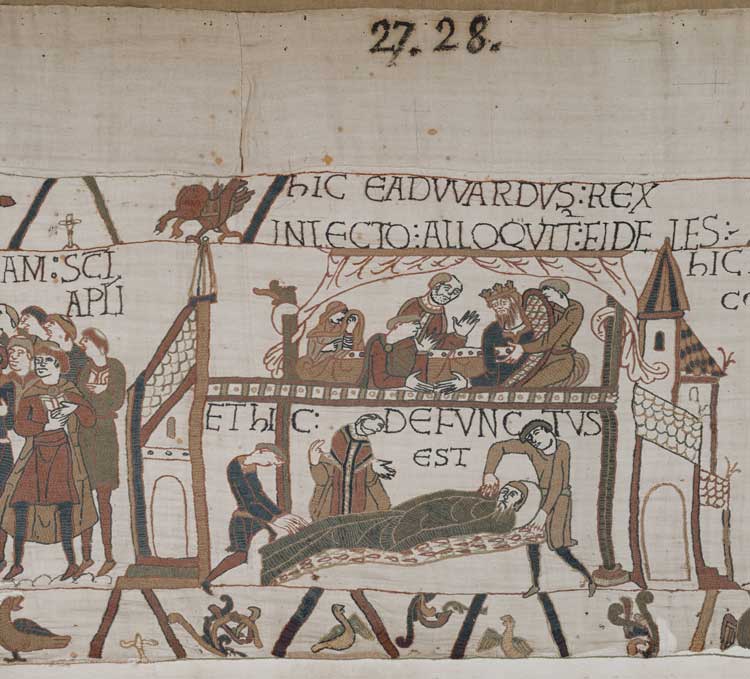
Bayeux Tapestry, scene 27, 28. Image by Université de Caen Normandie - CNRS - ENSICAEN, based on the 2017 photographic campaign by La Fabrique de patrimoines en Normandie.
Don’t miss Edward the Confessor’s death scenes (27 and 28), a pair of images one above the other. The text here reads: “Here King Edward, in bed, is addressing his faithful companions … And here he is dead.” At the foot of his bed in 27 is his queen, Edith (who was also Harold’s sister), dabbing her robe to her eye. She is unnamed but nobody doubts her identity (no other woman would have been shown in this position in this scene).
In a Tapestry totalling more than 600 human figures, Edith is one of just three women in the central narrative (there are three more in the border). The other two are an unnamed woman leaving a burning building (scene 47) and Ælfgyva, her face being awkwardly touched by a priest (scene 15). The stitched text here reads: “Where a certain cleric and Ælfgyva.” It stops there, failing to tell us what they did or are doing. In the border just below, however, is a little figure of a naked man with oversized genitals, his arms posed to match those of the cleric. There are various theories … make of it what you will.
.jpg "Bayeux Tapestry, scene 15. Image by Université de Caen Normandie - CNRS - ENSICAEN, based on the 2017 photographic campaign by La Fabrique de patrimoines en Normandie.")
Bayeux Tapestry, scene 15. Image by Université de Caen Normandie - CNRS - ENSICAEN, based on the 2017 photographic campaign by La Fabrique de patrimoines en Normandie.
The borders of the Tapestry, above and below, are full of little motifs and fabulous creatures, some real and familiar (a donkey, birds), others mythical and fantastical. The style often resembles that of illuminated manuscripts or in some cases medieval textiles. Experts still argue about whether they are merely decorative or are symbolic comments on the main scenes. I can’t help leaning towards the latter, but their specific meaning is lost in time.
Less so the flame-tailed Halley’s comet (scene 32) spotted just after Harold’s coronation. A gaggle of men point up at it, the one nearest us looking particularly fearful. This is regarded as an omen, a warning that Harold’s reign will not go well – and so it proves. By scene 35, we have William building ships for the crossing to England (some of the most colourful and vibrant images) and the scene is set, literally, for “1066 and all that”, the Norman invasion and the Battle of Hastings. Embroidery will always be symbolic in its representations, but the battle here is visceral. In the main scenes we see the Norman horsemen clash with English foot soldiers, while in the border below lie dead, wounded and decapitated solders. Beneath scene 57 dead combatants are being stripped not only of their weapons but of their armour and clothing too. There is no pretence here that battle is anything other than nasty.
Perhaps the Tapestry’s best-known image – King Harold being killed by an arrow in the eye – comes in the main section of scene 57. It is quite hard to spot the arrow, which turns out to be appropriate as it was apparently only added during the 19th century restoration. There is a vertical figure with a just-visible arrow pointing at his face, but the arrow is faint because the wool used here was coloured with “modern” synthetic dye rather than the far more durable organic original. Backing up the arrow’s 19th-century provenance, drawings of the tapestry from the 18th century do not show it.
.jpg "Bayeux Tapestry, scene 57 (detail). Image by Université de Caen Normandie - CNRS - ENSICAEN, based on the 2017 photographic campaign by La Fabrique de patrimoines en Normandie.")
Bayeux Tapestry, scene 57 (detail). Image by Université de Caen Normandie - CNRS - ENSICAEN, based on the 2017 photographic campaign by La Fabrique de patrimoines en Normandie.
The arrow story, indeed, does not appear in history until the 12th century, earlier sources describing Harold as hacked to death. And just after the Tapestry figure with the arrow is another, on the ground, shieldless, a sword-wielding horseman looming over him, an axe above his head. The text reads: “Harold Rex Interfectus Est”, “Here King Harold has been killed” – past tense. The word Harold is above the arrow man, “has been killed” above the horizontal man. So, the arrow man might be Harold (it has his moustache), facing the start of his demise (via, originally, weaponry other than an arrow) while the man on the ground (also moustachioed) also or more likely Harold, the dead or dying king. One thing is for sure; that most famous image is not original.
This end of the work is the least well preserved and it has for centuries been missing its final scene or scenes. The Tapestry may well have ended with the coronation of William in Westminster Abbey – it would be a logical end to the story – but we will never know for sure. We do know that the tapestry has been used (and abused) as a political tool probably since its creation, and certainly in more recent times.
Napoleon had it displayed at the Louvre ahead of his planned invasion of England as a symbol of French domination, and the Nazis (mis)appropriated it to demonstrate an Aryan race (as they saw the Normans) taking the land Hitler also wanted. The SS’s “ancestral heritage” unit was sent to study the Tapestry during the occupation of Bayeux in 1944, the work was dangerously transported to Paris. After the liberation, the Tapestry was displayed at the Louvre – with the final scene of the English fleeing the battlefield diplomatically folded out of sight.
The Tapestry still carries cultural and political power. The French President intervened to allow the “masterpiece” to travel, and it was welcomed here by the Prime Minister and King Charles III – a descendant of William. He called the “unprecedented” loan, the “best possible symbol” of the closeness of the UK and France and a reminder of “what our countries can do if we join forces”. So, regardless of the Tapestry’s previous and future display in Bayeux, this exhibition is undoubtedly important – and another chapter to add to the long and remarkable story of this unique work.
Click on the pictures below to enlarge

Copyright © 1893–2026 Studio International Foundation.
The title Studio International is the property of the Studio International Foundation and, together with the content, are bound by copyright. All rights reserved.
 |
 |
 |
|---|





-300.jpg)