




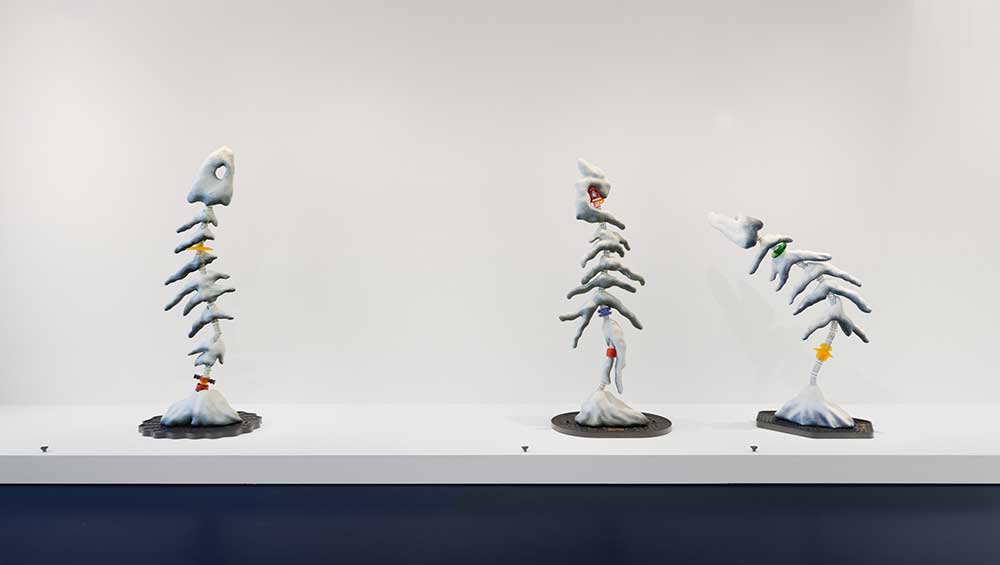
Magali Reus, three sculptures from the Streamers series (2025), Sprayed polyester; sprayed, sanded and waxed polyester; acrylic resin; screen- printed card; pigments; sprayed aluminium tubing; polished graphite-coated CNC’d MDF; sanded and patinated laser-cut brass; brass bolts and rivets; laser-cut steel, cast concrete; MDF; paint. Varied dimensions. Installation view at The Perimeter. © Magali Reus. All works courtesy of the Artist, The Approach, London; Tanya Bonakdar Gallery, NYC, USA; Galerie Greta Meert, Brussels; Mai 36 Galerie, Zurich. Photo: Eva Herzog.
The Perimeter, London
25 September – 16 December 2026
by JOE LLOYD
Consider the lobster – not any old homard, but the one hanging from a wall in The Perimeter, a non-profit art gallery in a mews in Bloomsbury, central London. Attached to a hook, which itself balances on a larger hook stuck to the wall, it has a body largely composed of glossy blue units somewhere between a spindle and a salt cellar. These components are bound together by a gleaming metal skeleton in an elaborate arrangement. But that’s not all: this biomorphic framework is counterpoised by alien elements. There are two yellowish stars, an oversized tooth, a slice of gouda and a potato. The end of one arm is covered by what appears to be a printed ribbon but is a thin curved strip of metal. A bathroom tap, embossed twice with the warning “Hot”, extends from its front. It is a lobster and not a lobster.
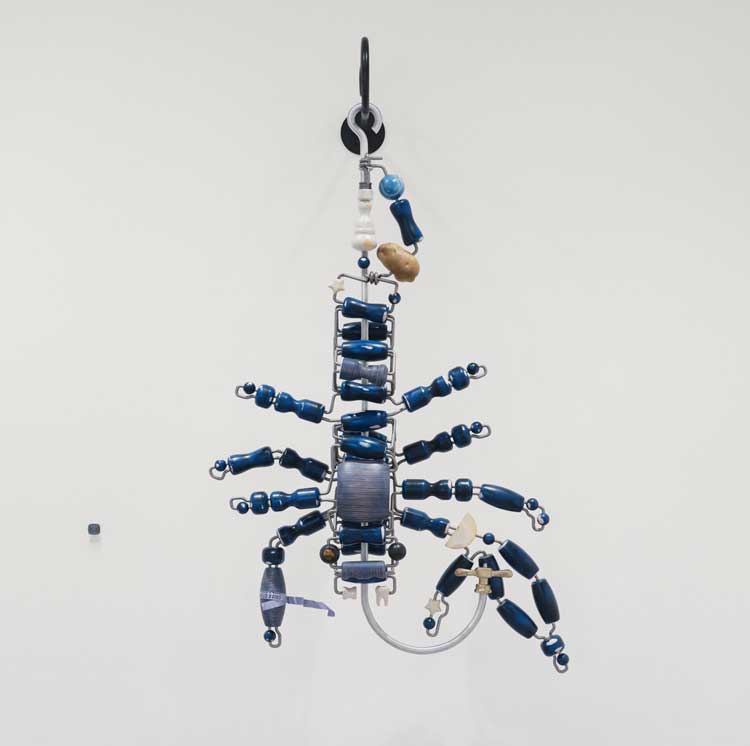
Magali Reus, Rig (Bisous Bisque), 2026. Painted, sanded, polished and waxed polyester; forged, brushed, blackened and oiled steel bar; forged, brushed and oiled aluminium bar; shaped, stained, sanded and wax-polished layered plywood; forged, sand-blasted and oiled stainless steel bar; polished graphite-coated polyester; sand-blasted, hand-manipulated, powder-coated and sprayed aluminium foil; brushed, sand-cast brass; shaped and polished Tiger Eye stone, powder-coated rivets. 167 x 93.5 x 49.5 cm. The Alexander Collection, London Installation view at The Perimeter. © Magali Reus. All works courtesy of the Artist, The Approach, London; Tanya Bonakdar Gallery, NYC, USA; Galerie Greta Meert, Brussels; Mai 36 Galerie, Zurich. Photo: Eva Herzog.
It is a new work created for Swimming by Night, Magali Reus’s first institutional exhibition in Britain since her South London Gallery showcase in 2018. There, Reus displayed sculptures that resembled variously the skeletons of transport, obsolete industrial measuring instruments and Heath Robinson machines. The gallery’s walls featured engraved numbers resembling the draft line on a ship’s hull that indicates the water depth above the keel. Swimming by Night continues this interest: the Perimeter’s central staircase features a series of numbers measuring water levels, as if the gallery is under threat from some flood of Biblical proportions. But many of the artworks here are less redolent of mechanical devices than entities from nature.
The lobster/not-lobster, Rig (Bisous Bisque) (2026), is part of Reus’s Rigs series, one of nine hanging inside the gallery. Each bears resemblance to a creature – a bat, a ray, a jellyfish, a seahorse – but equally interpolates or evokes other inanimate objects. The seahorse-esque Rig (She Saw) (2025) reimagines the long-snouted fish as a spiny, bony comb. As Reus explains: “I had already, for a while, been interested in the idea of the silhouette and how to use shape or form to mimic something that could be construed as an animal, or as living. I was trying to find ways of conjuring up ‘the idea of animal’ through using objects and materials that perhaps were not the most obvious of choices.”
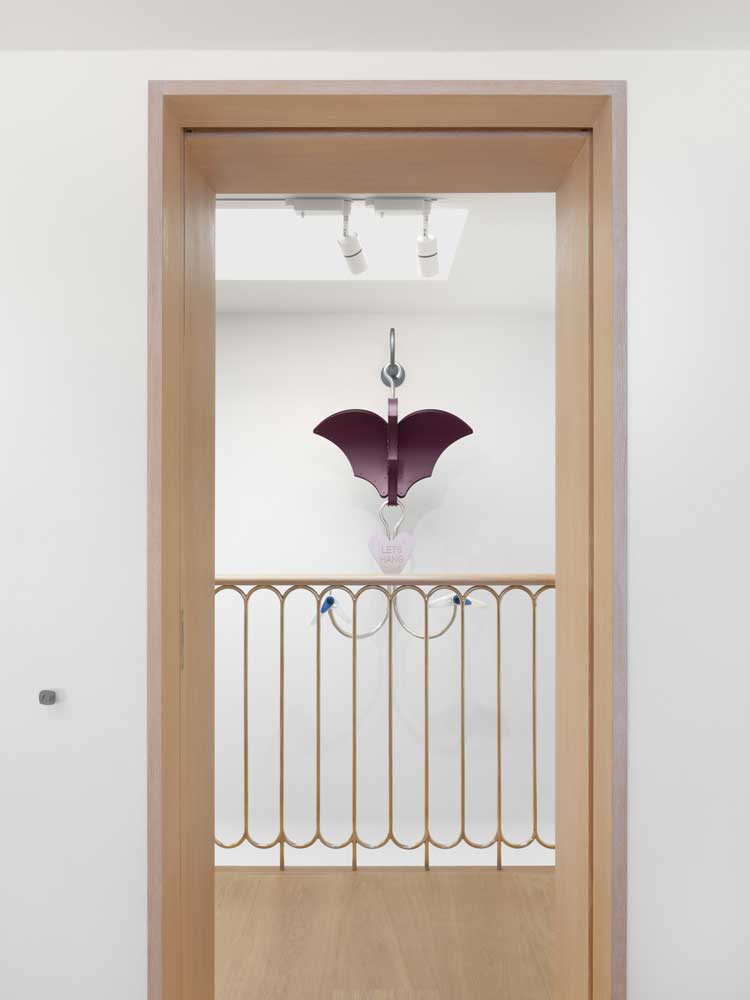
Magali Reus, Rig (All Eyes On), 2025. Laser-cut, bent, riveted and painted aluminium sheet; laser-cut, riveted and powder-coated aluminium sheet; forged, sand-blasted and oiled steel bar; forged, mirror-polished and oiled aluminium bar; laser-cut, bent, waxed, painted aluminium sheet; waxed and painted polyester; rivets. 137.5x77.5x57cm. Installation view at The Perimeter. © Magali Reus. All works courtesy of the Artist, The Approach, London; Tanya Bonakdar Gallery, NYC, USA; Galerie Greta Meert, Brussels; Mai 36 Galerie, Zurich. Photo: Eva Herzog.
Now based in London, Reus grew up on the coast of the Netherlands, and Swimming by Night has a nautical or at least aquatic bent. The Rigs series was first exhibited earlier this year at Museum Beelden aan Zee, an institution in the sand dunes of The Hague. “It’s a really beautiful museum and a unique architectural space,” says Reus. “Most of the natural light arrives far above eye-level. The walls were constructed from panelled concrete slabs, each of which had a threaded plug insert. I was very interested in the architectural motif of these threaded inserts and in using these as a means of hanging the sculptures, thereby plugging them directly into the existing architecture.”
For the Rigs, Reus drew on her childhood memory of the area, of swimming and time spent at the beach, and of a seafront thronged with souvenir shops selling keychains and earrings. “Wearing an earring,” says Reus, “is a mode of expression. In all its bodily proximity, it strongly relates to the person it is hooked on; it speaks of the way this person likes themselves to be perceived by others.” The town is also a fishing port. The idea of coalescing two types of hooks – those used to catch fish and those that people hook on their own bodies – emerged.
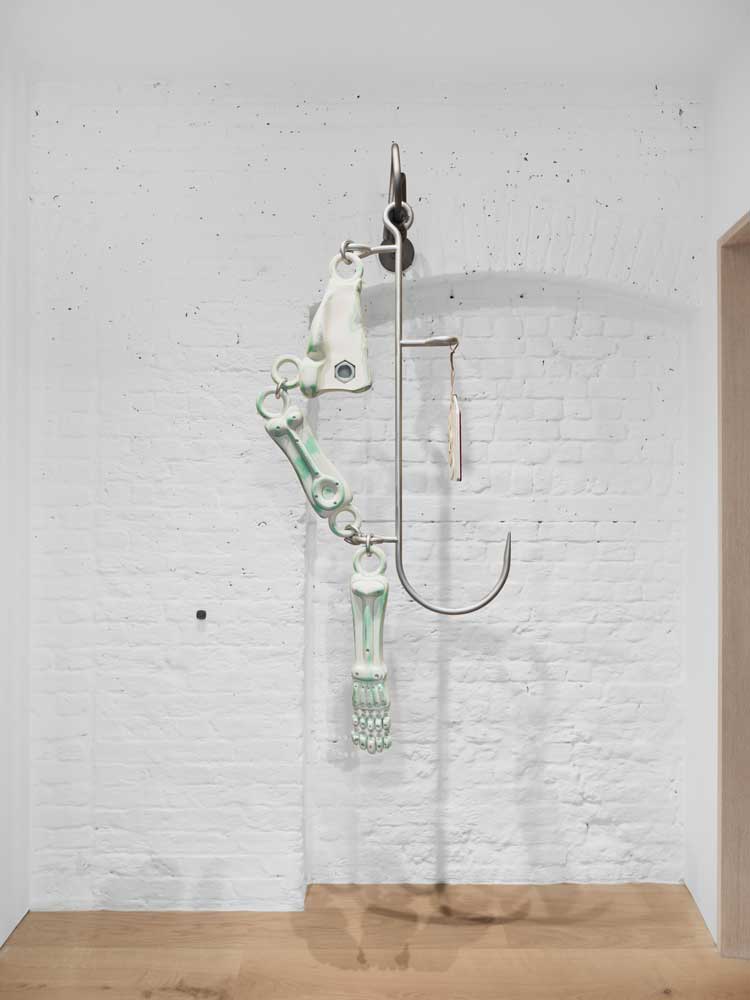
Magali Reus, Rig (The Lab), 2025. Matt-lacquered, painted and sanded polyester; forged, sand-blasted and oiled steel bar; forged, brushed and oiled aluminium bar; brushed and oiled aluminium wire; laser-cut, powder-coated, airbrushed and riveted aluminium sheet; powder-coated, manipulated aluminium wire; stainless steel nuts. 164.5 x 67.5 x 44.5 cm Installation view at The Perimeter. © Magali Reus. All works courtesy of the Artist, The Approach, London; Tanya Bonakdar Gallery, NYC, USA; Galerie Greta Meert, Brussels; Mai 36 Galerie, Zurich. Photo: Eva Herzog.
Reus continues: “I like to think about the viewer’s relationship to and experience of a work. It can be something that holds your attention, captures you, or catches you off-guard for a moment. I thought of this potential metaphorically for these Rig works, and how, to me, it relates to the idea of luring fish, or possibly also the luring potential that a piece of jewellery such as an earring holds.” Despite their similarities, the Rigs differ immensely in material and tone. The bat, Rig (All Eyes On) (2025), floats above a heart displaying, in punched up letters, the phrase “Lets hang”, as if on a Love Hearts sweet. Rig (The Lab) (2025) features components based on a glow-in-the-dark skeleton. Its creation proved fateful: a few weeks after starting it, Reus broke her elbow. Each one projects a different personality. One can imagine an entire menagerie of these carefully crafted beings.
The Rigs are joined by works from three other recent and new series. Upstairs, Reus has placed a series of sculptures from her Streamers series. At first glance, these resemble fish skeletons, swaying as if in a breeze. But with their colouration – each segment’s white top gives way to darker shades beneath – and occasional glimmering resin inserts, they also resemble the carcasses of a Christmas trees. Like the Rigs, these sculptures were first shown at Museum Beelden aan Zee in January. “I tend to find January a tragic time of year,” Reus explains, “much of it due to the bad weather and it being right after the holiday season celebrations. Streets then tend to be covered in discarded Christmas trees, some already without needles, left forlorn outside, beside garbage and other unwanted domestic debris.” Reus started photographing these festive remnants, before asking others to submit their own pictures. She has now amassed an archive of more than 3,000 from across the world.
The Streamers’ fish skeleton form links them to a second tossed-away object. “A similar thing,” Reus recalls, “occurs during the summertime at the seaside: the moment of enjoying a deliciously fresh, ocean-caught fish is a celebration of sorts, but once consumed, the bones are equally swiftly discarded, thrown out on the streets or into garbage bags. These carcasses in the Streamers series attempt to conjure up this idea of both these seasonal post-celebration moments.” The Streamers thus unite the disposables across seasons, granting them a new lease of life. Reus continues: “As newly conceived shapes, I wanted them to feel reanimated and optimistic in their new guise, for them to join forces in a sort of mournful/joyful dance.
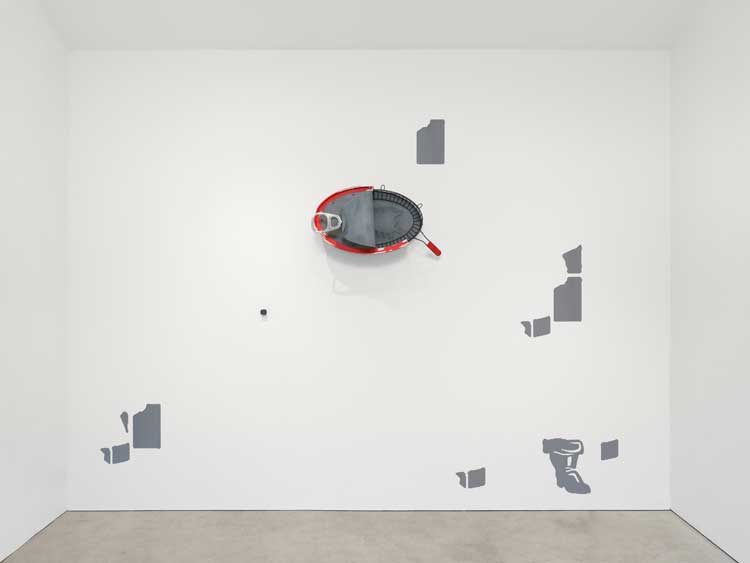
Magali Reus, Merlin (Rock and Sole), 2024. Shaped, burnt, waxed, painted, sanded and wax-polished layered plywood; forged, sand-blasted and oiled steel bar; forged and mirror-polished aluminium bar; laser-cut, powder-coated, airbrushed and riveted aluminum sheet; stainless steel rings; powder-coated manipulated aluminium wire. 147 x 54.5 x 43 cm. Installation view at The Perimeter. © Magali Reus. All works courtesy of the Artist, The Approach, London; Tanya Bonakdar Gallery, NYC, USA; Galerie Greta Meert, Brussels; Mai 36 Galerie, Zurich. Photo credit: Eva Herzog.
This idea of immortalising the disposable detritus of hedonistic consumption and seasonal celebration recurs throughout Swimming by Night. Merlin (Rock and Sole) (2024) fuses the basket of a deep-fat fryer with the ring-pulled lid of a fish tin. The Subs series (2026), some displayed opposite the Streamers, are structured around fabricated pizza boxes with uncannily accurate frayed edges. The interiors of these boxes are sheathed with yet another disposable item, Christmas wrapping paper, screen-printed based on Reus’s collection.
All of Reus’s sculptures are executed with meticulous attention to detail. The Subs have bespoke pizza saver tripods displaying images and patterns that match the wallpaper design. Each Streamer rises above a plinth crafted to resemble a manhole, labelled with an acronym reflecting its name, “to connect them to water, but also to the street and a larger network of sorts”. This attention to detail extends to the artworks themselves, which are all the products of myriad processes. Bisous Bisque features no less than 11 substances, all of which have been worked and processed in various ways. A steel bar has been “forged, brushed, blackened and oiled”, plywood has been “stained, sanded and wax-polished”.
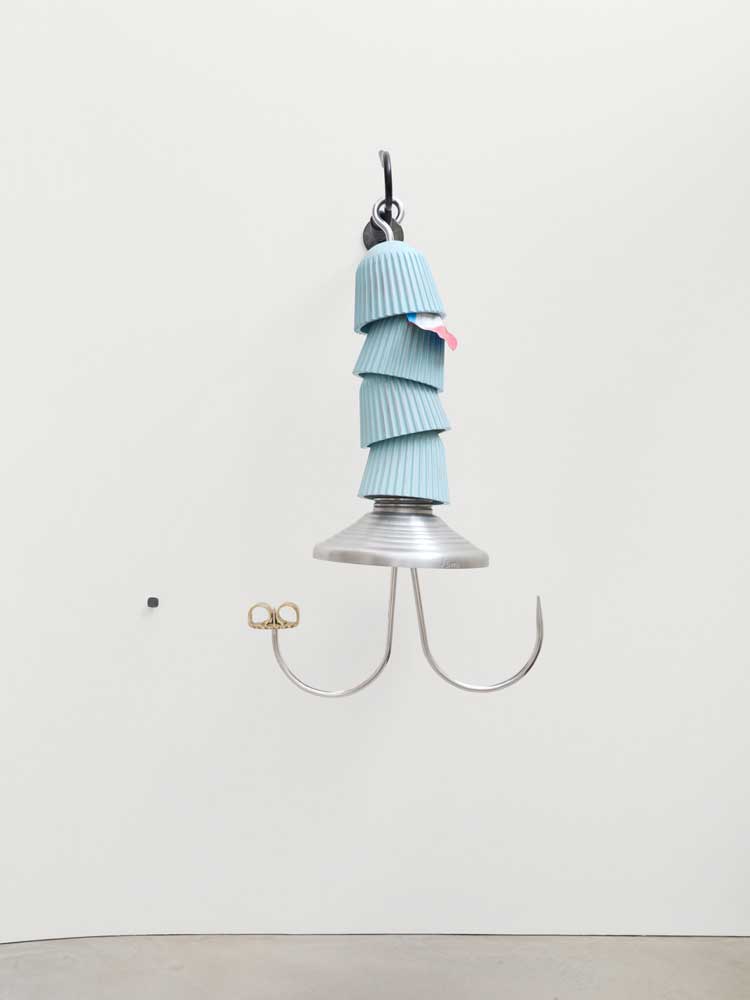
Magali Reus, Rig (Crown Caps), 2025. Waxed, painted and sanded polyester; forged, brushed, blackened and oiled steel bar; forged, mirror-polished and oiled aluminium bar; sand-cast, engraved aluminium; brushed, sand-cast brass; airbrushed aluminium foil. 149 x 76.5 x 61.5 cm. Installation view at The Perimeter. © Magali Reus. All works courtesy of the Artist, The Approach, London; Tanya Bonakdar Gallery, NYC, USA; Galerie Greta Meert, Brussels; Mai 36 Galerie, Zurich. Photo: Eva Herzog.
Magali models her works with computer programs before actualising them by hand. Nothing is a found object; each component is the product of immense labour. Bisous Bisque’s blue colour was created by layering up six shades of blue paint and then sanding them down to reveal what Reus aptly calls the “paint archaeology”, before being polished and waxed to give it the appearance of a glazed ceramic. Its skeleton system was inspired by traditional beading. I honestly don’t know,” recalls Reus, “how I was able to get to this stage and see the piece finished as such. When you consider all the individual parts involved in its construction: every little metal connection has its own very particular shape, all of which has been hand-bent. Every single piece within the sculpture had to be conceived and constructed separately, for it all to fit and hold itself together. Looking back, I can barely remember how I was able to do it. I believe the whole process took more than half a year.”
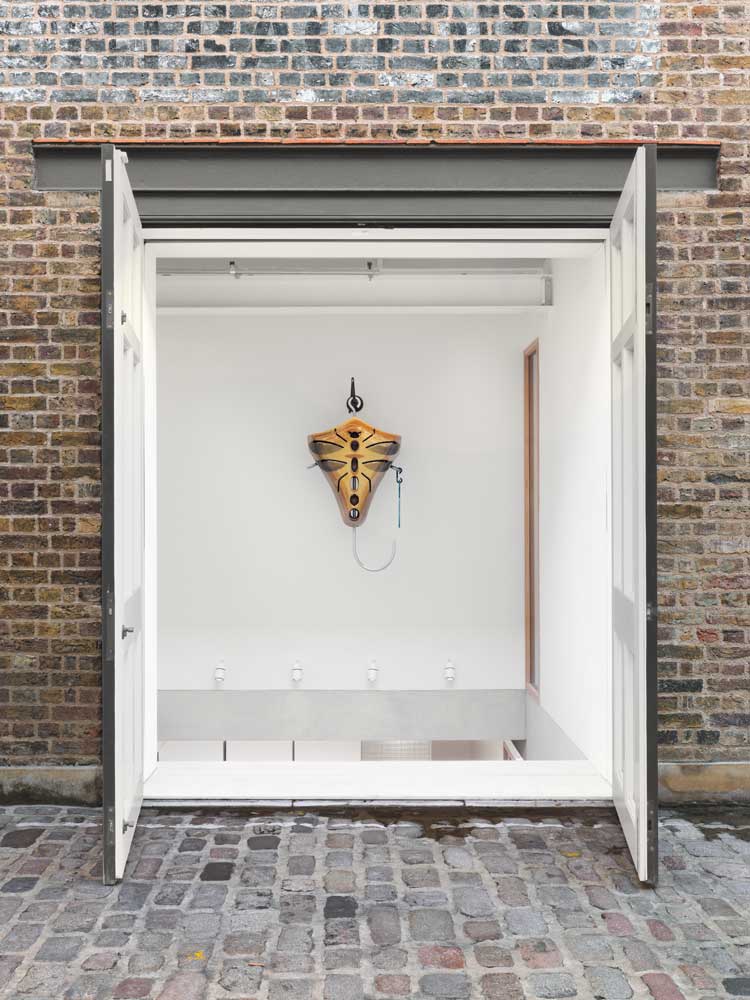
Magali Reus, Rig (Chip), 2025. Shaped, stained, airbrushed, painted, sanded and polished resin-encased layered plywood; forged, brushed, brass-plated and oiled steel bar; forged, brushed and oiled aluminium bar; forged, brushed, brass-plated and oiled aluminium bar; polished graphite-coated polyester; painted polyester; laser-cut, mirror-polished aluminium sheet; stainless steel rings; stainless steel rivets. 138.5 x 90 x 61 cm. Giverny Capital Collection, Montreal Installation view at The Perimeter. © Magali Reus. All works courtesy of the Artist, The Approach, London; Tanya Bonakdar Gallery, NYC, USA; Galerie Greta Meert, Brussels; Mai 36 Galerie, Zurich. Photo: Eva Herzog.
The same precision applies to the mise en scène of the entire exhibition. Artworks are identified with metallic number plates – made by Reus – which resemble those in an anthropology museum vitrine. The room featuring the Streamers series has a deep blue floor, like a cold northern sea. The Sub series wrapping paper conjures the forms and colours of stained glass, and is placed opposite a window so that it can be viewed speckled with light. Just as Reus grants dignity to the forms of jettisoned trees, bones, boxes and paper, the arrangement at the Perimeter accords each sculpture the respect that it deserves. It is a plunge worth taking.
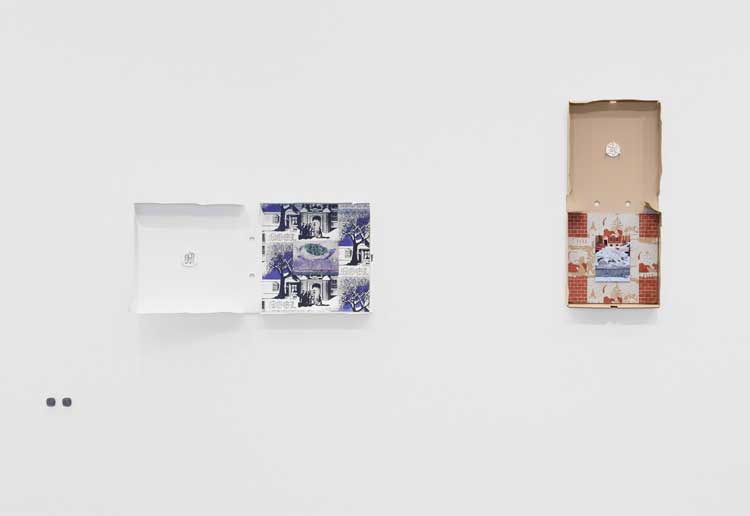
Magali Reus, two works from the Subs series,(2026). Laser-cut, folded, hand-hammered, sprayed and manipulated powder-coated aluminium; screen-printed powder-coated aluminium; c-print mounted on aluminium; sprayed, sanded and waxed polyester. Varied dimensions. Installation view at The Perimeter. © Magali Reus. All works courtesy of the Artist, The Approach, London; Tanya Bonakdar Gallery, NYC, USA; Galerie Greta Meert, Brussels; Mai 36 Galerie, Zurich. Photo: Eva Herzog.
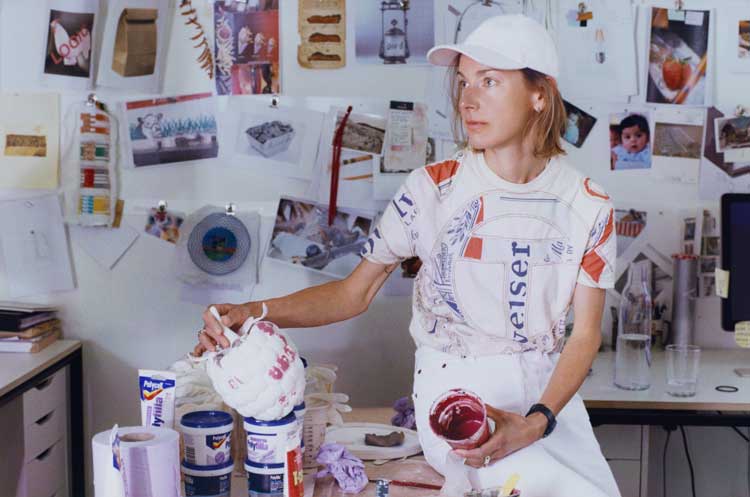
Portrait of Magali Reus. Photo: Jules Moskovtchenko.
Click on the pictures below to enlarge

Copyright © 1893–2026 Studio International Foundation.
The title Studio International is the property of the Studio International Foundation and, together with the content, are bound by copyright. All rights reserved.

 |
 |
 |
|---|


-300.jpg)
-300.jpg)

 The Extended Mind