




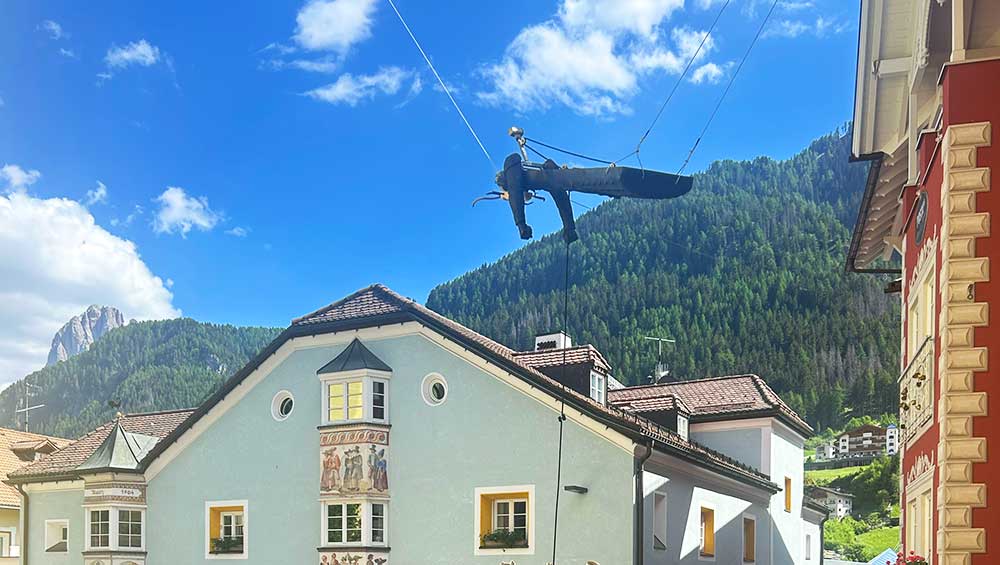
Sandra Knecht, Sirocco, 2026. Commissioned by Biennale Gherdëina 10. With the support of the Swiss Arts Council Pro Helvetia and Kulturförderung Baselland. Thanks to Chemun de Urtijëi, Atelier 3DW, Hubert Ploner, Telfholz, F.lli Ciechi. Credits: Tiberio Sorvillo.
Various venues in Ortisei, Pilat and Santa Cristina, Italy
31 May – 13 September 2026
by SABINE CASPARIE
Of all the biennales – and there are many – I would argue that Biennale Gherdëina, staged in the mighty Dolomites with its snow-capped peaks and cragged rocks, is unique. Many of the 27 artworks are situated in and around Ortisei, a blindingly picturesque mountain town with colourful, freshly painted houses, decorative balconies, and handmade wooden sculptures adorning almost every private garden. The garden is also the main theme of the 10th edition, (Future) Paradise Gardens.
Given its spectacular setting in the Unesco-listed Val Gardena, many of the previous biennales have engaged with themes of ecology, but the concept of the garden adds an interesting layer of complexity. The garden borrows from nature, but it is also cultivated and human-made. In the garden – physical and symbolical – opposing states coexist: enclosure/invasion; seduction/expulsion. In her book Orwell’s Roses (2021), Rebecca Solnit wrote: “Gardens are one way that culture does nature.” The curator, Samuel Leuenberger, emphasises the garden not as a completed world, but as a site of transformation. “The future paradise garden is not located at the end of the story, nor behind the walls of a reclaimed Eden,” he writes in his introduction. “It begins wherever we accept that life is divided, that control is only partially possible, that growth is relational, and that even in damaged landscapes, something unexpected can still take root.”
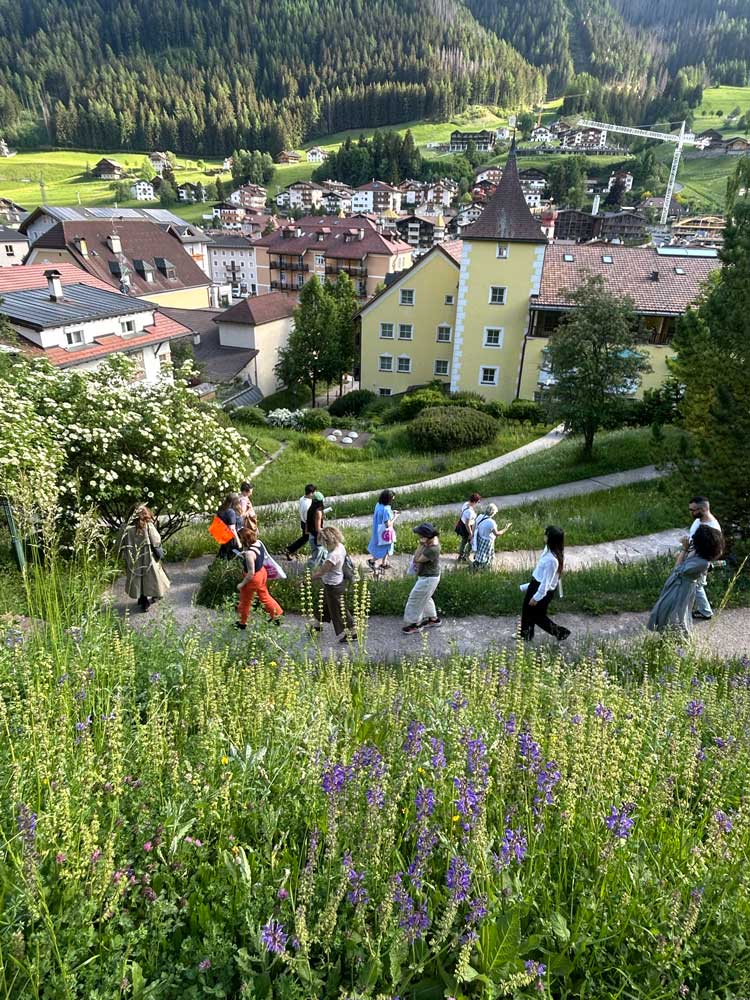
Biennale Gherdëina 10: (Future) Paradise Gardens, 2026. Photo: Sabine Casparie.
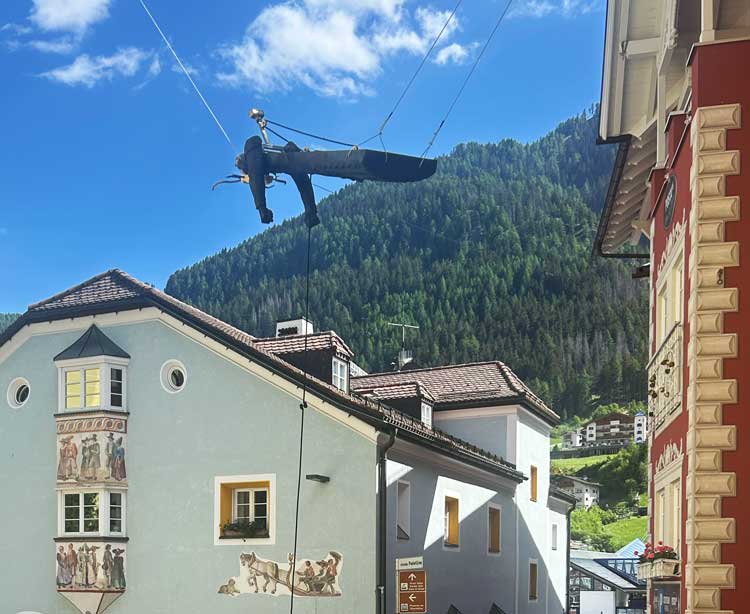
A willingness to engage with some of the darker undertones of the theme is perfectly illustrated in Swiss artist Sandra Knecht’s Sirocco (2026). A witch in a black robe dangles horizontally above our heads in the town square, her ominous presence in contrast with the bright blue sky and the sweet, pastel-coloured houses. A rope that can be pulled by the audience lifts the witch’s arms and her mask, revealing red lips in a scary smile. Knecht’s work is rooted in the folk traditions of rural Swizerland, something alluded to in the wooden materials and the antlers that decorate the witch’s mask. “More than 1,000 witches were burned at the stake here,” Knecht explains, “and I am their granddaughter, in a way.” The title adds layers of meteorology and migration: Sirocco is the hot, dusty Mediterranean wind that blows from the Sahara towards southern Europe, leaving a layer of red dust on the Dolomites’ glacier.
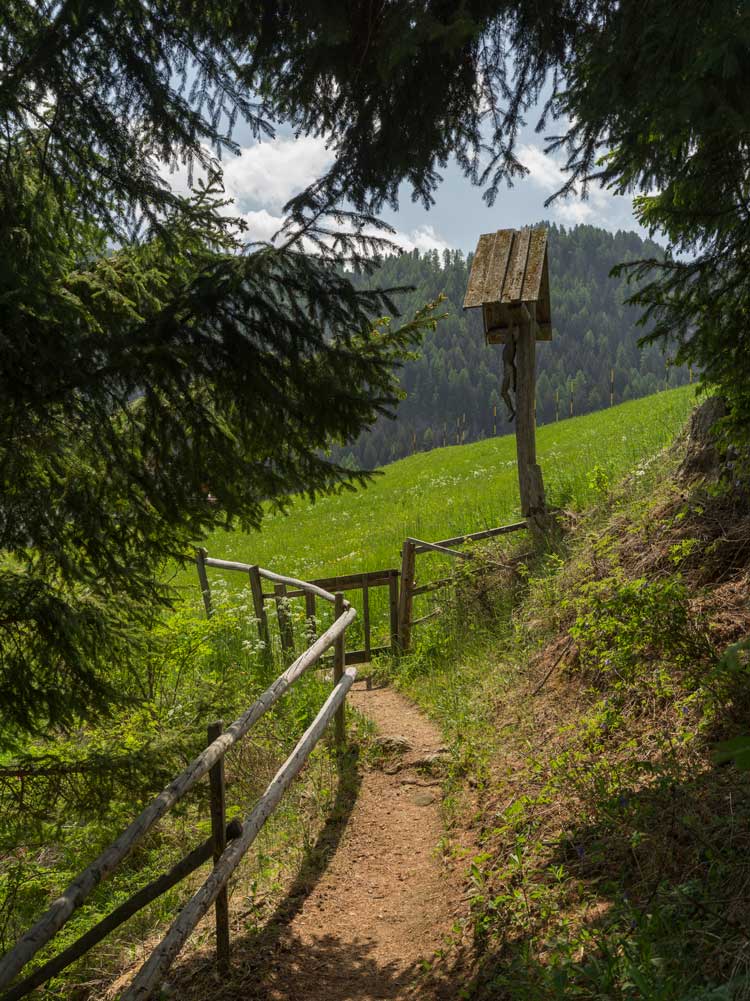
Constantin Thun, sound installation. Biennale Gherdëina 10. Photo: Tiberio Sorvillo.
There is a fair bit of hiking involved, with the art as reward. The Italian-born, Berlin-based artist Constantin Thun’s instrumental version of Disney’s Beauty and the Beast theme song appears seemingly out of nowhere after a steep, 45-minute trek, activated through a laser screen, but only when you walk up the mountain. “I learned from curating Art Basel Parcours that you need to get the audience walking,” Leuenberger tells us, once we have spread out over the lush, green meadow of Pilat to catch our breath. And it is true. Take Degrees of Elevation (2026) by Belgian artist and architecture duo Bas Smets and Eliane le Roux. At first glance, I dismiss the 300 yellow-and-black-striped snow poles, usually found on the mountain during ski season to measure the snowfall: too plain, too utilitarian. But that changes after Smets invites us to walk up and around the poles with him, taking in the different vistas they frame. The lines of poles, so called “contra lines” and 15 metres (49ft) apart, indicating the levels of snow, moving upwards by an average of 5 metres each year. “In 100 years, there will be no more snow on the mountain,” Smets declares, while his partner, Le Roux, crouches to photograph the poles against the bright yellow carpet of buttercups. The Disney tune stuck in my head, I think about these mountains, formed over millions of years. A “tale as old as time”, except in this story, the beast is climate change, and there won’t be a happily ever after.
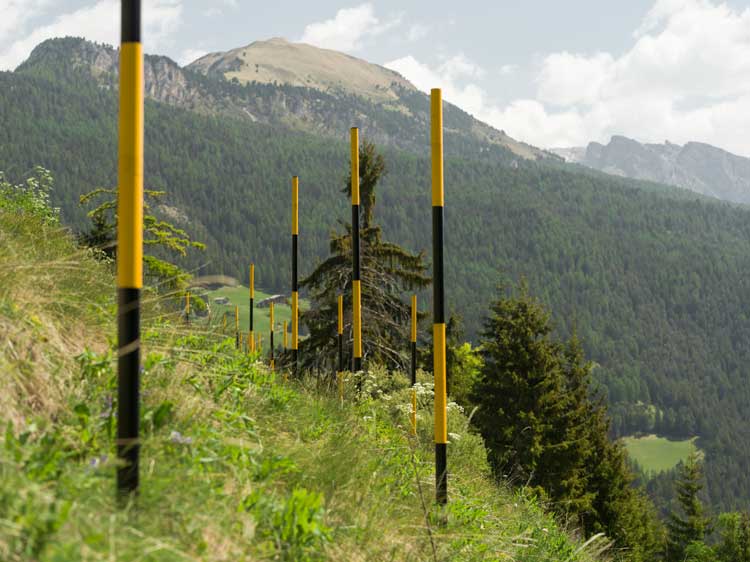
Bas Sets + Eliane Le Roux, Degrees of Elevation, 2026. Commissioned by Biennale Gherdëina 10. With the support of Nuovi Mecenati - Fondazione franco-italiana di sostegno allacreazione contemporanea. Photo: Tiberio Sorvillo.
Japanese artist Masatoshi Noguchi, who moved to the Val Gardena from Berlin during the Covid pandemic with his wife and young daughter, was also thinking of tales and time. “When I look out of my window at the mountain with my daughter, I imagine her talking to me in 50 years, saying: ‘Wow dad! You could ski here!’,” he says. In Winter Time; Star Time (2026), a sundial system traces a large moon and stars on the vaulted ceiling of an abandoned railway tunnel, but the logic of these cosmological systems is lost here in the tunnel where the sun can no longer reach. Various sculptures use children’s toys, including animal figurines in Big Dipper (2026) and coloured pencils in 12 and the Sun (2026). It is truly magical, this cross between a chapel, an industrial unit and a nursery, and it strengthens Leuenberger’s themes. Despite our attempts at mapping, the universe remains as hard to pin down as children’s play.
.jpg "Lydia Ourahmane, Hotel Ladinia, 2026, 12 tables, stools, lights, dimensions variable and Evelyn Taocheng Wang, Frog Princess Flies into Diamond Ruby, 2025, oil colour, gesso, pencil. Biennale Gherdëina 10.")
Lydia Ourahmane, Hotel Ladinia, 2026, 12 tables, stools, lights, dimensions variable and Evelyn Taocheng Wang, Frog Princess Flies into Diamond Ruby, 2025, oil colour, gesso, pencil. Biennale Gherdëina 10.
Another type of game is suggested in Ortisei’s Hotel Ladinia, abandoned years ago but brought alive by Algerian-born, Barcelona-based Lydia Ourahmane with light fittings, furniture, and chessboards on the tables; interviews with locals revealed that chess was a popular pastime in the bar. Four paintings by Taocheng Wang convey the adventures of the Frog Princess, regendered from the fairytale version (Museion in Bolzano is hosting Sweet Music, an excellent survey exhibition of Evelyn Taocheng Wang). In A Minimalist Hipster Day of Frog Princess (2025), the endearing character attends a pilates class, picks up a rosewood cabinet from a Japanese lifestyle brand, has a nerdy crafts-coffee at a cafe designed with minimalist Nordic furniture, and falls asleep after applying Dr Hauschka’s face cream. Before we get too comfortable, however, we are lured by chanting into the green-carpeted room at the back of the hotel, where Polish artist Dorota Gawęda and Lithuanian artist Eglė Kulbokaitė have choreographed an ensemble of wall sculptures and lights to the melodic and slightly eerie music of polyphonic choir Isokratisses from the Epirus region (now part of Greece and Albania). Together, these artists brilliantly transform Hotel Ladinia into a Gesamtkunstwerk, braiding tropes of local history, humour, decay and haunted house. It is interesting that, for a biennale centred around nature, the beauty of site-specificity is most fully felt inside this built environment with its peeling interior and creaking wood floors.
.jpg "Alice Bucknell, Ground Truthing, 2026. Installation with single-channel 4K video. Biennale Gherdëina 10.")
Alice Bucknell, Ground Truthing, 2026. Installation with single-channel 4K video. Biennale Gherdëina 10.
British-born and Los Angeles-based Alice Bucknell’s four-part video installation mixes the logics and aesthetics of gaming with various measuring devices and their data, suggesting humanity’s need to classify and compartmentalise nature despite its unpredictability. “In gaming, as in the garden, everything is an actor,” Bucknell explains. “Both game engine and garden seem to rest on the idea of control, but ultimately that idea of control gets exploded very quickly; everything has the capacity to influence everything else. The most exciting phase in gaming is the phase of ‘spawning’: at the start of a game, when all options are still open.” The biennale’s “future garden” is ultimately one of wildness. In the words of Leonora Prugger, whose fluid, semi-figurative paintings are framed in her partner Gregor Prugger’s wooden shelves in another room of Hotel Ladinia: “Our interventions address systems that organise the world – mapping, taxonomy architecture, language – and gently unsettle them from within. A landscape is always in the process of becoming.”
Waiting for the group to assemble at Hotel Adler, the centre of the biennale’s press activities and run by the same family for many generations, we watch a choir of primary school children sing uplifting songs, swaying to the gentle sounds of a keyboard and harmonica. They seem delightfully oblivious to the cutting-edge artworks populating their town. I ponder their innocence, and the world that we, adults, are leaving them behind. But then, warmed by the afternoon sun, I find myself comforted by another thought. There will always be art, and thus – hope.
Click on the pictures below to enlarge

Copyright © 1893–2026 Studio International Foundation.
The title Studio International is the property of the Studio International Foundation and, together with the content, are bound by copyright. All rights reserved.

 |
 |
 |
|---|



-1000-300.jpg)


 Thinking Like a Mountain
 Biennale Gherdëina 9: The Parliament of Marmots
-300.jpg) Kyriaki Goni – interview: ‘For me, technology is an existential discussion’
Kyriaki Goni – interview: ‘For me, technology is an existential discussion’.-You-Mountain,-You-River,-You-Tree,-2022-1000-300.jpg) Persones Persons: Biennale Gherdëina 8
Persones Persons: Biennale Gherdëina 8