




-Tate-(Larina-Annora-Fernandes)_6.jpg)
Frida: The Making of an Icon, installation view, Tate Modern, London, 25 June 2026 – 3 January 2027. Photo © Tate (Larina Annora Fernandes).
Tate Modern, London
25 June 2026 – 3 January 2027
by ANNA McNAY
With its pre-sale-record-breaking blockbuster, Frida: The Making of an Icon, Tate once again aptly demonstrates a case of more most certainly not being more. Don’t get me wrong, Kahlo fans will find this outing easier to digest than the V&A’s from 2018, Frida Kahlo: Making Herself Up, which felt exploitative in its focus on her ill health and medications, but it ought simply to have stopped at half the number of rooms and to have cut the dross. The number of Kahlo works on loan is impressive (more than 30), and they are all awe-inspiring and wonderful, but they are these things all by themselves; they do not need watering down – or bulking out – by the “Fridamania”, be that commercial, folk or “artistic”, filling the final rooms. Janet McKenzie wrote in her review of Tate’s 2005 exhibition, Frida Kahlo: “A stated intent of the curators of this exhibition is that Kahlo's paintings should be viewed independently, so as not to be consumed or overshadowed by the cult that has been created from her life.” Sadly, that seems not to have been their aim this time around. The subtitle of this exhibition, The Making of an Icon, admittedly does describe what the curators purport to be their intent: “Telling the tale of how Frida was posthumously transformed into a global icon and brand.” The only problem is that, in doing so, they have reduced her to just that, losing sight of the sheer brilliance of her art.

Frida Kahlo, Self-Portrait (With Velvet Dress), 1926. Private Collection.
Catherine Wood, the interim director of Tate Modern, described this as a “dialogue show”, and, featuring about 170 works by 80 artists, that is certainly what it is. The first sections include pictures by fellow Mexican painters, among them a couple of portraits of Frida by her on-again-off-again husband Diego Rivera – the suggestive lithograph Nude with Beads (Frida Kahlo) (1930) and the wide-eyed Portrait of Frida Kahlo (c1935) – and one, albeit very abstracted, by Kahlo’s close friend, the French émigré artist Alice Rahon, The Injured Cat (Portrait of Frida Kahlo) (c1946). Of Kahlo’s own works, we can bask in the seductive glory of the (possibly first) painting of herself, Self-Portrait (in a Velvet Dress) (1926), made for her then boyfriend, Alejandro Gómez Arias, and Self-Portrait with Loose Hair (1947), which – as is common in ex-voto (Mexican devotional) pictures and in Kahlo’s paintings – includes an inscription describing how it was made. In this later painting, her face appears tired and careworn compared with the fresh and smooth features of her 20-year-old self. Accompanying the former, being incapacitated at home following a bus crash in which she was involved at 18, she wrote to Gómez Arias: “The portrait will be at your house within a few days. Forgive me for giving it to you without a frame. I implore you to put it somewhere low, where you can look at it as if you were looking at me.” Her harrowing drawing The Accident (1926), made one year after the crash, which left her with injuries that caused life-long problems, is the opening bookend for the inclusion of works relating to pain, miscarriage and surgery dotted throughout the show. Made the same year as the self-portrait, it also demonstrates Kahlo’s tenacity and ability to mask her ongoing suffering (as also suggested by the drawing titled Appearances Can be Deceiving (1934), showing herself with the outline of a Tehuana dress but a broken column for her spine and a leg painted with blue butterflies). About the accident, Kahlo poignantly said: “It was a strange collision. It was not violent, but rather silent, slow and it harmed everybody, and me most of all.”

Julien Levy, Frida Kahlo 1938. © Courtesy Philadelphia Museum of Art.
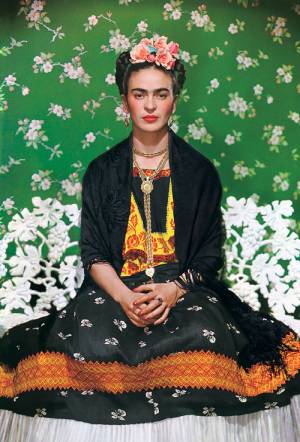
The exhibition includes a great number of photographs of Kahlo, beginning with some taken by her father, shortly after the accident, in one of which she is wearing one of her father’s suits, and moving through those taken by friends and lovers, including gallerist Julien Levy’s nudes and photographer Nickolas Muray’s colour-saturated portraits. Some of her Tehuana dresses are displayed, as at the V&A, and so are a couple of corsets (one painted with a communist hammer and sickle and a foetus) and prosthetics (her leg was amputated in 1953). As before, I question the necessity and relevance of this.
There is a section devoted to surrealism – a label that Kahlo vehemently rejected, saying: “I detest surrealism. To me it seems to be a decadent manifestation of bourgeois art, a deviation from the true art that the people hope for from the artist.” Nonetheless, it seems as if Tate may be trying to force the slipper to fit regardless, with slim evidence in the form of two exquisite-corpse drawings made with her friend Lucienne Bloch. Some lesser-known paintings are also included here, such as Flower of Life (1943), in which a flower takes on human characteristics.

Frida Kahlo, Untitled [Self-portrait with thorn necklace and hummingbird], 1940. Nickolas Muray Collection of Mexican Art.
The marketing image for this show is probably one of the best-known Kahlo images of all, Self-Portrait with Thorn Necklace and Hummingbird (1940). The monkey, seen on her right shoulder, had been a gift from Rivera, whom she had just recently divorced (only to later remarry), and it can be seen here playing with her necklace of thorns – tightening it to cause yet more pain? Earlier in the exhibition, in contrast, we saw Diego and Frida 1929-1944 (1944), in which, set in a frame of precious shells, two half portraits of the couple join to form a whole, a sentiment borne out when Kahlo said: “I love you more than my own skin and even though you don’t love me the same way, you love me anyways, don’t you? And if you don’t, I’ll always have hope that you do, and I’m satisfied with that. Love me a little. I adore you.” She gave this piece to him as a gift on the 15th anniversary of their first marriage and made a copy for herself. Self-Portrait (Dedicated to Jacqueline Lamba) (c1938) (Lamba was the wife of André Breton and a lover of Kahlo) also demonstrates an exquisite frame, this time comprising a butterfly made from hammered metal, like a votive, and Survivor (1938) similarly utilises a handcrafted Oaxacan tin frame with flowers in each corner. The aptly titled The Frame is another beautiful piece painted on aluminium and framed behind painted glass. Frames like this were often used to hold religious images, mirrors and photographs, and Kahlo’s use thereof is another nod to her adoption of indigenous Mexican traditions (as well as her wardrobe).

A Tehuana dress from Kahlo’s archive. Museo Frida Kahlo.
A later section explores more thoroughly Kahlo’s sense of nationality as a mestizo (a person of combined European and indigenous SouthAmerican (or Latin American) ancestry). My Dress Hangs There (1933) is a picture of an American city, with one of her Tehuana dresses suspended between a toilet and a trophy. It is filled with icons of a modern industrial society, but the broken wires, overflowing dustbin and burning building imply that this society is decaying and fundamental human values are being destroyed. Kahlo began this painting while living in New York with/for Rivera, who was painting a mural at the Rockefeller Center, and completed it after they returned to Mexico. A letter from the US to her mother expressed Kahlo’s disdain: “[W]e have nothing to talk about with these dull gringos, and we just fall asleep in all the gatherings.”The South American influence is also seen in Sun and Life (1947), which features a crying third eye and a crying foetus.

Mary McCartney, Being Frida, London 2000. © Mary McCartney. Courtesy the artist.
Of the many contemporary artists whose work is shown here alongside Kahlo’s – including a couple of altars (by Carmen Lomas Garza and Amalia Mesa-Bains) – I would say that Kiki Smith, Judy Chicago and Miriam Schapiro certainly have a rightful place. Chicago’s beautiful Birth Tear Embroidery 3 (1984) and Smith’s ambiguous paper sculpture Untitled (Paper Boday with Foetus) (1989) (it could represent either birth or miscarriage) resonate strongly, for example, with Kahlo’s lithograph Frida and the Miscarriage (1932) on display in the same room, in which she draws herself crying, in the style of an anatomical model, holding a palette, and with a foetus both in and outside her womb. Schapiro’s Conservatory (Portrait of Frida Kahlo) (1988) uses her “femmage” technique of combing paint, fabric, lace and other decorative motifs traditionally associated with women’s crafts. Another suitable homage is Nalini Malani’s Old Arguments on Indigenism (1989), featuring Kahlo alongside the Hungarian-Indian painter Amrita Sher-Gil and herself. Patricia Belli’s Broken Column (1996) speaks well to Kahlo’s painting of the same name (1944), sadly not on display, but which depicts her spine as a broken marble column (possibly my favourite of all Kahlo’s works for its simplicity and strength). Ana Mendieta is also included in the mix, although I don’t really see the link (a retrospective of Mendieta opens at the Tate this month), and Tracey Emin (whose exhibition A Second Life is at the other end of the corridor) is included vicariously through an iconic (and I don’t use that word lightly) portrait shot by Mary McCartney, called Being Frida, London (2000), showing Emin dressed and made up as Kahlo and lying on her – symbolic for both artists – bed. Other artists, such as Catherine Opie, simply have no connection as far as I can see (the tenuous link suggested is LGBTQI identity).

Frida Kahlo, Self-Portrait with Loose Hair, 1946. Private collection.
As Chicago writes in her introduction to Frida Kahlo: Face to Face (Prestel Publishing, 2010, page 15): “One reason why Frida Kahlo is so important is that, in addition to her artistic legacy, she signalled the moment when women artists began to break the historic silence about women’s experiences, thereby helping to lay the groundwork for an aesthetic narrative of our own.” This should be enough of a cultural phenomenon, without allowing the explosion of Fridamania to take over. The exhibition sadly (and wrongly, in my opinion) closes on a commercial note, sharing the information, alongside a Guerrilla Girls poster, that Kahlo recently set a record when her work The Dream (The Bed) sold for $55m (£41.7m) at auction, the highest price ever for a female artist. But what is most wonderful about Kahlo’s paintings are the minute details, which are entirely overlooked in the commodification of her “brand”. Take, for example, The Heart, also known as Memory (1937), which shows Kahlo standing one foot on dry land, one foot in the ocean, pierced through the heart (her heart, in fact, lies oversized on the ground beside her), with her school uniform hanging to her right and a Tehuana dress to her left.

Frida Kahlo, Memory (The Heart) 1937. Private Collection.
Look more closely at this undefinable work, and you will spot winged cherubs sitting at either end of the stake through her heart cavity, tears falling from her eyes and a sail attached to her shoe standing in the water. Other small details are significant, such as the short hair that marks a break with Diego (who had had an affair with Kahlo’s sister). Similarly, in Self-Portrait (with Dr Juan Farill) (1951), one of Kahlo’s last self-portraits, look closely and you’ll notice that Kahlo’s palette is a heart, and her paintbrushes are dripping red paint – or is it blood? – on to her Tehuana dress. These details, and the thought – and pain – behind them, are what makes Kahlo deserving of a lasting legacy and a grand retrospective of her work, completely independently of the cultural phenomenon surrounding her.
Click on the pictures below to enlarge

Copyright © 1893–2026 Studio International Foundation.
The title Studio International is the property of the Studio International Foundation and, together with the content, are bound by copyright. All rights reserved.
 |
 |
 |
|---|


-1000-300.jpg)

 Alge Julija Kavaliauskaitė: ‘There is something about glass that I am continually drawn to’
 Helen Flockhart: ‘Art doesn’t have to be large to be powerful’
 Frida Kahlo & Diego Rivera
 Breaking the Myths
 Kandinsky: The Path to Abstraction