



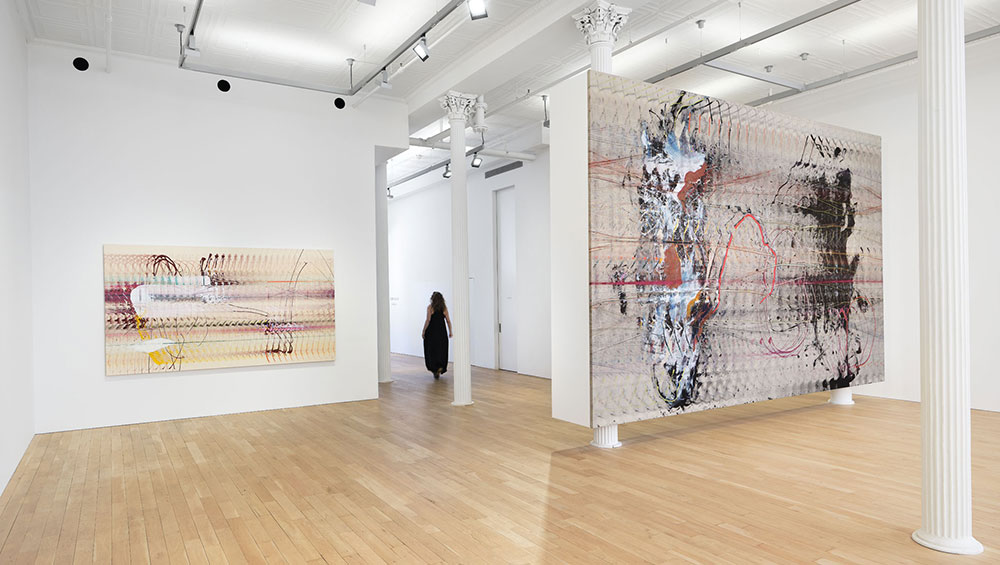
Installation view of Emily Kraus: In Relation, Luhring Augustine Tribeca, New York, April 11 – June 13, 2026. © Emily Kraus; Courtesy of the artist, Luhring Augustine, New York, and The Sunday Painter, London. Photo: Farzad Owrang.
by SAM CORNISH
Since graduating from the Royal College of Art, London, in 2022, Emily Kraus has made a name for herself with dramatic, innovative abstract paintings. She works using a purpose-built painting mechanism, with the canvas looped between four poles to form an immersive and mobile painting environment. Following her first solo exhibition in New York, with Luhring Augustine, here Kraus discusses the challenge of architecture, the mistake of conceiving the analogue and the digital as a binary, and the difference between working at large and small scale. Perhaps above all, her art engages with the question: “How can I be free and be human and expressive through the language of a mechanised world?”
Sam Cornish: Part of the anthropomorphism of your paintings must come from the interaction of your body, its scale and its movement, with the painting cage or loom you have developed. How has this mechanism evolved since you developed it at the Royal College of Art? I’m thinking in terms of technical process and the final images that result from this process.
Emily Kraus: The mechanism has evolved for the sake of functionality; its purpose is exactly the same as when I began. At first, I used shower poles, bought at a DIY shop, and wooden brackets that I cobbled together from scrap in the workshop; the canvas lined the walls, ceiling and floor of my 8ft x 8ft (2.4 sq metres) studio space and was constantly falling apart. Now I’ve designed a steel structure that is much easier to move around, secured with bearings that allow the structure to rotate with ease. I still operate it by hand (without a motor) – it remains entirely analogue.
I see the apparatus functioning as a cage and a liberating environment. It catches everything that I am and everything that I do when I’m inside it. Its limitation allows me to be free. I can push the boundaries as much as I want and yet the structure contains me – just as the human body is both vessel and vehicle. The body contains the organs and the mind within an external structure. It gives them form, a catalyst, so we can move around and interact and engage with our environment. I see the mechanism as a metaphor for that form.
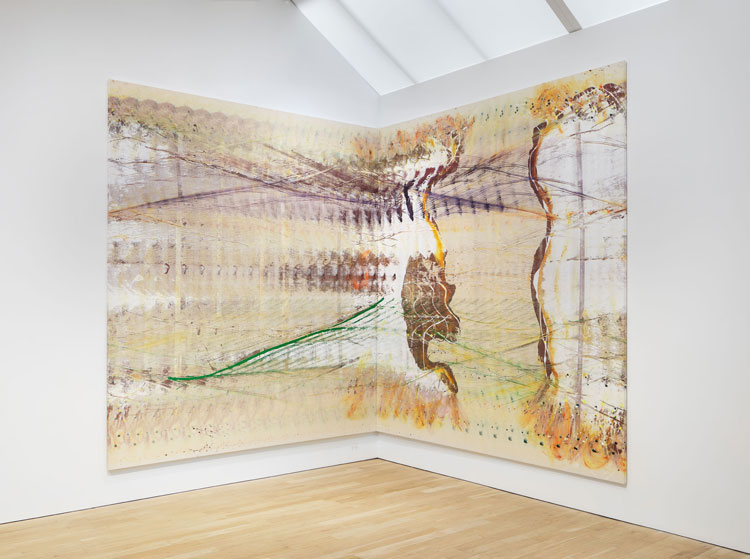
Installation view of Emily Kraus: In Relation, Luhring Augustine Tribeca, New York, April 11 – June 13, 2026. © Emily Kraus; Courtesy of the artist, Luhring Augustine, New York, and The Sunday Painter, London. Photo: Farzad Owrang.
SC: So, it’s a kind of extension of yourself and your self’s interaction with the world?
Emily Kraus: Yes.
SC: Some of your recent works have played with the exhibition environment in unexpected ways, with individual works going around corners or being split across parallel walls. Do you tend to conceive of your paintings for specific places or exhibition environments? And is architecture in general an important part of your thinking?
EK: I welcome the challenge of architecture. One of the central tenets of my work is the exploration of the relationship between the body and space. I’m interested in the interaction between my body and what’s on the outside, how the boundary of my physical self (skin) interacts with the boundaries/surfaces of everything else in its environment, whether that be a built space, other people or the natural world. That interaction is not just superficial, it’s about the commingling of ourselves within the environment. When I inhale, I’m taking in the environment; when I exhale, I’m actually putting myself back into it; it’s a complete ecosystem.
Architecture’s purpose is to host life, triggering experiences, emotions, habits and behaviours and invoking feelings of closeness, remoteness, intimacy, fear, excitement – everything that makes us what we are.
The architecture of exhibition spaces is an exciting starting point for a project because I can choreograph people’s first encounter with the paintings. The way I think about this is more commonly associated with installation art or performance art. The way I work within my structure to make the paintings, is quite physical and choreographed and is a sort of installation as I’m working. When I finish, I take the paintings down and stretch them and they’re reintroduced into the painting context. However, I am interested in maintaining this relationship with installation and performance.
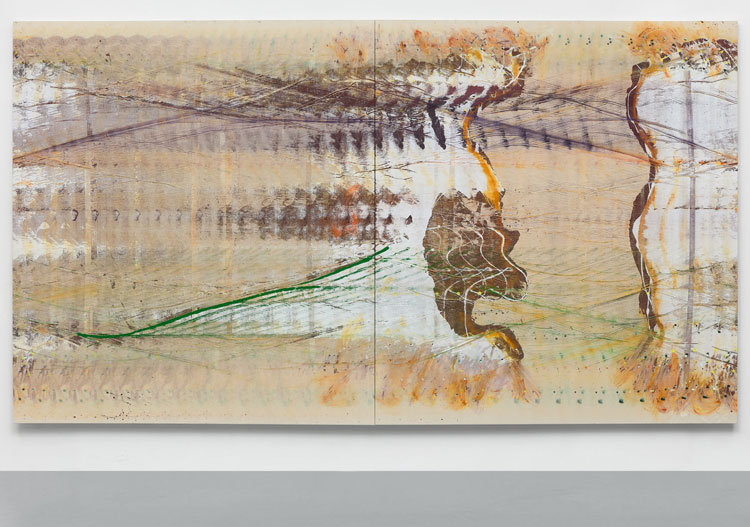
Emily Kraus, Anemoi, 2026. Oil on canvas, 125 1/4 x 225 1/4 in (318 x 572 cm). Each panel: 125 1/4 x 112 5/8 in (318 x 286 cm). © Emily Kraus; Courtesy of the artist, The Sunday Painter, London, and Luhring Augustine, New York. Photo: Ollie Hammick.
SC: You want to provide a connection to the genesis of the painting without those things being literally present.
EK: Yes.
SC: You tend to work at very large scale. Is the mechanism able to cope with paintings that are smaller, more intimate? A kind of intimacy is important in your large-scale works but is there a minimum size you can work at using your mechanism?
EK: This question of intimacy is interesting. Often when a work is referred to as intimate, the implication is that it is small. With a large work, you are consumed by it, but as you approach a small work, you’re choosing to engage with it. A large work engulfs you, but to engage with a small work is like looking through a window into another world, as if you have diminished your body a little bit to peer through, and that feels intimate… But when I am making the work, I’m inside it …
SC: You have stepped through the window …
EK: Yes, exactly. I am inside. I’ve stepped through the window; I’ve stepped through the wardrobe into Narnia. I’m in that world and so, to me, the making of the painting is all-consuming in an engrossingly intimate way. The limitation of making at a small scale with my process is that I can’t be inside it.
If it’s smaller than a three-metre painting, I can’t fit my body into it. My relation to it changes tremendously – I can fit my hand inside it, maybe I can fit my head inside it – but even then, it’s like I’m visiting. I’m looking through the window and even though that’s a type of intimacy, it’s not a sustainable intimacy.
SC: Your work has been written about in terms of digital glitches. And in fact, when I first saw it online, that’s how the works appeared to me, but in real life this is not the case, because of their physical texture, and the depth of their spatial illusions. You have spoken about your painting in terms of age-old tools. Do you see your paintings as concerned with contemporary experience or something more fundamental?
EK: I have highlighted that the paintings are made with age-old tools expressly because of people’s insistence in associating them with digital glitches. I think it’s a mistake to present the analogue and the digital as a binary, especially in our present time. Because the truth is that one was born from the other and that history is fascinating. The computer arose from early weaving technology; code, ones and zeros, was very much inspired by the mechanical binary code of the Jacquard loom. I make my paintings on canvas, which is a woven fabric and a traditional substrate for painting. So, in a way, one could argue that all painting is within the lineage of the digital. Obviously, the repetitive motif in my paintings pushes this idea of the digital further, and the canvas texture, when represented digitally, can appear to be pixels (which I find sort of hilarious).
Context is fascinating. It is the cocoon from where the work emerges, but it also shapes the viewers’ perception of what they’re seeing. I have no interest in making anything digital, but I grew up in the digital age, and I recognise that is the context in which the paintings are being seen.
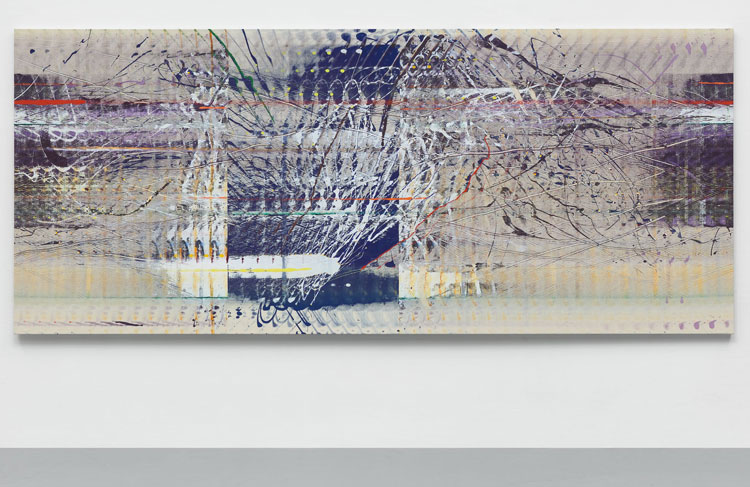
Emily Kraus, Burl, 2026. Oil on canvas, 66 7/8 x 157 1/2 in (170 x 400 cm). © Emily Kraus; Courtesy of the artist, The Sunday Painter, London, and Luhring Augustine, New York. Photo: Ollie Hammick.
SC: The paintings are much more physical, much more bodily in real life. In a way, the digital image is looking after its own. The jpeg we see on the screen is telling us more about itself than the painting it is picturing. Continuing with history, are there special moments in the history of painting you identify with?
EK: I’m interested in moments of transition, where thought and perception change. The moments where things are suddenly perceived or read differently. The impact of the invention of photography on painting is fascinating to me. Photography shifted the way that we optically frame images. It’s the greatest shift that’s happened in painting in the last few hundred years. Abstract painting very much arose as a counter movement to photography, or because photography took the space previously occupied by representational painting.
We’re always looking at things on our phones nowadays and have become used to a certain format which becomes a boundary that limits what sight is. Looking at things at a micro or macro scale is something that wouldn’t really have existed before telescopes or cameras and their ways of focusing the eye. Another transition is the invention of the train and the car, and how these impacted the speed at which we view the world.
SC: Is your painting specifically concerned with speed of perception?
EK: No, but it’s something people see a lot in my work. I’ve heard people compare the experience of viewing my paintings to looking out of a train or car window. But speed is not something I’m interested in, it’s simply a byproduct of my process.
SC: I can see why someone would make a reference to a moving vehicle. Movement, rhythm and change are all there in the paintings. But perhaps stillness is even more important to you as a subject?
EK: Yes, I think movement cannot exist without stillness, just as sound cannot exist without silence. No event exists without the lack of event. There is always this balance. There’s a great quote from Susan Sontag, from her essay The Aesthetics of Silence. She states that any given silence has an identity as a stretch of time perforated by sound. With my work perhaps more important than knowing when to act is knowing when not to act.
SC: Yes, there’s a sense of restraint in your paintings that I think is really important. Perhaps particularly now, when gesture seems to be a big part of abstract painting. A lot of painting uses gesture in an unthinking way, as its own justification, whereas in your work there is a distance from gesture, that gives it structure, and makes it more intense, more potent, more physical.
EK: Yes. You may have gleaned at this point in our conversation that I think a lot through metaphor. I have a very associative mind, and in many ways the structure of my paintings functions as a real, physical metaphor for the world we live in, which is very built. I’m sitting in my studio right now, and everything I’m looking at has been touched or built by a machine. The wood furniture was made using power tools, the white paint on the wall has been mixed by a machine. Even the canvas I use is woven on a machine. We’re so accustomed to living in this mechanised world that we don’t see it any more. In my practice, which is very structured and literally inside a mechanism, I come up against this question in a very conscious way every time I paint: how can I be free and be human and expressive through the language of a mechanised world?
SC: I understand that your painting mechanism began as a response to the limited studio space you had while studying at the RCA (and perhaps there is a whole different question about the limitations of art schools at the moment). But do you think that the mechanism itself could become a trap, that could restrict the possibilities of your practice in the future, and that you’ll need to plot an escape from?
EK: Well, it’s funny, the mechanism cannot become a trap because it has always been a trap. It’s incredibly limiting as I’ve mentioned, but much of the challenge of my work is the effort of unlocking that cage, negotiating with its limitations and growing from them. It’s very much a practice of facing my fear.
Click on the pictures below to enlarge

Copyright © 1893–2026 Studio International Foundation.
The title Studio International is the property of the Studio International Foundation and, together with the content, are bound by copyright. All rights reserved.
 |
 |
 |
|---|
(-Tate-(Yili-Liu)_011-300.jpg)
-Lucy-Jorge-Orta-Photo-Finn-Beales-300.jpg)
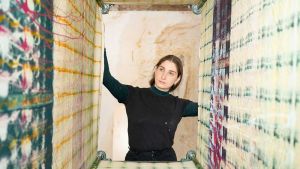 Emily Kraus: Nest Time